Ponytail: The Open-Source AI Skill That Stops Your Coding Assistant from Overengineering

Open-source skill Ponytail makes AI coding assistants think before they write, cutting overengineering at the source.
Ponytail is an open-source AI skill that makes coding assistants act like the laziest senior engineer in the room — pausing before writing to ask: Does this need to exist? Can we reuse something? Has the standard library handled this? Can one line replace fifty? By encoding these four questions as behavioral rules, Ponytail tackles overengineering at its root. Official benchmarks show ~54% less code, ~20% lower cost, and ~27% faster completion — all stemming from the same logic: fewer lines means fewer tokens. Compatible with Claude Code, Codex, Copilot, and Cursor, it represents the emerging trend of shaping AI behavior through prompt engineering rather than model-level changes.
AI coding assistants are getting more capable by the day, but a near-universal frustration remains: they love to overcomplicate things. A requirement that could be solved in one line might yield fifty lines from an AI; a feature already covered by the standard library gets reinvented from scratch. This "overengineering" doesn't just bloat your codebase — it drives up token costs and slows down execution. The open-source skill Ponytail is built specifically to fix this.
What Ponytail Sets Out to Solve
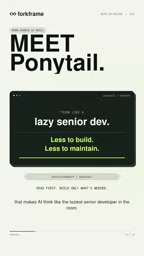
Ponytail is an open-source AI skill whose core philosophy can be summed up in a single line: make AI think like the laziest senior engineer in the room.
"Lazy" here isn't a criticism — it describes the instinct that experienced developers tend to develop over time: before writing a single line of code, ask a few questions and try to write as little as possible. According to the project's introductory video, Ponytail prompts the AI to ask itself before generating code:
- Does this feature actually need to exist?
- Can we reuse something that already exists?
- Has the standard library already implemented this?
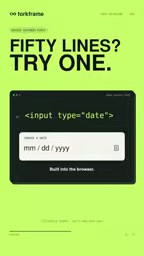
- Can this logic be replaced with one line instead of fifty?
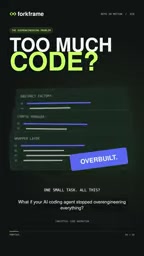
This questioning framework mirrors the decision-making process of great engineers. Experienced developers don't rush to the keyboard — they first assess whether a requirement is truly necessary and what resources already exist, avoiding pointless duplication of effort. Ponytail takes that human instinct for deliberation and encodes it as a set of behavioral rules for AI.
The Engineering Philosophy Behind Four Key Questions
These four questions may seem simple, but together they cover the parts of software development most prone to generating unnecessary complexity.
"Does this feature actually need to exist?" addresses requirement scrutiny — much of our complexity comes from implementing things that will never actually be used. "Can we reuse it?" and "Has the standard library already implemented this?" target the most common source of code bloat: reinventing the wheel. "Can one line replace fifty?" gets directly at implementation-level simplicity.

As the video concludes: "Sometimes the best code is the code you never write." That line captures Ponytail's essence — it's not about making AI write faster, it's about teaching AI when not to write at all. For coding assistants conditioned to treat generation as the goal, this kind of restraint is actually a higher-order capability.
Benchmark Results: Less Code, Lower Cost, Faster Completion
Ponytail shares a set of quantitative results from its own Claude Code benchmark:
- Code volume reduced by an average of ~54%
- Cost reduced by an average of ~20%
- Completion speed improved by an average of ~27%
It's worth noting that these figures come from Ponytail's own internal benchmarks — results will likely vary depending on project type and use case. Even with some adjustment for self-reported data, however, the three metrics form a coherent feedback loop: less code directly reduces token consumption (lower cost) and generation time (higher speed). All three are really different facets of the same underlying outcome.
For teams that call AI coding assistants heavily, a 20% cost reduction and nearly 30% speed gain add up to meaningful savings at scale.
The connection between cost and speed comes down to how large language models are billed and how they run. Today's leading AI coding assistants — including Claude Code and the GPT-4 series behind Copilot — are priced per token, the basic unit of text a model processes (roughly half a word in English, or one to two characters in Chinese). The more code generated, the more tokens consumed, the higher the cost, and the longer the response takes. So a 54% reduction in code volume isn't just "smaller files" — it directly compresses output token count. In high-frequency usage scenarios (AI reviews embedded in CI/CD pipelines, large teams using coding assistants at scale), that compression multiplies linearly into substantial cost savings. This is why "write less code" carries economic weight in the AI era that goes well beyond traditional engineering aesthetics.
Compatibility and Use Cases
Another strength of Ponytail is broad tool compatibility. It supports major AI coding tools including Claude Code, Codex, Copilot, and Cursor, meaning developers don't need to change their existing workflow — they simply layer this skill on top of whatever assistant they already use.
As an open-source project, Ponytail lowers the barrier to experimentation. Developers can inspect the underlying prompt logic directly, understand exactly how it constrains AI behavior, and adapt it to fit their team's coding standards.
Tools shaped like "skills" represent a growing trend in the AI coding ecosystem: rather than modifying base model capabilities, they use carefully designed behavioral constraints and prompt engineering to correct for a model's inherent tendencies. Models aren't naturally inclined toward simplicity — they're optimized to complete tasks. Ponytail fills the gap by adding a layer of how to complete tasks gracefully.
Prompt Engineering refers to the practice of carefully crafting the input text given to a large language model in order to guide its outputs toward a desired behavior or result — without modifying the model's weights. A Skill takes this a step further by packaging a validated set of prompt logic into a reusable module that developers can attach directly to their existing toolchain. These skills typically exist as system prompts or rules files that pre-define the model's behavioral boundaries before a user request is even made. That's precisely what Ponytail is: it doesn't change the underlying Claude, GPT, or other models — instead, it injects a "review before you write" behavioral ruleset before the model receives a coding task, automatically filtering every generation through a necessity check. This also explains why it works across multiple AI coding tools: as long as a tool supports custom system prompts or rules loading, Ponytail's logic can be ported right in.
Takeaway
Ponytail's value isn't in making AI more powerful — it's in making AI more restrained. Overengineering is a systemic problem with today's AI coding assistants, and by encoding a senior engineer's questioning instincts into a reusable skill, Ponytail attempts to strike a better balance between code quality, cost, and efficiency. For developers who rely heavily on AI-assisted coding, this open-source direction is worth watching — because the best code, more often than not, is the code you never had to write.
Related articles

Chain of Thought Isn't Just for AI: How Humans Can Use CoT to Improve Thinking Quality
Chain of Thought isn't just a prompt trick for large models. Starting from a Hacker News discussion, this article analyzes why CoT works for human thinking too, breaks down actionable ways to transfer it, and highlights the key differences between human CoT and machine CoT.
Cloudflare Teams Up with OpenAI: Closi…
Cloudflare Teams Up with OpenAI: Closing the Loop from Vulnerability Discovery to Defense with AI
Cloudflare uses OpenAI Daybreak to investigate security vulnerabilities and generate reviewable remediation plans, while developers use Codex to boost coding efficiency and quality.

Orca Multi-Agent Orchestration in Practice: A Guide to Parallel Collaboration with Claude and Codex
Orca is Stable AI's free open-source agent workbench supporting 34 agents like Claude Code and Codex in parallel. Learn its Git worktree isolation, multi-model orchestration, and mobile management.