Pope Leo XIV Calls for AI 'Disarmament': Machines Are Tools, Not People

Pope Leo XIV calls for AI 'disarmament,' banning lethal autonomous weapons, and reaffirming human responsibility.
In his Friday address, Pope Leo XIV proposed that AI systems should be 'disarmed,' emphasizing humanity's responsibility to guide, change, and when necessary reject their applications. He explicitly called on UN member states to take concrete steps at next month's Geneva conference to ban lethal autonomous weapons. The article highlights that the core assertion 'machines are tools, not people' rejects granting algorithms moral agency, while the three verbs—guide, change, reject—form a progressive ethical framework preserving humanity's ultimate veto power over AI applications.
The Pope Speaks Out: 'Disarming' AI
In his papal address on Friday, Pope Leo XIV proposed that artificial intelligence systems should be "disarmed." He emphasized that humanity "has the responsibility to guide, change, and, when necessary, reject their applications." This statement pushed the AI ethics discussion from the tech community to the highest podium of global governance.
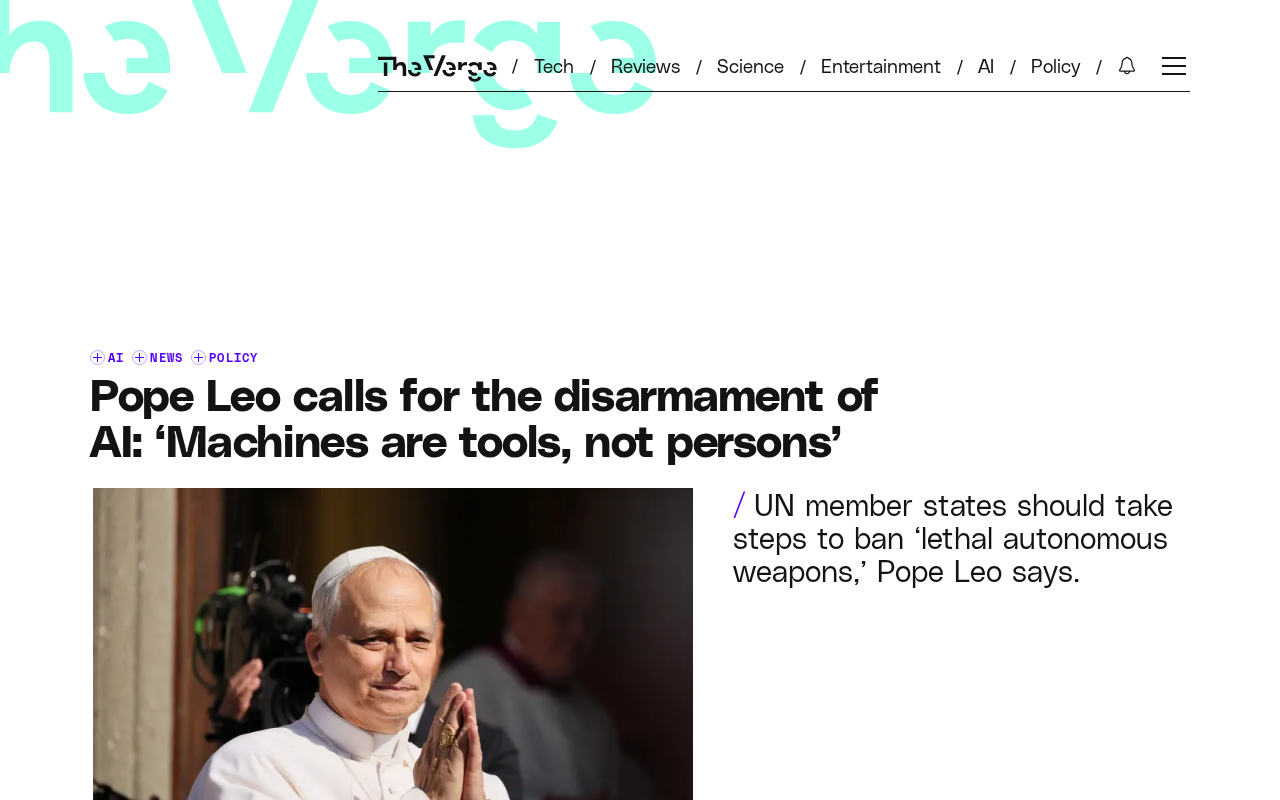
"Machines are tools, not people"—this core assertion directly targets a fundamental divide in the current AI debate: are we inadvertently granting algorithms moral agency? The Pope's answer is no. In his view, no matter how complex an AI system may be, it remains fundamentally a tool in human hands, and responsibility always rests on the human side.
Specific Demand: Ban Lethal Autonomous Weapons
In his address, Pope Leo XIV issued a clear call to UN member states, urging them to "take concrete steps to ban lethal autonomous weapons" at next month's conference in Geneva.
This demand is not unfounded. Lethal Autonomous Weapons Systems (LAWS) have long been a focal point of international arms control negotiations—when a weapons system can select and engage targets without human intervention, who bears responsibility for collateral damage? The Pope's intervention injects moral weight into this technical issue.
The very framing of AI "disarmament" is worth examining. It borrows the discourse framework of nuclear disarmament, suggesting that the militarization of AI could bring about global risks of a similar magnitude. This rhetorical strategy helps push the public and policymakers to treat AI governance with greater seriousness.
Lethal Autonomous Weapons Systems (LAWS) generally refer to weapons platforms capable of autonomously searching for, identifying, selecting, and engaging targets without any human operator intervention. The core controversy centers on the concept of "meaningful human control": if machines can independently decide whom to use lethal force against, the chain of accountability breaks down, and the risks of collateral damage, misjudgment, and conflict escalation rise accordingly.
International discussions on LAWS primarily take place under the framework of the Convention on Certain Conventional Weapons (CCW), with the United Nations Office at Geneva serving as the permanent venue for related Group of Governmental Experts meetings. Because the CCW operates on the principle of consensus, negotiations have long progressed slowly, prompting some states and civil society organizations to push for a legally binding prohibition treaty. The International Committee of the Red Cross, the UN Secretary-General, and numerous governments have all called for clear restrictions on fully autonomous weapons. The Pope's statement brings this technical arms control issue into a broader moral discourse.
Human Responsibility: Guide, Change, and Reject
The more actionable part of the Pope's address is the definition of human responsibility: guide, change, and "when necessary, reject" AI applications.
These three verbs form a progressive ethical framework. Guiding means actively shaping the direction of AI development; changing means continuously correcting during application; and rejecting preserves the last line of defense—when an AI application crosses a red line, humans have the right and the duty to say "no."
The deeper meaning of this framework lies in its rejection of passive acceptance of technology. At a time when AI capabilities are rapidly expanding, this assertion of a "right to reject" provides both policymakers and ordinary users with a stance: technical feasibility does not equal ought-to-be-deployed.
From Nuclear Weapons to Algorithms: The Discursive Shift in AI Governance
Pope Leo XIV's address is not an isolated event but part of a broader trend of religious and ethical institutions engaging in AI governance discussions in recent years. Linking AI to disarmament issues is, in effect, promoting a cognitive shift: the risks of AI are not limited to privacy breaches or job displacement but also include substantive impacts on the global security landscape.
The stance reflected in the address resonates with the concerns of many AI safety researchers—when a system's autonomy exceeds human oversight capacity, risks become uncontrollable. By defining AI as a "tool," the Pope is essentially reaffirming an anthropocentric responsibility framework: no matter how technology evolves, moral judgment and accountability cannot be outsourced to machines.
For readers concerned with AI governance, the value of this address lies not in how many technical solutions it proposes but in placing a critical question on the table: while pursuing AI capabilities, have we preserved the right and the mechanisms to say "no"?
"Disarmament" has specific historical connotations in international politics, most notably the nuclear arms control and disarmament processes of the Cold War era, whose core logic includes transparency, verifiability, deployment limits, and ultimate elimination. Applying this framework to AI does not mean advocating the destruction of algorithms but rather metaphorically emphasizing the restriction, constraint, and de-weaponization of certain high-risk capabilities—especially military autonomy.
The significance of this discursive migration lies in changing the reference frame for risk perception: nuclear disarmament discussions are taken seriously because their consequences are irreversible and global. Juxtaposing AI militarization with nuclear risk is intended to remind policymakers that algorithmic autonomy may bring not局部 accidents but systemic, transnational security challenges. Of course, critics will point out that AI and nuclear weapons differ enormously in verifiability, proliferation patterns, and technical attributes, and that the analogy must be used cautiously; but as a rhetorical tool for mobilizing the public and advancing international norms, it has a significant agenda-setting effect.
One-line Summary
Pope Leo XIV calls for AI "disarmament," banning lethal autonomous weapons, and reaffirming human responsibility.
Paragraph Summary
In his Friday address, Pope Leo XIV proposed that AI systems should be "disarmed," emphasizing that humanity has the responsibility to guide, change, and when necessary reject their applications. He explicitly called on UN member states to take concrete steps at next month's Geneva conference to ban lethal autonomous weapons. The article notes that the core assertion "machines are tools, not people" rejects granting algorithms moral agency, while the three verbs—guide, change, reject—form a progressive ethical framework that preserves humanity's ultimate veto power over AI applications. Linking AI to disarmament discourse is intended to push the public to take the global risks of AI militarization more seriously; its value lies not in technical solutions but in putting the question on the table: have we preserved the right and the mechanisms to say "no"?
Related articles

The Truth About AI Coding: Code Output Soars, So Why Is Delivery Still Hard to Speed Up?
Engineering leaders from Databricks, Uber, and Google Maps discuss AI coding's real impact: code output soars but delivery bottlenecks shift, code review faces rethinking, and enterprises begin fine-grained token governance.

A New Paradigm for Text Editing in Compose: TextFieldState Replaces the Old API
Jetpack Compose introduces the TextFieldState API to fix dropped characters and cursor jumps from async input. The old value/onValueChange callbacks will be deprecated in 1.13. This article covers InputTransformation, OutputTransformation, four state hoisting patterns, and new formatted text editing capabilities.

Remote Compose: A New Document-Driven Paradigm for Cross-Platform UI on Android
Remote Compose transmits compact binary documents instead of screen pixels, enabling efficient UI rendering on remote surfaces like Wear OS and widgets. This article covers its document creation API, expression animations, size optimization techniques, and Wear OS progress.