POrchestra: How a Proactive Agentic Orchestration Framework Breaks Through Long-Horizon Task Bottlenecks

POrchestra lets sub-agents proactively request resource adjustments mid-execution, using OPOD to convert revision signals into process supervision for better long-horizon task performance.
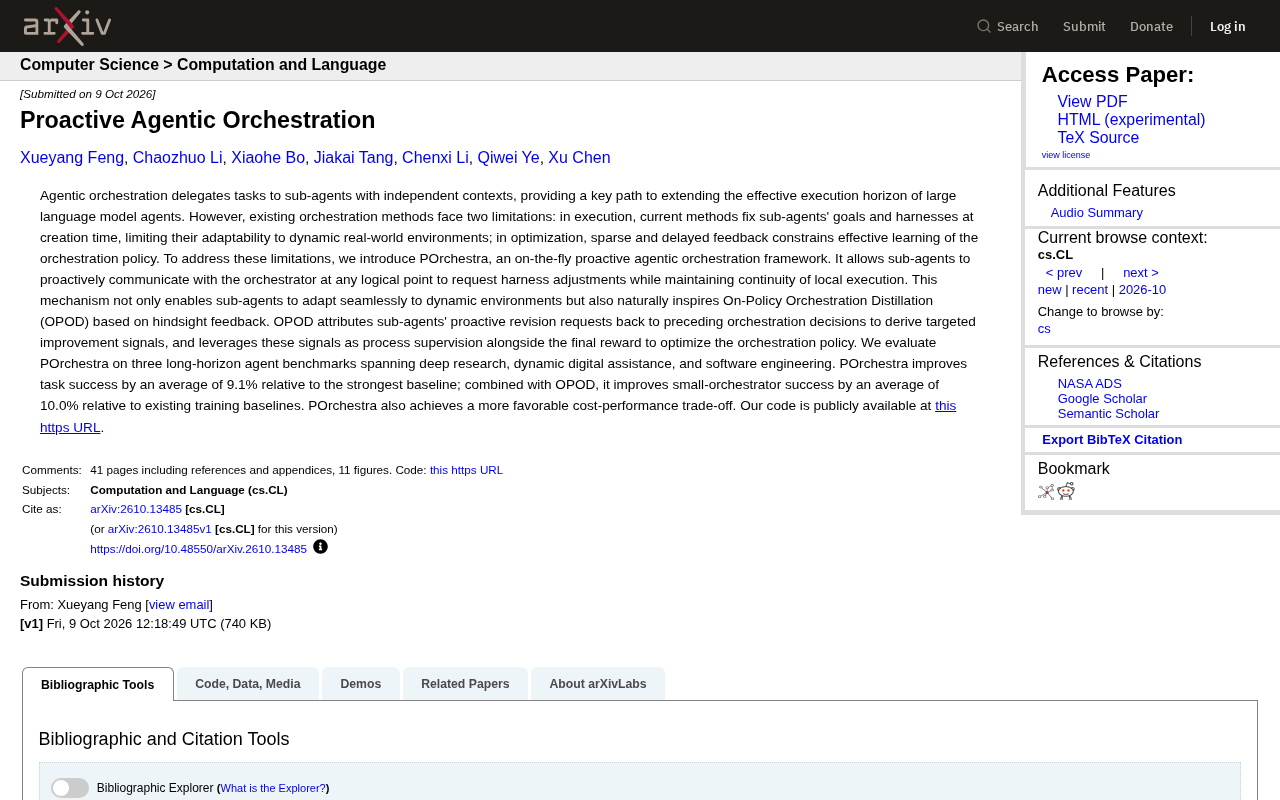
POrchestra is an on-the-fly proactive agentic orchestration framework targeting two key weaknesses in traditional orchestration: static tool harness assignment that can't adapt to dynamic environments, and sparse end-of-task feedback that hampers strategy learning. Sub-agents can proactively request tool adjustments from the orchestrator at any point during execution. The companion OPOD method traces these revision requests back to prior orchestration decisions, converting sparse final rewards into dense process supervision signals. Across deep research, dynamic digital assistance, and software engineering benchmarks, POrchestra improves task success rates by 9.1% over the strongest baseline, with small orchestrators gaining 10.0% via OPOD, all while achieving a better cost-performance trade-off.
LLM agents often struggle with complex, long-horizon tasks. A single agent is constrained by context length, making it difficult to maintain coherent reasoning across dozens of steps. Agentic orchestration—breaking tasks into subtasks assigned to sub-agents with independent context windows—has emerged as a key approach for extending effective execution horizons. However, existing orchestration methods have notable shortcomings. A new study introducing a framework called POrchestra proposes an on-the-fly proactive orchestration system designed to address these problems at both the execution and optimization levels.
Two Core Pain Points in Existing Orchestration Methods
Traditional agentic orchestration exposes two fundamental problems in practice. The first arises during execution: current methods lock in a sub-agent's goals and tool harness at the moment of creation. This static allocation makes sub-agents ill-equipped to handle dynamically changing real-world environments. Once task conditions shift, the fixed objectives and resources become a bottleneck rather than an asset.
The second problem emerges during optimization. Learning orchestration strategies depends on feedback signals, but in practice such feedback is often sparse and delayed—systems typically only receive a judgment about success or failure after the entire task is complete. This sparse, lagged feedback makes it difficult for orchestration strategies to improve effectively, as the model cannot quickly pinpoint which orchestration decision led to failure.
These two limitations jointly constrain agentic system performance on long-horizon tasks, and they are precisely what POrchestra aims to overcome.
The basic architecture of agentic orchestration typically consists of an orchestrator and a set of sub-agents. The orchestrator decomposes complex tasks into subtasks and assigns them to sub-agents with independent context windows for parallel or sequential execution. The core value of this design lies in overcoming the context length limitations of a single LLM—each sub-agent handles only a local portion of the task, while the orchestrator manages global coordination. Common implementations include rule-based static allocation (e.g., LangGraph) and LLM-driven dynamic planning (e.g., AutoGen, OpenAI Swarm). However, in both approaches, the goals and tool harness (i.e., the set of APIs, plugins, databases, and other resources a sub-agent can invoke) are typically fixed at launch. If the context drifts mid-execution, sub-agents can neither request new tools nor revise their objectives—they can only push forward under existing constraints or report failure.
POrchestra's Core Mechanism: Proactive Communication
POrchestra stands for on-the-fly proactive agentic orchestration framework. Its most critical innovation is breaking sub-agents out of their "passive" state.
In traditional architectures, sub-agents receive a task and execute it without any ability to course-correct. POrchestra allows sub-agents to proactively communicate with the orchestrator at any logical checkpoint during execution, requesting adjustments to their tool harness—while maintaining continuity of local execution. In other words, when a sub-agent determines that its current goals or tools are insufficient for the situation at hand, it can "raise its hand" to request resource reallocation from the orchestrator, rather than starting over from scratch.
The immediate benefit of this mechanism is that sub-agents can seamlessly adapt to dynamic environments. But more valuable still is the fact that these proactive revision requests naturally generate signals that can be leveraged to optimize orchestration strategies.
OPOD: On-Policy Orchestration Distillation
Building directly on the proactive communication mechanism, the researchers introduce On-Policy Orchestration Distillation (OPOD) as the accompanying optimization method.
The core logic of OPOD is attribution. When a sub-agent issues a proactive revision request, that request implicitly signals that a prior orchestration decision was inadequate. OPOD traces these revision requests back to the preceding orchestration decisions, deriving targeted improvement signals.
From Sparse Feedback to Process Supervision
This design elegantly dissolves the sparse feedback problem described earlier. Rather than relying solely on a final reward at task completion, OPOD uses the attribution-derived improvement signals as process supervision, combining them with the final reward to jointly optimize the orchestration strategy. This is equivalent to inserting multiple intermediate checkpoints throughout a long execution chain, making the learning signal denser and more timely. This is especially meaningful for training smaller orchestrators—models with inherently limited capacity benefit most from dense guidance signals.
Process Supervision is a training paradigm that contrasts with Outcome Supervision, and it is receiving growing attention in reinforcement learning and LLM alignment. Outcome supervision only provides a reward or penalty at task completion; the signal is sparse, and it is difficult for the model to backtrack and identify which decision along the way led to failure—a problem that is especially pronounced in long-chain reasoning and multi-step tasks. Process supervision provides evaluation signals at intermediate steps, effectively giving the model step-by-step feedback. OpenAI's research on mathematical reasoning found that models trained with process supervision significantly outperformed those trained with outcome supervision alone on complex reasoning tasks. OPOD treats the revision requests proactively issued by sub-agents as natural intermediate failure signals—without requiring manual annotation of intermediate steps—thereby converting an outcome supervision problem into a process supervision problem. For smaller orchestrator models with limited learning capacity, this is equivalent to dramatically increasing the density and quality of training data.
Experimental Results: Improvements in Both Success Rate and Cost
POrchestra was evaluated on three long-horizon agentic benchmarks spanning deep research, dynamic digital assistance, and software engineering.
The results are quite robust:
- Compared to the strongest baseline, POrchestra improves average task success rate by 9.1%;
- When combined with OPOD, small orchestrators achieve an average success rate improvement of 10.0% over existing training baselines;
- POrchestra also achieves a more favorable cost-performance trade-off.
The cost-performance improvement is particularly significant. In real-world deployments, the inference cost of agentic systems is an unavoidable constraint—a framework that simultaneously improves success rates and controls costs is far more viable for production use. The research team has open-sourced the code on GitHub (XueyangFeng/POrchestra) for community reproduction and extension.
Implications for Agentic System Design
POrchestra's approach reflects an emerging trend in agentic engineering: moving from static, pre-specified task allocation toward dynamic, negotiable collaboration. Equipping sub-agents with the ability to proactively provide feedback not only improves a system's adaptability to its environment, but also opens up new sources of signals for policy optimization—a design paradigm where the execution mechanism and the optimization mechanism mutually reinforce each other.
For developers building multi-agent systems, this research offers a worthwhile direction: rather than chasing a more perfect initial plan, invest in building real-time negotiation and attribution feedback mechanisms during execution, enabling the system to continuously self-correct as it runs.
Related articles

Chain of Thought Isn't Just for AI: How Humans Can Use CoT to Improve Thinking Quality
Chain of Thought isn't just a prompt trick for large models. Starting from a Hacker News discussion, this article analyzes why CoT works for human thinking too, breaks down actionable ways to transfer it, and highlights the key differences between human CoT and machine CoT.
Cloudflare Teams Up with OpenAI: Closi…
Cloudflare Teams Up with OpenAI: Closing the Loop from Vulnerability Discovery to Defense with AI
Cloudflare uses OpenAI Daybreak to investigate security vulnerabilities and generate reviewable remediation plans, while developers use Codex to boost coding efficiency and quality.

Orca Multi-Agent Orchestration in Practice: A Guide to Parallel Collaboration with Claude and Codex
Orca is Stable AI's free open-source agent workbench supporting 34 agents like Claude Code and Codex in parallel. Learn its Git worktree isolation, multi-model orchestration, and mobile management.