Portable Computer Lands on AMD Ryzen AI Max: Local AI Agents Come to Windows

Portable Computer adds AMD Ryzen AI Max support, bringing fully local AI agents to Windows without cloud dependency.
Portable Computer for Windows now supports AMD Ryzen AI Max processors, marking a milestone for local AI agents on everyday Windows devices. Leveraging Ryzen AI Max's powerful NPU and unified memory architecture, AI agents can read local files, call connected apps, and run both on-demand and scheduled recurring tasks — entirely on-device, with no data sent to the cloud. This is a significant win for privacy and offline usability, and reflects the broader industry trend of AI inference shifting from the cloud to the edge.
Portable Computer Now Supports AMD Ryzen AI Max
Portable Computer for Windows has announced support for AMD Ryzen AI Max series processors. The core significance of this move is bringing "local AI agents" to the desktops of everyday Windows users — without relying on cloud computing or a constant internet connection.
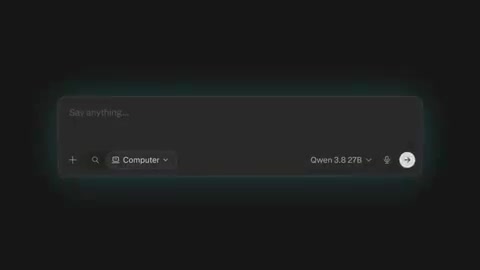
According to the official announcement, this solution allows users to run AI agents directly on their own devices. These agents can work in tandem with connected apps and local files. In other words, AI is no longer just a remote API — it becomes an assistant capable of reading and operating within your local environment.

What "Running Locally" Actually Means
The most notable aspect is the phrase "entirely on your device" — tasks are executed completely on-device. For users and enterprises concerned about privacy and data security, this is a key selling point. Files don't need to be uploaded to the cloud, and sensitive data can be processed entirely on the local machine.
The technical foundation behind this is the NPU (Neural Processing Unit) compute power provided by the AMD Ryzen AI Max series. Ryzen AI Max targets high-performance mobile and desktop platforms, featuring strong integrated AI acceleration that makes running mid-scale models and inference tasks locally feasible. Work that once required a discrete GPU or cloud service can now be handled within a single SoC.
What Can the Agent Do?
Based on the official description, Portable Computer's capabilities center on two main areas:
- Kick off tasks on demand: Users can initiate a task at any time, letting the AI agent call on local files or connected apps to complete it.
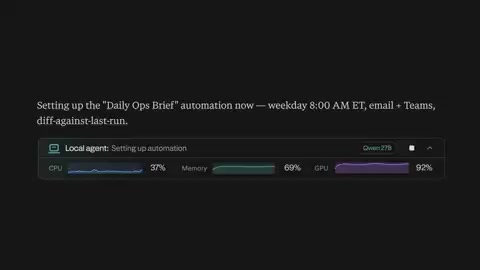
- Schedule recurring work: Periodic workflows can be scheduled to run automatically on-device, with no need for repeated manual intervention.
This combination of "local + automation" points toward a usage model much closer to a true personal digital assistant — one that doesn't just answer questions, but actually executes a series of operations on your behalf.
An NPU (Neural Processing Unit) is a dedicated compute unit designed specifically for AI inference tasks. Unlike the general-purpose computation of a CPU or the parallel graphics processing of a GPU, NPUs are hardware-optimized for deep learning operations such as matrix multiplication and convolution, consuming far less power than a GPU when running Transformer inference. The AMD Ryzen AI Max series (codenamed Strix Halo) integrates up to 50 TOPS (Tera Operations Per Second) of NPU compute and uses a Unified Memory Architecture (UMA), where the CPU, GPU, and NPU all share the same high-bandwidth memory pool — configurable up to 128GB. This means that even large language models with up to 70 billion parameters can theoretically be fully loaded into memory and run inference locally, without slicing data and sending it to a remote cloud server. This architectural advantage is the core differentiator that sets Ryzen AI Max apart from conventional mobile processors.
The fundamental difference between an "AI Agent" and an ordinary chatbot lies in its capacity for action. Traditional large language models only handle text input and output, whereas AI agents can complete multi-step tasks by calling tools (Tool Use) or operating system APIs — reading and writing local files, accessing calendars, sending emails, launching applications, and more. Their working model typically follows a "perceive → plan → execute → feedback" loop, capable of completing complex workflows made up of multiple subtasks without human intervention. The "scheduled recurring tasks" supported by Portable Computer are a prime example of this capability — the agent can execute autonomously on schedule, rather than waiting for a user prompt each time. This paradigm is best understood as a fusion of RPA (Robotic Process Automation) and large model inference.
Why AMD's Platform?
The AI PC race is heating up among hardware vendors. AMD's Ryzen AI Max series stands out for its enhanced NPU performance and unified memory architecture, making it especially well-suited to hosting larger local models. Portable Computer's decision to support this platform first reflects how application-layer software is actively aligning itself with next-generation chips that offer strong AI acceleration.
For AMD, having more local AI applications like Portable Computer land on its platform helps reinforce the "Ryzen AI" brand's presence in the AI PC market. The mutual binding of software and hardware ecosystems is often what determines a platform's ultimate success or failure.
In the current AI PC space, Intel (Meteor Lake / Lunar Lake), Qualcomm (Snapdragon X Elite), and AMD (Ryzen AI series) have all integrated NPUs into consumer-grade chips — but with different performance targets. Qualcomm's Snapdragon X Elite is known for low power consumption, aimed squarely at the thin-and-light laptop market. Intel's Core Ultra series NPU is relatively conservative in compute, handling mostly lightweight AI tasks. AMD Ryzen AI Max (Strix Halo), by contrast, is positioned at the high-performance workstation and creator market with its large unified memory capacity and higher NPU compute. For AI agent applications that need to run mid- to large-scale language models locally, memory bandwidth and capacity are often the bottleneck — and that is precisely where Ryzen AI Max's unified memory architecture shines. This is the technical logic behind Portable Computer prioritizing this platform.
The Trend Toward Local AI Agents
This announcement, though brief, reflects a clear industry direction: AI is moving from the cloud to the edge. As NPU compute becomes more widespread, an increasing share of inference tasks will move down to users' local devices, delivering lower latency, better privacy, and offline availability.
For everyday users, the value of tools like this lies in allowing AI to truly "reach into" their working environment — local documents, desktop applications, and daily workflows. When an AI agent is no longer confined to a browser window but can operate across an entire computer, the possibilities for personal productivity tools expand considerably.
It's worth noting that this information comes primarily from a product launch announcement on Twitter. Specific performance benchmarks, supported model sizes, and real-world user experience all remain to be verified through hands-on testing. Users who are interested can try it out on Windows devices equipped with a Ryzen AI Max processor.
Related articles

Gemini 4 Argon Hands-On: AI Builds Board Games, Constructs Temples, and Trains Robots Autonomously
Gemini 4 Argon hands-on roundup: AI autonomously builds a desk racetrack and temple in Blender, writes a ray tracing engine, trains a humanoid robot to sink 7 shots, plus API pricing and developer access.

The Magic Octagonal Coin: Why Only 9% of People Can Predict Its Flip?
Only 9% of people can correctly predict the Magic Octagon coin flip. This article explains its spatial rotation mechanism, common cognitive pitfalls, and a new hypothesis based on Relevance Theory, exploring the limits of human spatial reasoning.

Sam Altman: AI Is Entering the Era of Scientific Discovery — Math Breakthroughs Will Replicate in Biology and Energy
Sam Altman says AI is entering the era of scientific discovery — math breakthroughs will replicate in biology, materials science, and energy to help develop new drugs and energy sources.