Post-Incident Review: Claude Sonnet 5.5 and Fable 5.2 Error Event

Brief error rate spike across multiple Claude models, fixed in 13 minutes, but with limited disclosure.
At 07:49 UTC on November 16, Anthropic's status page reported elevated error rates for Claude Sonnet 5.5, Claude Fable 5.2, and other Claude models; by 08:02 a fix was deployed and the status moved to Monitoring—about 13 minutes in total. The official wording indicates multiple models were affected, but no root cause, scope, error codes, or percentage of affected requests were disclosed, and no Resolved update appeared, leaving enterprises with insufficient information for post-incident review. Such short-lived failures typically manifest as failed requests, timeouts, or 5xx responses, making it hard to pinpoint whether failures stemmed from this incident. The article recommends subscribing to the status page RSS, configuring exponential backoff retries for idempotent requests, preparing multi-model fallback plans, and recording request IDs.
Incident Overview
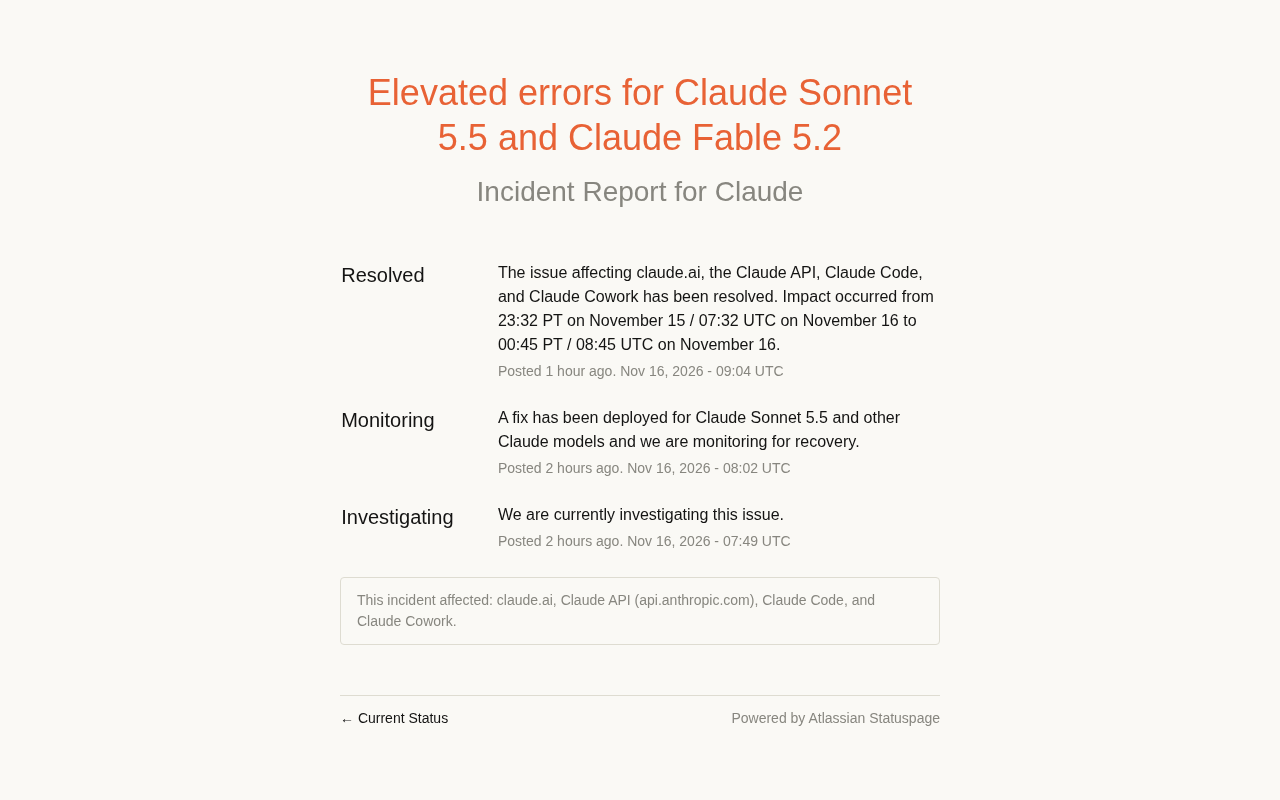
According to the RSS feed from Anthropic's official status page, models including Claude Sonnet 5.5 and Claude Fable 5.2 began experiencing elevated error rates at 07:49 UTC on November 16. At 08:02, the official status was updated to "Monitoring," indicating that a fix had been deployed and recovery was being monitored. The entire process from "Investigating" to "Monitoring" spanned approximately 13 minutes, making this a short-duration incident.
Incident Timeline and Response Actions
The status page recorded two key milestones:
- 07:49 UTC — Investigating: The official team confirmed it was investigating the issue but did not disclose the specific error type or scope of impact.
- 08:02 UTC — Monitoring: A fix had been deployed, and the team entered the recovery monitoring phase.
Judging from the wording, "A fix has been deployed for Claude Sonnet 5.5 and other Claude models" indicates that this incident was not limited to a single model but affected multiple Claude models. Sonnet 5.5 was named explicitly, and Fable 5.2 appeared in the title, suggesting these two may have been the most directly affected or the models with the most concentrated user reports.
Practical Impact on Developers
For developers building applications on the Claude API, this type of short-lived error rate spike typically manifests as failed requests, timeouts, or 5xx status codes. Because the official team did not publish specific error codes or affected regions, developers will find it difficult to retroactively determine whether their failed requests were caused by this incident.
It is worth noting that the status page provided only the vague description "Elevated errors." For teams in production environments, this means relying on their own monitoring and retry mechanisms to assess the scope of impact. It is recommended to configure exponential backoff retries when integrating the Claude API and to set up subscription alerts for the status page RSS.
Exponential Backoff with Jitter refers to a client retrying a failed request at exponentially increasing intervals (e.g., 1s, 2s, 4s, 8s...) while adding random jitter to prevent a large number of clients from retrying simultaneously and creating a "retry storm." For developers calling cloud inference APIs like Claude, short-lived error rate spikes often self-resolve within minutes, and exponential backoff can smoothly ride out the failure window without adding pressure on the server. In practice, note the following: only retry idempotent requests (such as GET or POST with an idempotency key); set a maximum retry count and total timeout cap (e.g., 3 attempts, 30 seconds); use different strategies for 4xx client errors (such as 401 or quota-exceeded 429); and distinguish between 5xx server errors and network timeouts.
5xx status codes belong to the server error category in HTTP semantics (500 Internal Server Error, 502 Bad Gateway, 503 Service Unavailable, 504 Gateway Timeout, etc.), indicating that the request reached the server but processing failed or an upstream dependency was unavailable—as opposed to 4xx client errors. The phrase "failed requests, timeouts, or 5xx responses" in this article corresponds exactly to this phenomenon: when the model service is overloaded or backend dependencies are abnormal, the gateway typically returns 503/504. Since the official team did not publish specific error codes, developers must rely on the status code distribution, request IDs, and timestamps in their own logs to infer whether failures fell within this incident window.
Transparency Issues in Status Page Communication
The information disclosure for this incident was quite brief: no root cause was stated, no percentage of affected requests was given, and no distinction was made between recovery progress across different models. For enterprise users, this level of granularity may be insufficient to support a post-incident review.
On the positive side, the transition from investigation to deployed fix within 13 minutes is commendable in terms of response speed. However, the "Monitoring" status itself does not include confirmation of recovery, so readers cannot determine from that update alone whether the service has fully recovered. Whether there was a subsequent "Resolved" update is not reflected in the original material.
Status Pages and RSS Subscriptions are the standard channels through which SaaS vendors disclose service health, typically including component-level statuses (Operational / Degraded Performance / Partial Outage / Major Outage / Under Maintenance) and an incident timeline. The incident lifecycle generally follows four stages: Investigating → Identified → Monitoring → Resolved. Investigating means an anomaly has been confirmed and is being investigated; Identified means the root cause has been located; Monitoring means a fix has been deployed and recovery is being observed; Resolved means the incident is closed. This incident skipped the Identified stage and went directly to Monitoring, and no Resolved update appeared—a detail worth noting when assessing the completeness of information disclosure. By subscribing to the status page via RSS/Atom, on-call systems can receive push notifications within seconds and trigger alert routing, which is more reliable than manual polling.
Operational Recommendations for Teams
- Subscribe to the status page RSS: Learn about incidents faster than manual refreshing, especially suited for on-call scenarios.
- Client retry strategy: Enable retries for idempotent requests to prevent short-lived failures from escalating into business incidents.
- Multi-model fallback plan: This incident affected multiple Claude models, demonstrating the risk of single-model dependency. Consider configuring backup models or backup providers.
- Record request IDs: This facilitates correlation analysis when the official team later publishes details.
Conclusion
This was a typical short-duration model service incident with a timely official response but limited information disclosure. For developers, the focus should not be on the incident itself but on using it to review whether their own fault-tolerance design for third-party AI services is adequate.
One-line Summary
Multiple Claude models saw a brief error rate spike, fixed in 13 minutes, but with limited disclosure.
Paragraph Summary
At 07:49 UTC on November 16, Anthropic's status page reported elevated error rates for models including Claude Sonnet 5.5 and Claude Fable 5.2. By 08:02, a fix had been deployed and the status moved to Monitoring—about 13 minutes in total. The official wording indicates the incident affected multiple Claude models rather than a single one, but no root cause, scope of impact, error codes, or percentage of affected requests were disclosed, and no Resolved update appeared, leaving enterprise users with insufficient information for post-incident review. For developers, such short-lived failures typically manifest as failed requests, timeouts, or 5xx responses, making it difficult to pinpoint whether failed requests stemmed from this incident. The article recommends subscribing to the status page RSS, configuring exponential backoff retries for idempotent requests, preparing multi-model fallback plans, and recording request IDs—using these to review your own fault-tolerance design for third-party AI services.
Related articles

RePlan-VLA: Progress-Aware Replanning Breakthrough for Long-Horizon Robotic Manipulation
The RePlan-VLA framework converts VLA models' short-horizon capabilities into reliable long-horizon execution through progress-aware adaptive replanning, improving success rates by 21.9% and 10.4% on RoboCasa365 and CALVIN, and validating real-world deployment on a Franka Research 3 robot.

Geometric Bridge Flow Matching: A New Breakthrough in Blind Rigid Motion Correction
Geometric bridge flow matching enables blind rigid motion correction in head CBCT, achieving 37.1 dB PSNR and 0.27 mm RPE on simulated data in ~9.1 minutes, outperforming existing methods.

Google Releases Gemini 4 Hydrogen: 2.5x Faster Without Sacrificing Intelligence
Google releases the lightweight Gemini 4 Hydrogen: 2.5x faster task completion, AA Intelligence Index of 54 beating its flagship sibling, 7.3s single-step on Agent Arena faster than Claude and GPT rivals, four thinking levels with pay-as-you-need pricing, now available across AI Studio and more.