PostgreSQL 19 Officially Released: Core Features and Upgrade Outlook

PostgreSQL 19 release docs are online; community buzz is steady; check compatibility and dependencies before upgrading.
PostgreSQL 19's release documentation is now on the official site and has gained 328 points and 21 comments on Hacker News, reflecting the typical "important but unassuming" cadence of infrastructure releases. The article highlights that compatibility changes are the top items to verify before upgrading, and that upgrade paths usually depend on pg_upgrade or logical replication, requiring planned downtime. Teams should also assess extension, driver, and ORM compatibility and rehearse the upgrade in a pre-release environment. The author stresses that hype does not equal importance and encourages reading official docs directly.
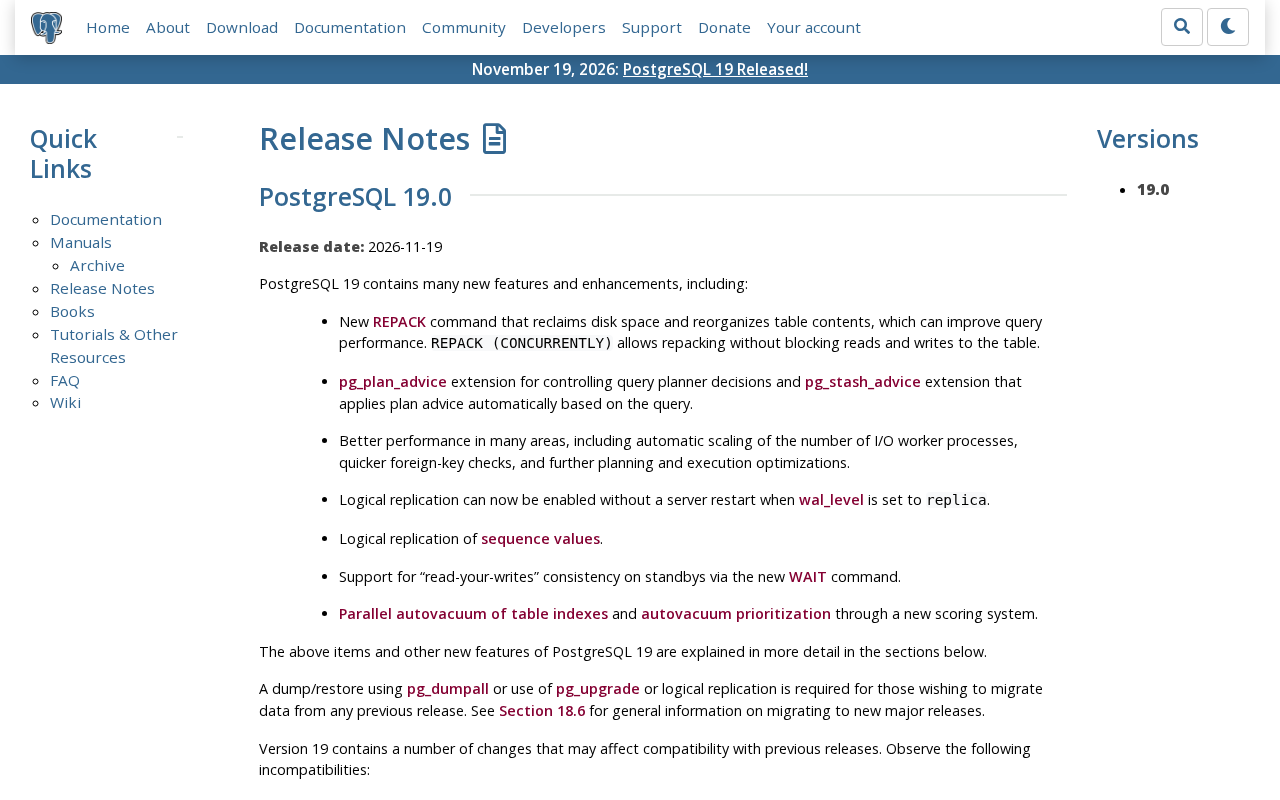
PostgreSQL 19's release documentation has appeared on the official site and sparked attention in the Hacker News tech community, with the related discussion thread reaching 328 points. Although the official page currently presents the release notes form, it is enough for database practitioners to begin assessing the changes this version will bring.
Community Reaction and Release Cadence
The Hacker News discussion gathered 21 comments in a short time. That number isn't high compared to hot threads with hundreds of comments, but it fits PostgreSQL's consistent release cadence—core users tend to read the release notes and upgrade documentation directly rather than engage in lengthy debates on social platforms. The 328 points indicate steady attention, characteristic of an "important but unassuming" infrastructure update.
Judging from the pattern of community feedback, every major PostgreSQL release goes through a similar cycle: early adopters validate it in test environments first, then managed service providers follow with support, and finally large-scale migration happens in production. Discussion of version 19 is still in the first phase.
Version Positioning as Seen from the Release Notes
The official release documentation (/docs/release/19.0/) is the primary source for understanding this version. PostgreSQL's release notes are typically organized by compatibility changes, performance improvements, new features, bug fixes, and other dimensions. The compatibility changes section is the most important to check item by item before upgrading, because it directly determines whether existing applications need modification.
For operations teams, the upgrade path guidance in the release notes is equally critical. PostgreSQL minor version upgrades can usually be done by simply replacing binaries, but major version upgrades often require pg_upgrade or logical replication and other approaches, making it necessary to plan a maintenance window.
PostgreSQL's release notes are typically organized into sections such as Incompatibilities, Migration to Version 19, and Changes. The Incompatibilities section lists modifications that may break existing application behavior or dependencies, such as default configuration adjustments, system view column changes, built-in function behavior corrections, and removal of deprecated features. Operations and development staff should check these items one by one before upgrading and assess their impact on existing SQL, drivers, extensions, and backup and recovery procedures.
The "Migration to Version 19" section of the release notes also explains the specific requirements for upgrading from older versions, including whether pg_upgrade needs to be run, whether upgrading to an intermediate version first is required, and compatibility considerations for pg_dump/pg_restore. The details in these subsections often affect upgrade window planning more directly than feature highlights.
What to Focus on in Upgrade Decisions
When facing a new major version, teams need to answer several questions: Have existing extensions been adapted? Are there known compatibility issues in the driver and ORM layers? Can each node in the replication topology be upgraded in sync? The answers to these questions lie not in the release notes themselves but in each team's dependency inventory.
A pragmatic approach is to run the full upgrade process in a pre-release environment, record the time required and any anomalies, and then estimate the production downtime window accordingly. For businesses that cannot tolerate downtime, logical replication combined with a switchover is the safer path.
pg_upgrade is PostgreSQL's built-in tool for in-place major version upgrades. It completes the upgrade by creating a new-version data directory, copying or linking user data files in binary form, and rebuilding system catalogs and statistics, thereby avoiding the time-consuming full export that pg_dump entails. Using pg_upgrade usually requires both the old and new version binaries to be present at the same time and running steps such as analyze after the upgrade. For large databases, the --link mode can significantly shorten downtime, but it makes rollback difficult, so backups must be made before the operation.
Logical replication is another major version migration path: create a publication on the old version and a subscription on the new version, then perform a switchover once the data has caught up. It allows old and new versions to run in parallel and enables gradual migration, making it suitable for businesses that cannot tolerate long downtime, but it requires handling additional complexity such as sequences, DDL change synchronization, and conflicts.
PostgreSQL's extension ecosystem (such as PostGIS, pg_stat_statements, Citus, pgvector, etc.) is bound to major versions at the compilation and ABI level. Extensions usually need to be recompiled or have the corresponding version installed for the new major version. Before upgrading, confirm whether the extensions in use have published builds supporting version 19, and check whether the extensions' SQL scripts require running ALTER EXTENSION ... UPDATE.
Drivers and ORM layers also require attention: clients such as JDBC, psycopg, and Npgsql, as well as ORMs such as Hibernate and SQLAlchemy, may depend on specific server behaviors or protocol features. Before upgrading, consult their compatibility notes and perform regression validation with real business queries in a pre-release environment.
A Rational View of Version Hype
The combination of 328 points and 21 comments reminds us that the hype around infrastructure software releases is not always proportional to their actual importance. PostgreSQL's value lies in long-term stability and ecosystem compatibility, not in the buzz generated by a single release. What truly determines the benefits of an upgrade is the team's understanding of its own workload characteristics and the depth of its validation of changes.
Developers are advised to read the official release notes directly and conduct targeted assessments based on their own tech stacks rather than relying on secondhand interpretations.
One-line Summary
PostgreSQL 19 release documentation is now online, community attention is steady, and compatibility changes and dependency adaptation should be the focus before upgrading.
Paragraph Summary
PostgreSQL 19's release documentation is now live on the official site and has gained 328 points and 21 comments on Hacker News, showing the typical "important but unassuming" release cadence of infrastructure software. The article notes that compatibility changes in the release notes are the most important items to check one by one before upgrading, and that upgrade path guidance should also be heeded: major version upgrades usually rely on pg_upgrade or logical replication and require advance planning of downtime windows. Teams should also assess the adaptation of extensions, drivers, and ORMs, and rehearse the full upgrade process in a pre-release environment. The author emphasizes that version hype does not equal actual importance, and developers should read the official documentation directly and conduct targeted assessments based on their own workload characteristics.
Related articles

Yung Pueblo on Self-Awareness: A 365-Day Guide to Inner Transformation
Yung Pueblo shares his new book Journey's 365-day self-awareness structure on Talks at Google, discussing meditation, intuition, co-leadership in relationships, and gratitude practices.

FBI and USDA Hit by Cyberattacks: Critical Infrastructure Security Alarms Sound Again
FBI and USDA reportedly hit by cyberattacks; the FBI was breached for the second time in recent months, this time targeting the National Crime Information Center (NCIC). This article analyzes the incident details, NCIC's strategic value, and common security challenges facing government agencies.

How Do UK Grid Battery Storage Systems Make Money?
How UK grid battery storage makes money: stacking frequency response, capacity market, and wholesale arbitrage revenue, plus operational trade-offs and market risks.