Practical Guide to Analytical AI: Making LLMs Actually Work for Data Analysis

A practical guide to building reliable LLM-powered data analysis systems with hybrid model-tool architectures.
This guide explores Analytical AI — using LLMs for structured data analysis rather than just conversation. It covers the hybrid architecture where models handle semantic understanding while deterministic engines execute computations, the role of semantic layers and context engineering, multi-layer validation mechanisms, iterative Agent-style error correction, and human-AI collaboration patterns for enterprise-grade reliability.
From Conversational AI to Analytical AI
When most people think about large language models, what comes to mind is typically chatbots, content generation, or code completion. However, an increasingly important direction is emerging — Analytical AI, which leverages LLMs to process, understand, and interpret structured data, helping humans perform real data analysis and decision-making.
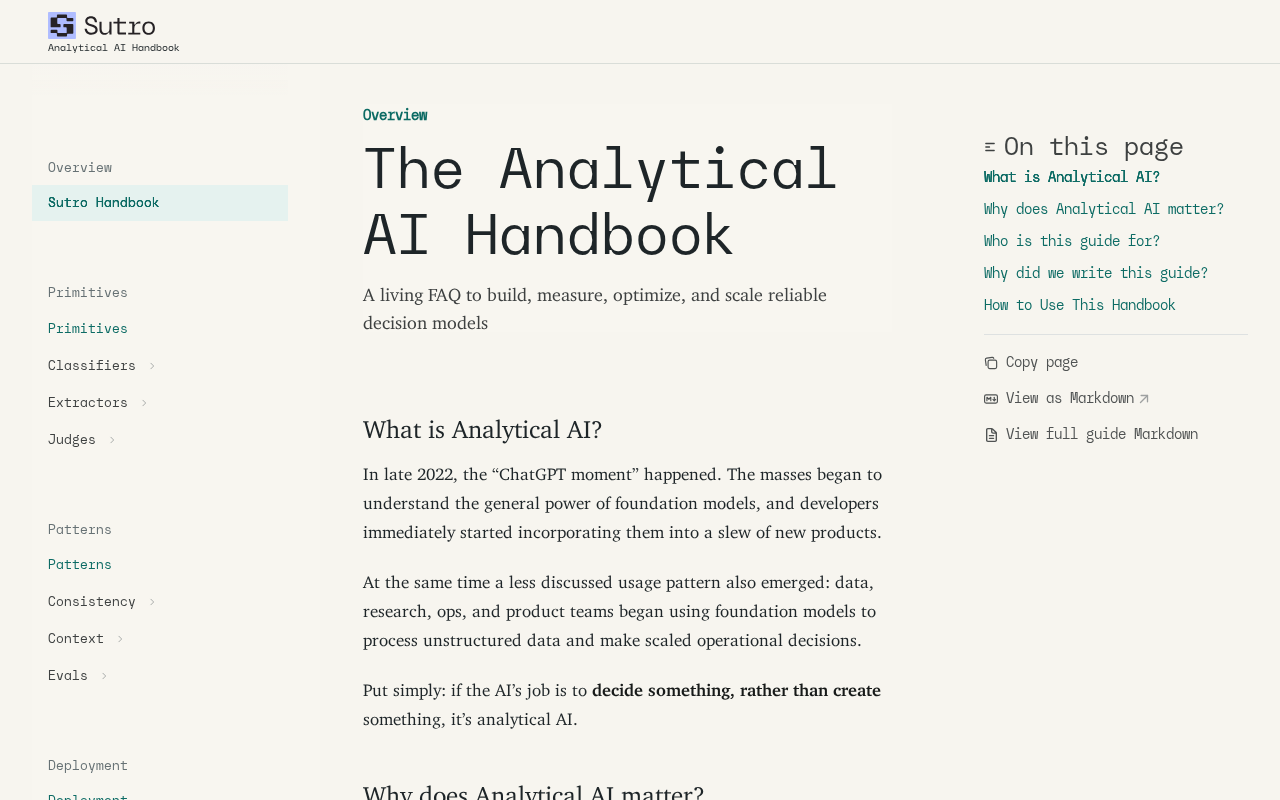
A recent discussion on Hacker News around The Analytical AI Handbook focuses precisely on this field. The handbook attempts to systematically answer a core question: how do we make LLMs go beyond just "being articulate" to actually "being analytical"? The engineering practices, data processing paradigms, and reliability guarantees involved are fundamentally different from traditional conversational AI applications.
Why Analytical AI Is a Distinct Challenge
The Gap Between Generative and Analytical Tasks
Generative tasks have a higher tolerance for error — slightly imprecise copy or code that needs manual tweaking is generally acceptable to users. Analytical tasks are an entirely different story, with near-exacting requirements for accuracy, explainability, and reproducibility. When an AI system tells you "revenue declined 12% this quarter," that number must be precisely correct, or the entire decision chain collapses.
This highlights the unique challenges of Analytical AI: LLMs are inherently not good at precise computation and are prone to hallucinations. LLM "hallucination" refers to the model generating content that appears plausible but is actually fabricated or incorrect. This phenomenon is rooted in how LLMs work — they are fundamentally probabilistic prediction models that generate text by predicting the next most likely token, rather than retrieving information from a factual database. In conversational or creative writing scenarios, mild hallucinations may be harmless, but in data analysis scenarios, even a single decimal point error can lead to completely wrong business decisions. Research shows that even frontier models like GPT-4 have accuracy rates on multi-step mathematical reasoning far below traditional computation engines.
Therefore, a key principle emphasized in the handbook is: don't let the model directly produce numbers — let it generate executable analytical logic, which is then actually executed by deterministic computation engines (such as SQL, Python, or Pandas). This is the fundamental reason why Analytical AI must adopt a "model + tools" hybrid architecture.
From "Direct Model Answers" to "Tool Orchestration"
This shift reflects the prevailing approach in current Analytical AI architecture. The LLM plays a role more like a "translator" and "orchestrator":
- Understanding intent: Parsing the user's natural language query requirements
- Generating logic: Converting requirements into structured queries (e.g., SQL) or computation scripts
- Invoking tools: Handing the generated code to external engines for execution
- Interpreting results: Explaining data meanings to users in natural language
Among these, converting natural language to SQL queries (Text-to-SQL) is one of the most critical technical capabilities of Analytical AI, and a classic NLP task that academia has studied for nearly a decade. Early approaches based on rules and sequence-to-sequence models performed poorly on complex queries, but the emergence of LLMs brought a qualitative leap. On standard benchmarks like Spider, GPT-4-level models with appropriate schema prompting can achieve over 80% execution accuracy. However, a massive gap remains between academic benchmarks and real enterprise scenarios: real databases may contain hundreds of tables and thousands of fields, with widespread naming inconsistencies and implicit business rules that standard benchmarks cannot cover. This is why industry places greater emphasis on Context Engineering — how to precisely provide the most relevant metadata for the current query within the prompt.
This division of labor — "model handles semantic understanding, tools handle precise computation" — dramatically improves system reliability.
Core Components of Building an Analytical AI System
Data Access and Contextual Understanding
The first hurdle Analytical AI faces is enabling the model to "understand" the data. Real-world databases often have complex table structures, cryptic field names, and implicit business logic. To have the LLM generate correct queries, sufficient context must be provided — including table schemas, field descriptions, data samples, and even business rules.
The engineering practices here are critical: how do you efficiently provide the most relevant metadata within a limited context window? The concept of a Semantic Layer becomes especially important here. The semantic layer concept originally emerged from the Business Intelligence (BI) field and was popularized by tools like Looker. It is essentially an abstraction layer built on top of raw database table structures, mapping technical table names, field names, and JOIN relationships to metrics and dimensions that business users can understand. For example, the underlying database might have multiple tables like orders, order_items, and refunds — the semantic layer can encapsulate them into a business metric like "net revenue" with its complete calculation logic defined.
In the context of Analytical AI, the importance of the semantic layer is further amplified — it serves not only human users but also LLMs. Current mainstream implementations include dbt Metrics Layer, Cube.js, and proprietary semantic layer solutions from various cloud providers. These tools use YAML or SQL-like syntax to define business semantics, enabling LLMs to understand data at a higher level of abstraction, which significantly reduces the probability of generating incorrect queries. When a user asks "how many active users last month," the semantic layer helps the model accurately understand the business definition of "active user" and map it to the correct tables and fields.
Query Generation and Multi-Layer Validation
Generating SQL or analytical code is just the first step — more importantly, its correctness must be validated. A mature Analytical AI system needs to establish multi-layer verification mechanisms:
- Syntax checking: Ensuring the generated SQL or code can compile
- Dry Run: Pre-assessing query reasonableness before execution — for example, checking whether it would trigger a full table scan or produce a Cartesian product and other performance disasters
- Result sanity checking: Determining whether returned data falls within expected ranges — for example, triggering an alert when a percentage metric exceeds 100%
- Model self-review: Having the LLM perform a logical review of its own generated query
A key practical takeaway mentioned in the handbook: rather than striving for a perfect query on the first try, design an iterative error-correction loop. When a query execution fails, feed the error message back to the model for self-correction — this Agent-style workflow can significantly improve the final accuracy of results.
The "Agent-style workflow" here represents a typical application pattern of AI Agents. An AI Agent refers to an LLM application architecture with autonomous planning, tool-calling, and reflection capabilities, distinct from simple single-turn "input-output" calls. In Analytical AI scenarios, Agent workflows typically include four cyclical steps: Plan (strategize the query approach), Act (execute SQL or code), Observe (check execution results), and Reflect (determine if corrections are needed). This aligns with the design philosophy of the ReAct (Reasoning + Acting) framework. Mainstream frameworks like LangChain and LlamaIndex provide infrastructure for building such Agents. In practice, Agent systems that allow the model 2-3 rounds of self-correction typically achieve SQL generation accuracy rates 15-25 percentage points higher than single-round generation.
Result Interpretation and Insight Delivery
Once data results are obtained, transforming cold numbers into valuable business insights is the last mile of Analytical AI. An excellent system should not only tell you "what happened" but also explain "why" and "what it means." This requires the model to possess domain knowledge and combine data trends with business context to provide actionable analytical recommendations. For example, when the system detects that a product line's return rate has suddenly spiked over the past two weeks, it shouldn't just report the numbers — it should also consider known context (such as recent product updates, promotional campaigns, or supply chain changes) to propose possible attribution hypotheses, helping decision-makers quickly focus on the root cause.
Key Challenges in Production Deployment
Reliability Is Always the Top Priority
In enterprise-grade analytical scenarios, a single erroneous analysis could lead to millions in misguided decisions. Therefore, productizing Analytical AI must put reliability first. This means accepting a design principle: it's better to refuse to answer than to give a wrong answer. When the model doesn't have sufficient confidence in a result, proactively acknowledging uncertainty is far more valuable than forcing an answer.
In engineering terms, this typically means establishing a confidence scoring mechanism — the system attaches a reliability score when returning results, and when the score falls below a threshold, it automatically triggers a manual review process or explicitly labels the result as "needs verification" for the user. Additionally, comprehensive audit logs are crucial — recording the generation logic, execution process, and data sources for every query to ensure results are traceable and reproducible.
Human-AI Collaboration, Not Complete Replacement
Given current technology maturity, Analytical AI is better positioned as a "data analyst's assistant" rather than a "replacement." Its value manifests on two levels:
- Lowering the barrier: Enabling non-technical users to query databases through natural language and access business data. This capability is known in the industry as "Data Democratization" — it breaks down the barrier where only people with technical skills like SQL could directly access data, enabling product managers, operations staff, and even executives to obtain information in a self-service manner.
- Freeing up capacity: Liberating professional analysts from repetitive data extraction work so they can focus on higher-value deep insights. It's estimated that data analysts spend 40-60% of their daily work on data extraction and cleaning — Analytical AI has the potential to dramatically reduce this proportion.
Establishing an Evaluation Framework
Compared to generative tasks, a major advantage of analytical tasks is that results can be objectively evaluated. Whether a query returns the correct data and whether calculations are accurate — these have definitive ground-truth answers. Therefore, establishing comprehensive evaluation benchmarks is critical for continuously improving Analytical AI systems.
Mainstream evaluation dimensions typically include three levels: Execution Accuracy (whether the generated SQL can execute and return correct results), Logical Accuracy (whether the SQL logic is equivalent to the reference answer, even if written differently), and end-to-end satisfaction (whether the final natural language interpretation is accurate and valuable). Teams can build proprietary evaluation datasets by accumulating real-world question-answer pairs, quantifying system accuracy and iterating continuously. Some teams also introduce the "LLM-as-Judge" approach, using another LLM to evaluate the quality of analytical conclusions as a supplement to human evaluation. This combination of automated evaluation and manual spot-checks maintains evaluation quality while significantly reducing evaluation costs.
Conclusion
Analytical AI represents a deep-dive direction in large language model applications. It doesn't pursue flashy conversational experiences but instead focuses on serious business value — making data analysis more accessible and efficient. The value of The Analytical AI Handbook lies in systematizing the scattered engineering practices in this field, providing developers who want to build reliable data analysis AI systems with a clear roadmap.
For teams exploring LLM deployment scenarios, this serves as an important reminder: AI's true value isn't in making machines talk more like humans, but in making them truly usable, trustworthy, and dependable in professional domains. Analytical AI is the perfect embodiment of this principle.
Related articles

Chain of Thought Isn't Just for AI: How Humans Can Use CoT to Improve Thinking Quality
Chain of Thought isn't just a prompt trick for large models. Starting from a Hacker News discussion, this article analyzes why CoT works for human thinking too, breaks down actionable ways to transfer it, and highlights the key differences between human CoT and machine CoT.
Cloudflare Teams Up with OpenAI: Closi…
Cloudflare Teams Up with OpenAI: Closing the Loop from Vulnerability Discovery to Defense with AI
Cloudflare uses OpenAI Daybreak to investigate security vulnerabilities and generate reviewable remediation plans, while developers use Codex to boost coding efficiency and quality.

Orca Multi-Agent Orchestration in Practice: A Guide to Parallel Collaboration with Claude and Codex
Orca is Stable AI's free open-source agent workbench supporting 34 agents like Claude Code and Codex in parallel. Learn its Git worktree isolation, multi-model orchestration, and mobile management.