Praxis: Turning Research Papers into Actionable Engineering Blueprints

Praxis converts research paper ideas into reviewable engineering blueprints, bridging the gap between understanding and building.
Praxis is an open-source tool by developer Sushit that addresses the gap between reading a research paper and knowing what to actually build. Rather than generating code or reproducing papers directly, it translates research ideas into engineering blueprints covering PRD, feasibility, architecture, and implementation planning. It's designed for constrained hardware environments and front-loads feasibility decisions into the blueprint phase. A built-in design-critic stage provides adversarial architectural review before implementation begins, surfacing hidden assumptions early. The project is available on GitHub and actively seeking feedback from developers with research reproduction experience.
The Gap Between "Interesting Idea" and "Ready to Build"
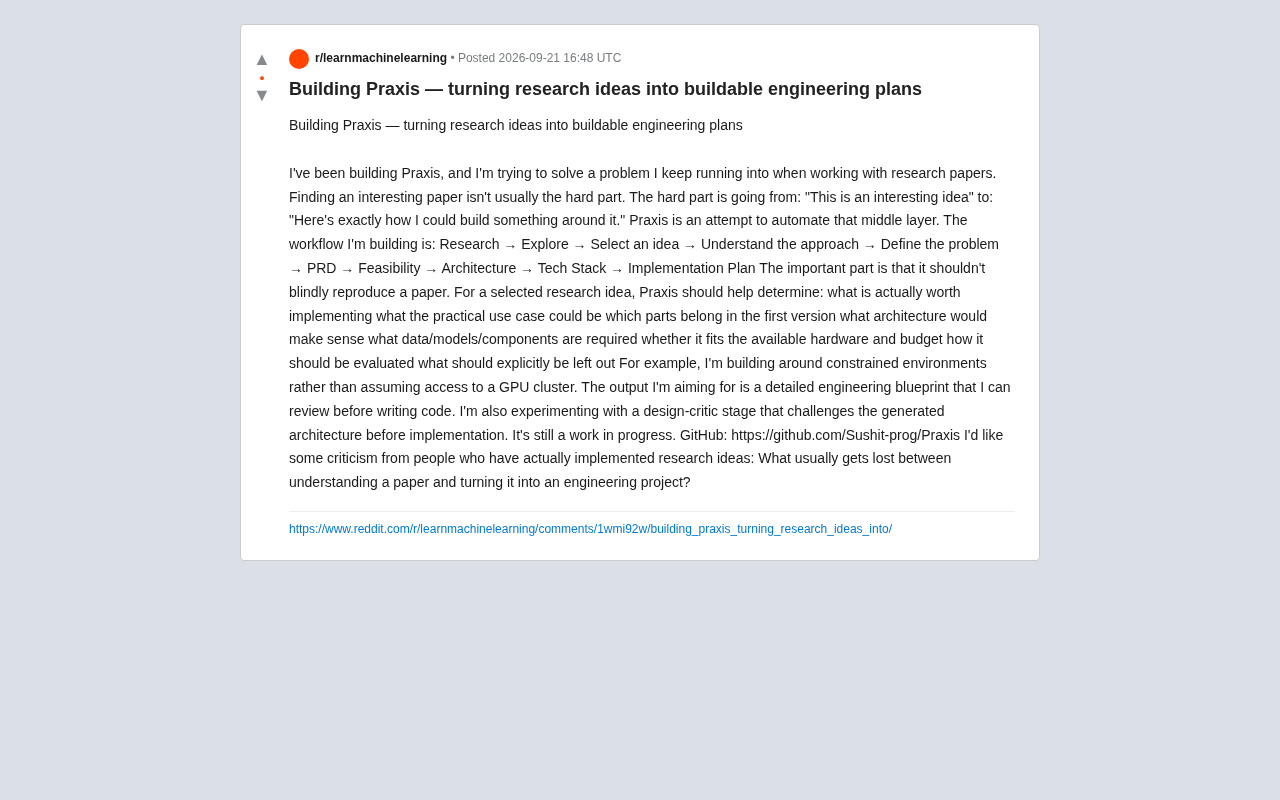
Anyone who reads research papers has probably felt this: finding an interesting paper is the easy part. The real bottleneck comes next — how do you turn "this idea is fascinating" into "here's exactly what I should build"? That gap in the middle is precisely what developer Sushit's open-source project Praxis, shared on Reddit, aims to solve.
Praxis isn't designed to reproduce papers. Instead, it translates the research ideas within a paper into a reviewable engineering blueprint. In the author's own words, it tries to automate the part of the journey most likely to fall apart — the stretch between "understanding a paper" and "actually writing code."
How Praxis's Workflow Is Designed
The author breaks the entire process down into a clear chain:
Research → Explore → Select Idea → Understand Method → Define Problem → PRD → Feasibility → Architecture → Tech Stack → Implementation Plan
The key insight here is "don't blindly reproduce the paper." For a selected research idea, Praxis works through a series of engineering decision questions:
- What parts are actually worth implementing
- What real-world use cases might exist
- Which features should make it into version one
- What kind of architecture actually makes sense
- What data, models, and components are needed
- Does it fit within available hardware and budget
- How should results be evaluated
- What should be explicitly out of scope
These are exactly the questions that cause many research reproduction projects to fail — not because of technical limitations, but because no one thought clearly from the start about "where do we actually stop."
Designed for Constrained Environments, Not GPU Clusters
One notable design philosophy: Praxis assumes constrained environments, not that you have an entire GPU cluster at your disposal. This is especially practical for independent developers and small teams. Many papers are built on experiments that assume abundant compute — directly porting them often fails at the hardware and budget stage. By making "does this fit available hardware and budget" an explicit decision node, Praxis front-loads the feasibility question into the blueprint phase.
The Design Critic Phase: Let Architecture Face Scrutiny First
One of the more interesting experimental features in Praxis is the design-critic phase: before moving to implementation, a dedicated criticism step challenges the generated architectural plan.
This addresses a common pain point with generative tools — they tend to produce plans that look complete but haven't been stress-tested. Adding a dedicated "find the flaws" step is essentially an adversarial review pass before any code gets written, surfacing architectural weaknesses as early as possible. The author acknowledges this is still a work in progress and an area being actively refined.
The design-critic concept has broader precedents in software engineering. Traditional Architecture Review Boards and Red Teaming exercises follow similar logic: have an independent perspective find holes before a design solidifies. In the context of AI-assisted development, this pattern is sometimes called "critic-generator separation" — using different prompts or agent roles to separately handle "producing a solution" and "challenging a solution," countering the tendency of language models toward self-confirmation bias. When a single agent is immediately asked to critique its own output, results are often weak. Treating criticism as a distinct phase is more likely to surface overly optimistic assumptions, uncovered edge cases, and undeclared dependencies. By placing this step before writing code rather than at code review, Praxis theoretically reduces the rework cost of discovering architectural flaws late in the process.
What Actually Gets Lost?
The author ends their post with a question worth reflecting on for anyone who has attempted a research reproduction:
What usually gets lost between "understanding a paper" and "turning it into an engineering project"?
Looking at Praxis's workflow, you can infer the author's answer: what gets lost usually isn't the algorithmic details — it's the context behind engineering decisions. The experimental conditions papers assume, the trade-offs they omit, the assumptions that don't transfer to real-world constraints. A paper tells you "this method works," but rarely tells you "given your budget and hardware, here's what version one should and shouldn't include."
Filling that layer of information is exactly what Praxis is trying to do. Its output isn't code — it's a detailed engineering blueprint that can be reviewed and revised before any code gets written. For developers trying to turn academic results into actual products, this "plan first, implement second" approach points in the right direction.
This translation difficulty from academic work to engineering implementation has been widely discussed in the MLOps and Research Engineering communities. Papers typically report results under idealized conditions: fixed dataset splits, dedicated compute clusters, carefully tuned hyperparameters, and implementation details often buried in appendices. When developers attempt reproduction, they face the "reproducibility gap" — even following a paper's description exactly, results often don't align, due to random seeds, library versions, hardware differences, or data preprocessing steps that were never fully specified. The deeper issue is the absence of "engineering intent": paper authors know which ablations were critical and which tricks were essential, but these judgments rarely make it into the main text. Praxis tries to make these omitted engineering decisions explicit by systematically asking "what should go into version one."
Summary
Praxis is still in active development, with code already open-sourced on GitHub (github.com/Sushit-prog/Praxis). It represents a growing category of tool philosophy: rather than chasing end-to-end automatic code generation, it focuses on the "translation layer" between research and engineering — the part that's hardest to automate and most in need of judgment. For developers who regularly struggle between papers and products, this is a tool worth keeping an eye on.
The author is also openly soliciting critical feedback from people who have done research reproductions themselves — which is itself a healthy sign for an early-stage open-source project.
Related articles

Chain of Thought Isn't Just for AI: How Humans Can Use CoT to Improve Thinking Quality
Chain of Thought isn't just a prompt trick for large models. Starting from a Hacker News discussion, this article analyzes why CoT works for human thinking too, breaks down actionable ways to transfer it, and highlights the key differences between human CoT and machine CoT.
Cloudflare Teams Up with OpenAI: Closi…
Cloudflare Teams Up with OpenAI: Closing the Loop from Vulnerability Discovery to Defense with AI
Cloudflare uses OpenAI Daybreak to investigate security vulnerabilities and generate reviewable remediation plans, while developers use Codex to boost coding efficiency and quality.

Orca Multi-Agent Orchestration in Practice: A Guide to Parallel Collaboration with Claude and Codex
Orca is Stable AI's free open-source agent workbench supporting 34 agents like Claude Code and Codex in parallel. Learn its Git worktree isolation, multi-model orchestration, and mobile management.