Predicting Molecular Behavior with Scarce Data: An Analysis of the CheMeleon Method

CheMeleon predicts molecular behavior with less and rougher data, lowering the data barrier for drug development.
The article introduces a machine learning method called CheMeleon, which aims to predict molecular behavior using far less experimental data than traditional approaches. Traditional molecular property prediction relies on massive high-quality labeled data, yet experimental data is precisely the scarcest and most expensive resource in real R&D. CheMeleon adopts a "data-efficiency-first" modeling paradigm, emphasizing practicality. If it can provide valuable predictions with limited data, it would help early drug discovery quickly rule out non-viable candidates. However, the original report lacks model architecture and performance data, so it should be viewed as a promising direction rather than a mature solution.
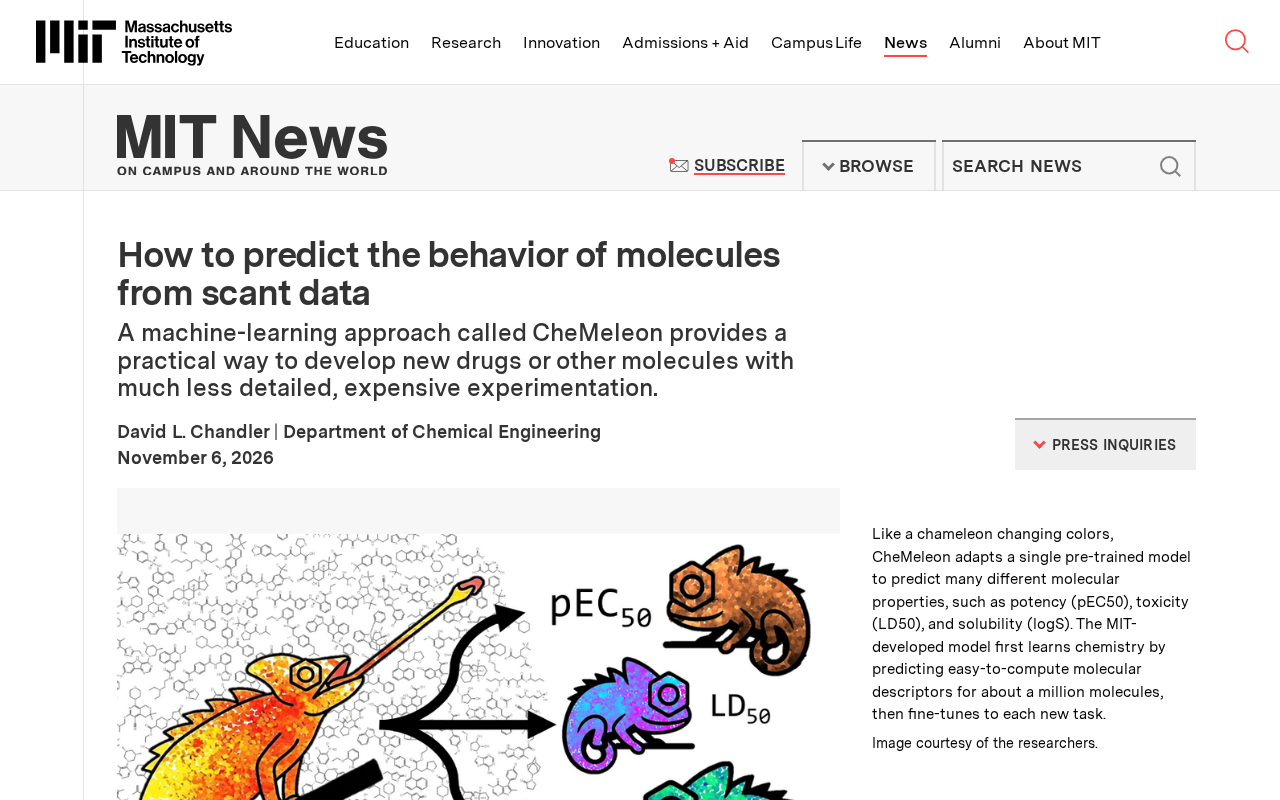
When developing new drugs or materials, predicting molecular behavior typically relies on large amounts of expensive and time-consuming experimental data. A machine learning method called CheMeleon attempts to accomplish the same prediction tasks with less and rougher data, offering a more practical path for molecular design.
Why molecular prediction needs "less data" solutions
Traditional molecular property prediction models often require massive amounts of labeled data to reach usable accuracy. But in real R&D scenarios, high-quality experimental data is precisely the scarcest resource—every measurement means cost and time investment. CheMeleon's starting point is exactly this contradiction: can models still deliver reliable predictions when data is insufficient?
The value of this approach lies in shifting the focus from "stacking data" to "using the right method," enabling early-stage R&D to leverage machine learning for screening and judgment even when data is limited.
Molecular property prediction and quantitative structure-activity relationships (QSAR)
Molecular property prediction is typically built on the framework of quantitative structure-activity relationships (QSAR): given a molecular structure representation (such as molecular fingerprints, SMILES strings, or graph structures), the model learns a mapping from structure to properties (such as solubility, toxicity, target affinity). Traditional QSAR and subsequent deep learning models are both supervised learning approaches whose accuracy depends heavily on the quantity and quality of labeled samples. The scale of chemical space is enormous (the number of drug-like molecules can reach the order of 10^60), while experimentally labeled molecules number only in the millions—this constitutes the fundamental difficulty of data sparsity.
The cost structure of experimental data
The expense of molecular labeled data is not caused by any single step. Wet-lab synthesis and purification themselves require labor and reagent costs, and the costs of in vitro activity testing, animal pharmacokinetics, and toxicity studies escalate progressively—complete characterization of a single compound may take weeks to months. Additionally, while high-throughput screening has increased per-measurement throughput, coverage of novel chemical space remains limited, and noise and batch effects are pronounced. Therefore, the core challenges of "less data" solutions are not only small sample sizes but also high label noise and strong distribution shift.
CheMeleon's core approach
According to the original report, CheMeleon is a machine learning method whose goal is to predict molecular behavior using experimental data far less detailed than traditional approaches. In other words, it lowers the data barrier so that developing new drugs or other molecules does not require completing large-scale, high-cost experiments first.
The report does not disclose specific model architecture, training details, or performance metrics, so judgment here can only be made regarding its positioning: CheMeleon belongs to a "data-efficiency-first" modeling paradigm, emphasizing practicality under sparse data conditions rather than pursuing extreme accuracy when data is abundant.
A practicality-oriented design philosophy
From the description, CheMeleon emphasizes a "practical way." This means it focuses more on whether it can truly be embedded into drug discovery or molecular design workflows, rather than simply topping some benchmark score. For R&D teams, this orientation may be more appealing than impressive numbers in a paper.
Data efficiency and transfer learning paradigms
The "data-efficiency-first" modeling approach typically corresponds to several technical routes in machine learning: transfer learning (pre-training on large-scale unlabeled or related-task data, then fine-tuning on small-scale target tasks), self-supervised pre-training (constructing prediction targets from molecular structures themselves, such as masked atom prediction), few-shot learning, and active learning (actively selecting the most informative molecules to send for experiments). The common assumption of these methods is that molecular structure data itself is cheap and readily available, and chemical patterns can be absorbed first, thereby reducing dependence on expensive experimental labels. CheMeleon's specific technical categorization is not explained in the original report, but the phrase "experimental data far less detailed than traditional approaches" suggests it may involve both tolerance for label quality and compression of label quantity—that is, making trade-offs on both the "less" and "rougher" dimensions simultaneously.
Potential significance for drug development
Early-stage drug discovery requires quickly ruling out non-viable options from large numbers of candidate molecules. If CheMeleon can provide valuable predictions when data is limited, it can help teams focus earlier on molecules worth deeper experimental investigation, thereby saving experimental resources.
It should be noted that the original material does not provide comparison results between CheMeleon and existing methods, nor does it specify the applicable molecule types or task scope. Therefore, it can currently only be regarded as a promising direction rather than a validated, mature solution.
Virtual screening and early decision-making
In the drug discovery process, from target validation to lead compound optimization, stages typically include structure-based virtual screening, preliminary drug-likeness assessment (such as Lipinski's rules, solubility and permeability prediction), and early toxicity warnings. Predictions at these stages do not need to achieve experimental accuracy—they only need sufficient ranking capability, i.e., placing more likely successful molecules first. This gives "models usable under limited data conditions" real-world value: even with larger absolute errors, as long as they can effectively reduce the number of candidates requiring experimental validation, R&D costs can be significantly compressed. Common metrics for evaluating such methods include enrichment factor, hit rate, and ranking correlation, rather than pure regression error.
Limitations and points to watch
Several key questions about CheMeleon remain unanswered: at what data scale does it begin to fail? Does it perform consistently across different types of molecular tasks? How large is the accuracy gap compared to traditional models that require large amounts of data? These all require evidence from future research.
In the absence of quantitative information, maintaining cautious optimism about its capabilities is the more appropriate attitude. The "less data" challenge in molecular prediction will not be completely solved by any single method, but attempts like CheMeleon at least demonstrate that reducing data dependence is a research direction being taken seriously.
One-line Summary
CheMeleon predicts molecular behavior with less and rougher data, lowering the data barrier for drug development.
Paragraph Summary
The article introduces a machine learning method called CheMeleon, whose core goal is to predict molecular behavior using far less experimental data than traditional approaches. Traditional molecular property prediction relies on massive high-quality labeled data, yet in real R&D, experimental data is precisely the scarcest and most expensive resource. CheMeleon addresses this contradiction with a "data-efficiency-first" modeling paradigm, emphasizing practicality rather than pursuing extreme accuracy when data is abundant. The article notes that if this method can provide valuable predictions when data is limited, it will help early-stage drug discovery quickly rule out non-viable candidate molecules and save experimental resources. However, the original report does not disclose model architecture, performance metrics, or comparison results, and its performance across data scales, task types, and accuracy gaps all remain to be verified—it should currently be regarded as a promising direction rather than a mature solution.
Related articles
 Tech Frontiers
Sherlock: An Open-Source Tool for Tracking Usernames Across Social Networks
Sherlock is an open-source Python tool that tracks social accounts across networks by username. This article covers its core features, why developers love it, typical use cases, and privacy compliance considerations.
 Tech Frontiers
GitHub Daily·Nov 07: Agent-Ready and Context Compression
GitHub Trending Nov 07: meta's agent-ready design system astryx, billion-context's 5x context compression, sherlock nearing 100k stars, plus local-first localthings and bare-metal GPU orchestration nvke.
 Tech Frontiers
Buoyant Open-Sources Kinference: An Inference Control Plane for vLLM on K8s
Buoyant open-sources Kinference, an inference control plane for vLLM on Kubernetes, with declarative routing, KV-cache-aware load balancing, and per-tenant metrics—claiming 95% lower median TTFT in official benchmarks.