Predicting Transmembrane Protein Topology from 3D Structure with Graph Neural Networks

SchNet GNN predicts transmembrane protein topology directly from all-atom 3D structure, bypassing sequence-based methods.
This arXiv preprint proposes using the graph neural network SchNet to predict transmembrane protein topology directly from 3D protein structures. Unlike mainstream approaches relying on amino acid sequences or α-carbon coordinates, the study builds all-atom embeddings to capture finer-grained spatial relationships. Using the same dataset and 5-fold cross-validation as DeepTMHMM — without any pretrained weights — the results show that GNNs are capable of this task, though no quantitative comparison is provided. The work's broader significance lies in addressing a key challenge of the AlphaFold era: how to fully leverage structural information for downstream prediction beyond sequence-driven methods.
Background: A New Approach to Transmembrane Protein Topology Prediction
Transmembrane proteins play critical roles in cellular signaling, molecular transport, and other essential biological processes. They account for roughly one-quarter of all human genome-encoded proteins and represent important targets for many drugs. Accurately predicting the topology of these proteins — that is, which segments reside within the membrane and which are exposed on either side — has long been a central challenge in structural biology.
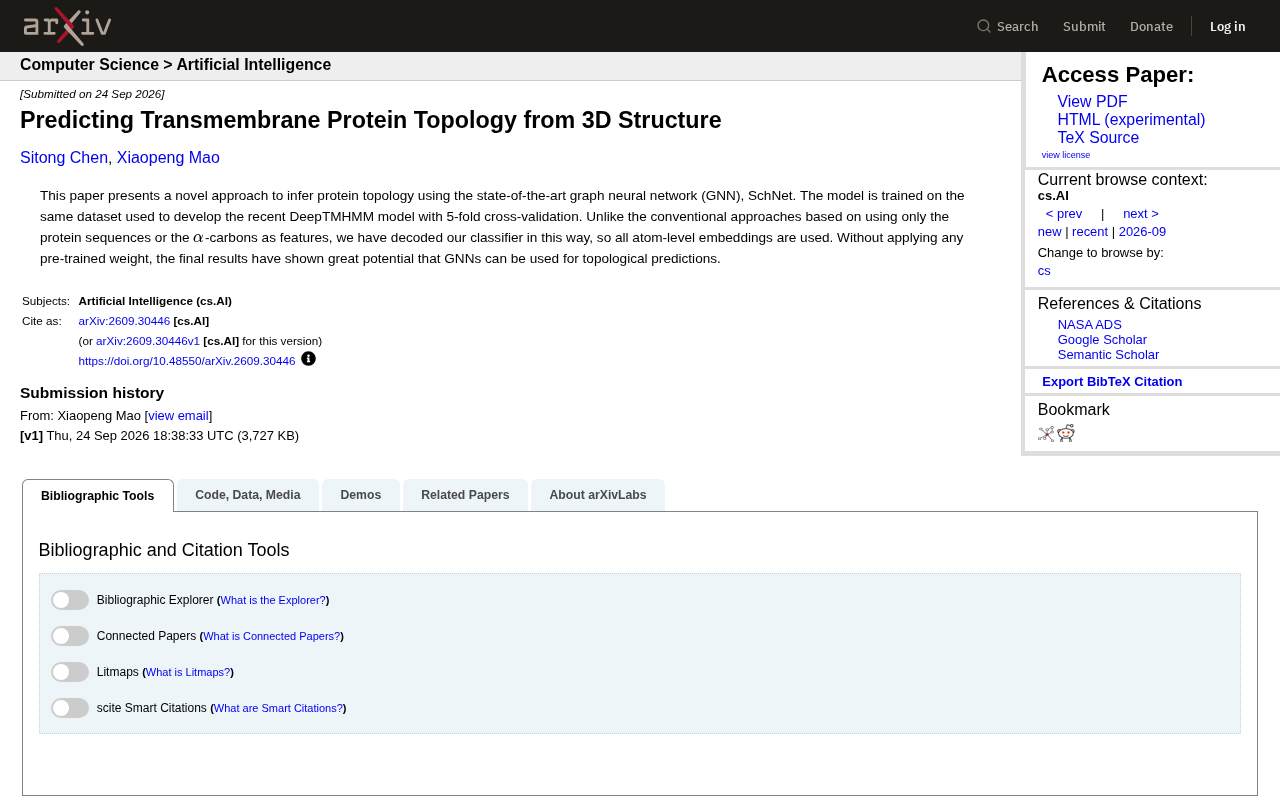
A new paper posted to arXiv (arXiv:2609.30446v1) proposes a novel approach: using the cutting-edge graph neural network (GNN) model SchNet to directly infer topological classifications from protein three-dimensional structures. This work offers a methodological counterpoint to the widely discussed DeepTMHMM model and presents a noteworthy exploration of alternative strategies in this field.
Methodological Innovation: From Sequences to All-Atom Embeddings
Traditional transmembrane protein topology prediction methods rely primarily on two types of features: amino acid sequence information, or structural representations limited to alpha-carbon (α-carbon) positions. While these simplifications reduce computational complexity, they also discard much of the spatial information encoded in three-dimensional structures.
The core innovation of this paper lies in the classifier's use of all atom-level embeddings rather than sequence or α-carbon representations alone. This means the model can capture finer-grained atomic spatial relationships within protein structures, theoretically enabling it to exploit the topological cues inherent in 3D structure more fully.
SchNet, a graph neural network designed specifically for molecular systems, is naturally suited to handling graph structures defined by atoms and their spatial coordinates. Applying it to transmembrane protein topology prediction represents an effort to transfer a mature tool from molecular modeling into structural bioinformatics.
Training Strategy and Dataset
To ensure comparability, the research team used the same dataset as was used in developing DeepTMHMM, and evaluated model performance with 5-fold cross-validation. This design allows a reasonably fair side-by-side comparison between the new approach and the existing benchmark.
Notably, the model was trained without any pretrained weights. In an era when many deep learning methods rely heavily on large-scale pretraining, this setting means the model must learn the mapping between structure and topology entirely from task-specific data.
SchNet was originally introduced by Schütt et al. in 2017, designed for quantum chemistry and molecular property prediction. It treats molecules as graphs of atoms, using interatomic Euclidean distances as edge features, and aggregates information across atomic neighborhoods via continuous-filter convolution — learning molecular representations that are invariant to rotation and translation. This inherent 3D spatial awareness makes it highly effective at small-molecule energy prediction and drug molecular property regression. Unlike sequence models, SchNet learns geometric relationships end-to-end directly from atomic coordinates without hand-crafted spatial features, which is the core motivation for transferring it to protein structure tasks.
Results and Significance: The Potential of GNNs for Topology Prediction
The paper reports that even without pretrained weights, results show significant promise — indicating that graph neural networks are indeed capable of handling protein topology prediction. While preliminary, this conclusion points the way for future research.
From a broader perspective, this work reflects an accelerating trend: as tools like AlphaFold make large-scale, high-quality protein 3D structures widely accessible, methods that perform downstream prediction directly from 3D structure are increasingly replacing traditional sequence-driven approaches. When structural information is no longer scarce, the key question becomes how to fully extract spatial features from it — and GNNs are natural candidates for handling such geometric data.
Limitations and Future Directions
As a preprint, this study is primarily a proof-of-concept. The paper does not provide detailed accuracy figures or a quantitative comparison against DeepTMHMM, so the practical advantages of this approach still require further validation. Additionally, while all-atom embeddings are information-rich, they may also incur higher computational costs; balancing accuracy and efficiency is a practical concern for real-world applications.
Looking ahead, incorporating pretraining strategies, expanding dataset scale, or combining hybrid sequence-structure features could allow GNN-based methods like this one to deliver greater value in transmembrane protein research and drug discovery.
DeepTMHMM is currently one of the strongest baseline models for transmembrane protein topology prediction, released in 2022 by a team at the Technical University of Denmark. It takes sequence embeddings generated by a protein language model as input, combined with a structured hidden Markov model (HMM) output layer, enabling simultaneous prediction of α-helical transmembrane segments, β-barrel transmembrane segments, and signal peptides — achieving state-of-the-art performance on multiple benchmark datasets at the time. DeepTMHMM's success relies heavily on the rich semantic representations provided by large-scale sequence pretraining. The direction explored in this paper stands in contrast: forgoing sequence pretraining entirely and instead extracting signals directly from experimental or predicted 3D coordinates. The comparison between the two approaches reveals the complementary potential of sequence information versus structural information for topology prediction.
AlphaFold2, released by DeepMind in 2021, can predict protein 3D structures with near-atomic accuracy and is widely regarded as a landmark breakthrough in structural biology. The subsequently released AlphaFold database now contains structural predictions for over 200 million proteins, covering the vast majority of the known protein universe. This development has fundamentally lowered the barrier to obtaining structural information — where previously high-quality structures required expensive, time-consuming X-ray crystallography or cryo-EM experiments, most proteins can now be modeled with reasonable confidence at low cost. It is precisely against this backdrop that downstream prediction methods taking 3D coordinates as direct input have become truly feasible at scale, providing the data foundation that makes GNN-based transmembrane topology prediction research possible.
Summary
This paper introduces the graph neural network SchNet to transmembrane protein topology prediction, replacing traditional sequence or α-carbon representations with all-atom structural features. Evaluated on the same dataset and cross-validation framework as DeepTMHMM, the approach demonstrates feasibility. Though still in an early exploratory stage, it clearly illustrates the broad promise of 3D structure-driven deep learning in structural bioinformatics.
Related articles

Chain of Thought Isn't Just for AI: How Humans Can Use CoT to Improve Thinking Quality
Chain of Thought isn't just a prompt trick for large models. Starting from a Hacker News discussion, this article analyzes why CoT works for human thinking too, breaks down actionable ways to transfer it, and highlights the key differences between human CoT and machine CoT.
Cloudflare Teams Up with OpenAI: Closi…
Cloudflare Teams Up with OpenAI: Closing the Loop from Vulnerability Discovery to Defense with AI
Cloudflare uses OpenAI Daybreak to investigate security vulnerabilities and generate reviewable remediation plans, while developers use Codex to boost coding efficiency and quality.

Orca Multi-Agent Orchestration in Practice: A Guide to Parallel Collaboration with Claude and Codex
Orca is Stable AI's free open-source agent workbench supporting 34 agents like Claude Code and Codex in parallel. Learn its Git worktree isolation, multi-model orchestration, and mobile management.