Prediction Is Not Memory: Why Reproducing Current Predictions Can Still Mean Forgetting How to Learn

Prediction-consistent memory states may still lose the ability to learn — this paper proves exactly when and why.
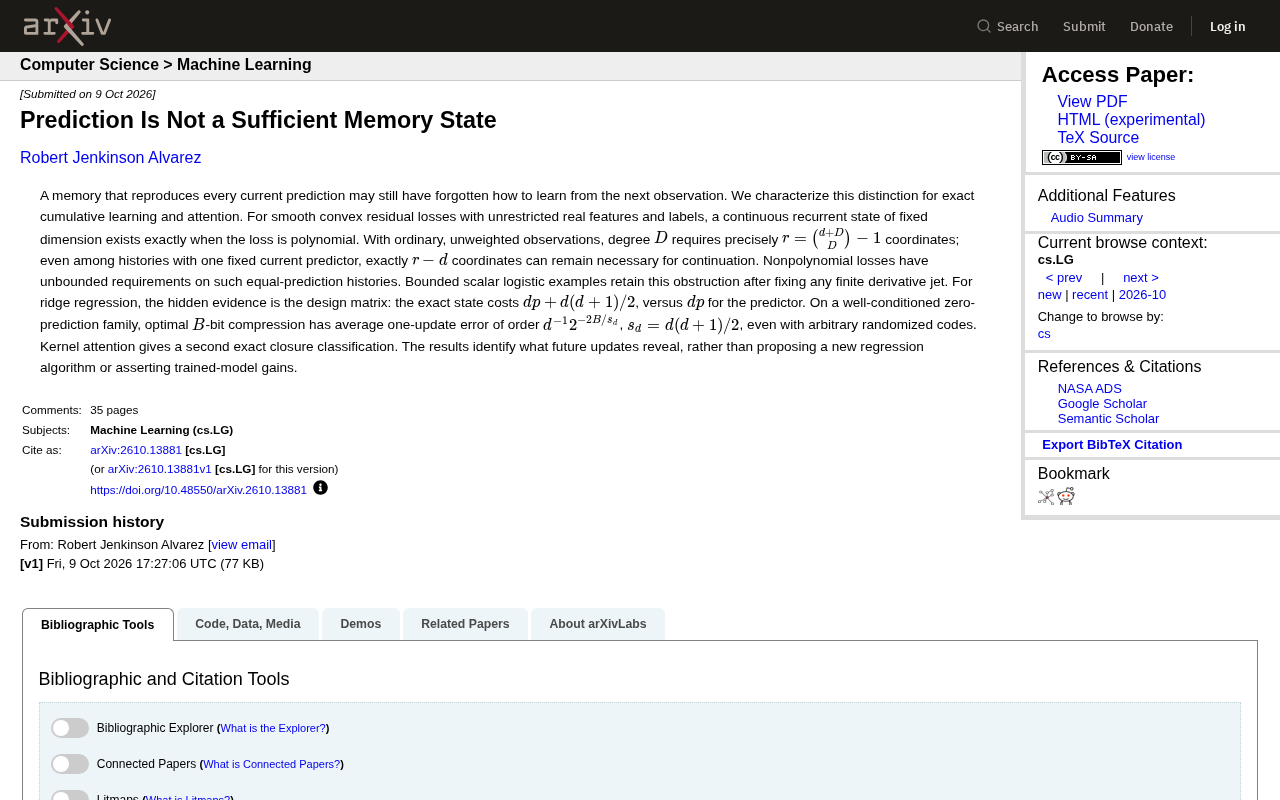
This paper rigorously proves a counterintuitive result: in online/cumulative learning, a memory state that fully reproduces current predictions is fundamentally different from one that can accurately execute the next update. The core theorem shows a fixed-dimensional exact recursive state exists if and only if the loss is a polynomial, requiring exactly $\binom{d+D}{D}-1$ coordinates; non-polynomial losses like logistic have unbounded state requirements. Ridge regression illustrates this concretely: exact learning requires storing $d(d+1)/2$ extra dimensions of covariance structure invisible in the predictor. The analysis extends to kernel attention with a second exact closure classification.
An Overlooked Distinction: Reproducing Predictions ≠ Preserving Learning Ability
In the theoretical study of machine learning and online learning, there has long been a default intuition: if a memory state can accurately reproduce all of a model's current predictions, it seems to have "remembered" enough. But a paper titled Prediction Is Not a Sufficient Memory State draws a far more profound distinction — a memory that can reproduce every current prediction may have already lost the ability to continue learning from the next observation.
In other words, "prediction sufficiency" and "learning sufficiency" are two different things. A model that appears consistent right now does not necessarily retain all the internal evidence needed to continue updating accurately. This work precisely characterizes the mathematical boundary of this gap in the context of cumulative learning and attention mechanisms.
Polynomial Losses Are the Key to Finite-Dimensional Memory
One of the paper's central results concerns when a fixed-dimensional continuous recursive state exists. For smooth convex residual losses — where both features and labels are unconstrained real numbers — the paper proves: a fixed-dimensional exact continuous recursive state exists if and only if the loss function is a polynomial.
This result is remarkably sharp. It means that for non-polynomial losses, it is mathematically impossible to exactly encode "learnable" information into a finite-dimensional state — the required dimensionality is unbounded.
Exact Coordinate Counts
For ordinary, unweighted observations, the paper provides an exact coordinate count: when the loss is a degree-$D$ polynomial, exactly $r = \binom{d+D}{D} - 1$ coordinates are needed. More subtly, even among all histories that share the same fixed current predictor, as many as $r - d$ coordinates may still be necessary for continued learning.
This is the quantitative expression of "prediction is not memory": fixing the current predictor (which accounts for $d$ degrees of freedom), the remaining $r - d$ dimensions still cannot be discarded without introducing errors in subsequent updates. Histories that agree on predictions may hide a deep chasm in learning capacity.
Recursive state is a core concept in online learning: as data arrives one sample at a time, the model must "compress" all past observations into a fixed-structure internal state for future updates. A "continuous recursive state" requires this compression map to be continuous with respect to the data; "fixed dimensionality" requires the state vector's coordinate count not to grow with the number of observations. Cumulative learning is the central scenario of this framework: the model updates sequentially on streaming data, each step based on the current state rather than recomputing from the full history, so the informational sufficiency of the state directly determines the accuracy of every future update. The paper's contribution lies in moving beyond the weak condition of "prediction consistency" and asking: what kind of state guarantees that every gradient update is exactly identical to that of a model that has seen the full history?
Unbounded Barriers for Non-Polynomial Losses
The paper further shows that non-polynomial losses face unbounded state requirements on histories that agree on predictions. Even for bounded scalar losses like the logistic loss — a common example — this barrier persists after fixing any finite-order derivative jet.
This has a practical warning: the logistic loss, widely used in logistic regression and classification tasks, does not enjoy the "finite dimensions suffice for exact continued learning" property that polynomial losses possess. Exactly preserving learning capacity would theoretically require unbounded memory overhead.
Derivative jet is a concept from calculus and differential geometry referring to the ordered collection of all partial derivatives of a function at a point up to order $k$. In this paper's context, "fixing any finite-order derivative jet" means: even if we know all finite-order derivative information of the loss with respect to the parameters, a non-polynomial loss like logistic still cannot be exactly captured in a finite-dimensional state for learning purposes. The strength of this result lies in ruling out all "polynomial approximation" escape routes — any finite truncation will introduce error at some learning step, because the Taylor expansion of a non-polynomial function has infinitely many terms, each potentially carrying independent information needed for future updates.
Ridge Regression: The Hidden Evidence Is the Design Matrix
The paper uses ridge regression as a concrete, illuminating example. The key insight is: the truly hidden "evidence" is the design matrix, not just the predictor itself.
- Storing only the predictor costs $dp$;
- An exact learning state costs $dp + d(d+1)/2$.
The extra $d(d+1)/2$ terms correspond to the second-order covariance structure in the design matrix. It doesn't show up in the current predictions, yet it determines how the next update should be performed.
Information-Theoretic Lower Bounds on Compression
The paper also provides quantitative compression results. On a well-conditioned zero-prediction family, the optimal $B$-bit compression incurs an average per-step update error of order $d^{-1} 2^{-2B/s_d}$, where $s_d = d(d+1)/2$.
Notably, this lower bound cannot be circumvented even with arbitrary randomized encoding. It establishes, from an information-theoretic perspective, the precision limit of "approximately preserving learning capacity with finite bits," advancing the question from "is it possible?" to "what is the geometry of the cost?"
Design matrix in regression analysis is the matrix formed by stacking all input feature vectors as rows, denoted $X \in \mathbb{R}^{n \times d}$. In ridge regression, the optimal solution is $(X^\top X + \lambda I)^{-1} X^\top y$, where $X^\top X$ is a $d \times d$ covariance matrix containing $d(d+1)/2$ independent elements (due to symmetry). Storing only the predictor (i.e., the current parameter vector $\hat{w} \in \mathbb{R}^d$, at cost $dp$) discards this covariance structure: when a new sample arrives, $X^\top X$ cannot be recovered from $\hat{w}$, making it impossible to execute the correct ridge regression update. The extra $d(d+1)/2$ coordinates are precisely what is needed to store $X^\top X$ — a sufficient statistic that is more "fundamental" than the predictor itself, yet indispensable for continued learning.
A Second Exact Closure Classification for Attention Mechanisms
Beyond cumulative learning, the paper extends the same analytical framework to kernel attention, yielding a second exact closure classification. This means the attention mechanism — a core component of modern architectures — also falls within the theoretical landscape of "prediction sufficiency vs. learning sufficiency."
For researchers interested in the intrinsic expressive capacity of Transformers and attention, this closure classification offers a new lens: under what conditions can an attention state exactly carry the information needed for future updates?
Kernel attention replaces the softmax operation in standard attention with a general positive-definite kernel function: $\text{Attn}(Q,K,V)_i = \sum_j k(q_i, k_j) v_j / \sum_j k(q_i, k_j)$, where $k(\cdot,\cdot)$ is a kernel function. This framework unifies standard Transformer attention (corresponding to an exponential kernel) as well as linear attention, polynomial attention, and other variants. Exact closure means there exists a finite-dimensional state space such that the sequential computation of attention can be expressed exactly as a recursion — when a new token arrives, only this state needs to be updated, without rescanning the full context. The classification theorem in the paper answers "which kernel functions allow this exact recursion," theoretically echoing the engineering practice of approximating standard attention with linear attention via matrix accumulation, while also identifying the fundamental limitation of standard softmax attention within this framework.
What This Work Says — and What It Doesn't
The authors are notably restrained in defining the scope of their research at the end of the paper — and this is worth highlighting on its own. The paper explicitly states that it is not proposing a new regression algorithm, nor claiming performance improvements in trained models.
The question it aims to answer is more foundational: what information do future updates actually reveal? What must be retained in the memory state, and what can safely be discarded? This is a precise analysis of the concept of "memory sufficiency," not an engineering speedup or efficiency gain.
This framing only makes the conclusions weightier. It reminds us: when designing any system that relies on compact states for online or incremental learning, "are the predictions consistent?" is not a valid criterion for state sufficiency. The real question is — can this state still learn something from the next observation?
Related articles

Chain of Thought Isn't Just for AI: How Humans Can Use CoT to Improve Thinking Quality
Chain of Thought isn't just a prompt trick for large models. Starting from a Hacker News discussion, this article analyzes why CoT works for human thinking too, breaks down actionable ways to transfer it, and highlights the key differences between human CoT and machine CoT.
Cloudflare Teams Up with OpenAI: Closi…
Cloudflare Teams Up with OpenAI: Closing the Loop from Vulnerability Discovery to Defense with AI
Cloudflare uses OpenAI Daybreak to investigate security vulnerabilities and generate reviewable remediation plans, while developers use Codex to boost coding efficiency and quality.

Orca Multi-Agent Orchestration in Practice: A Guide to Parallel Collaboration with Claude and Codex
Orca is Stable AI's free open-source agent workbench supporting 34 agents like Claude Code and Codex in parallel. Learn its Git worktree isolation, multi-model orchestration, and mobile management.