Prediction-Powered Data Fusion: Improving the Precision of Causal Effect Estimation

A new study proposes a prediction-powered data fusion framework that improves estimation precision by leveraging observational data while maintaining RCT unbiasedness.
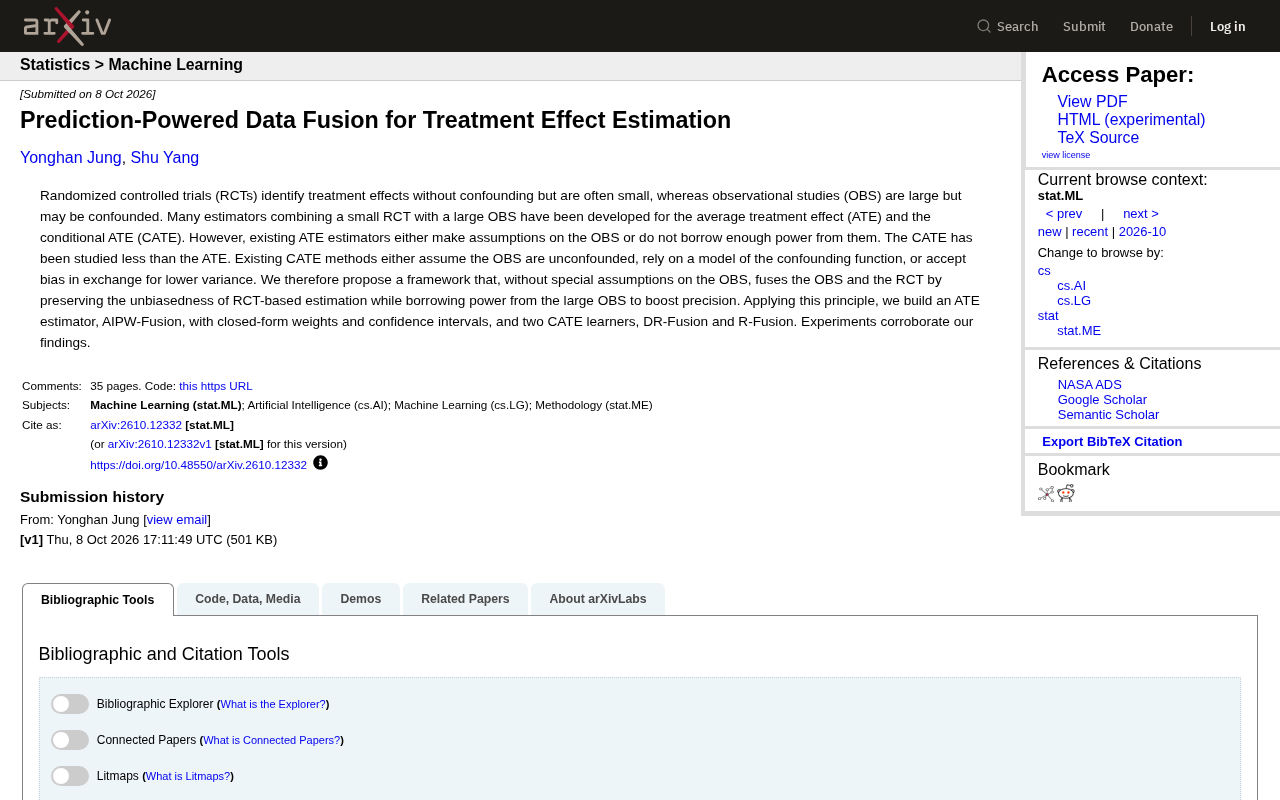
This study addresses a long-standing challenge in causal inference—how to leverage large-scale observational studies (OBS) to improve estimation precision while maintaining the unbiasedness of randomized controlled trials (RCTs)—by proposing a "Prediction-Powered Data Fusion" framework. Existing ATE estimators either impose strong assumptions such as unconfoundedness on OBS or trade bias for lower variance; CATE methods are even weaker. The new framework uses the unbiased RCT estimate as an anchor and transfers OBS information into the estimation process through machine learning prediction models, without requiring the two data sources to be identically distributed or making strong assumptions about the confounding mechanism. The study constructs three estimators: AIPW-Fusion (ATE) and DR-Fusion and R-Fusion (CATE), among which AIPW-Fusion has closed-form weights and confidence intervals, making it convenient for practical application.
Randomized controlled trials (RCTs) are widely recognized as the gold standard for identifying causal effects because randomization eliminates confounding factors. However, RCTs typically have small sample sizes, resulting in insufficient estimation precision. In contrast, observational studies (OBS) may suffer from confounding despite their large sample sizes. How to integrate the strengths of both has been a long-standing challenge in causal inference. A new study proposes a "Prediction-Powered Data Fusion" framework that attempts to maintain the unbiasedness of RCTs while leveraging OBS to improve precision—without relying on special assumptions.
The Dilemma of Existing Methods
According to the study's analysis, existing average treatment effect (ATE) estimators fall roughly into two categories. The first imposes additional assumptions on OBS, such as assuming OBS is unconfounded or building a model of the confounding function; the second directly accepts bias in exchange for lower variance. Both strategies come at a clear cost: the former may produce severe bias when its assumptions fail, while the latter sacrifices the unbiasedness guarantee that is most central to causal inference.
Research on conditional average treatment effects (CATE) is even thinner. Existing CATE methods either assume OBS is unconfounded by default, rely on correct modeling of the confounding function, or compromise between bias and variance. This situation means that when researchers face a large but potentially confounded observational dataset, they lack robust tools to fully exploit its information.
Inverse probability weighting (IPW) is a classic method for estimating ATE in causal inference: for each individual, the inverse of their probability of receiving the actual treatment (the propensity score) is used as a weight to construct a weighted average of outcomes in the treatment and control groups. The unbiasedness of IPW depends on the propensity score model being correctly specified; if the model is misspecified, the estimate may be significantly biased. Moreover, when propensity scores approach 0 or 1, weights become extremely large, causing variance inflation—this is precisely an important reason why IPW estimates lack precision in small-sample RCTs, and it is also the motivation for fusing OBS information to reduce variance.
The Core Idea of Prediction-Powered Fusion
The framework proposed in this study bypasses special assumptions about OBS. Its basic logic is: using the unbiased estimate from the RCT as an anchor, it "transfers" information from OBS into the RCT estimation process through a prediction model, thereby reducing variance while maintaining unbiasedness.
The key to this idea is "prediction-powered"—using machine learning models to predict outcome or treatment variables and using the predictions as a bridge for fusion. Unlike traditional meta-analysis or weighting methods, prediction-powered fusion does not require OBS and RCT to come from the same distribution, nor does it require strong assumptions about the confounding mechanism.
In terms of implementation, the research team built three tools: AIPW-Fusion for estimating ATE, and DR-Fusion and R-Fusion for estimating CATE. Among them, AIPW-Fusion has closed-form weights and confidence intervals, making it convenient for practical application.
The AIPW (augmented inverse probability weighting) estimator combines IPW with an outcome regression model and has double robustness: as long as either the propensity score model or the outcome model is correctly specified, the estimate remains consistent. Its form is the IPW term plus an augmentation term based on the predicted residuals from the outcome model; the latter can correct bias caused by misspecification of the propensity score model. The variance of AIPW is usually lower than that of pure IPW, and it reaches the semiparametric efficiency bound when both models are correct. AIPW-Fusion uses AIPW as its backbone and embeds predictions from OBS into the augmentation term, thereby further reducing variance while maintaining unbiasedness.
Design of the Three Estimators
The core idea of AIPW-Fusion is to fuse inverse probability weighting (IPW) from the RCT with predictions from OBS. The existence of closed-form weights means researchers can obtain estimates without numerical optimization, which significantly reduces computational cost in large-scale data settings. At the same time, the analytical form of the confidence intervals also facilitates statistical inference.
DR-Fusion and R-Fusion target the CATE setting. DR-Fusion adopts a doubly robust strategy, combining predictions from the outcome model and the treatment model, and can remain consistent when one of the models is misspecified. R-Fusion is more concise and may adopt an approach similar to regression adjustment. Both attempt to leverage OBS without introducing additional assumptions about the confounding structure.
CATE (conditional average treatment effect) characterizes how the treatment effect depends on individual characteristics X, that is, τ(x)=E[Y(1)−Y(0)|X=x], and is a core quantity in scenarios such as precision medicine and heterogeneous policy evaluation. Unlike ATE, which estimates only a single population average, CATE requires estimating a function, making it more sensitive to sample size and model specification. In RCTs, CATE estimates are often unstable due to small sample sizes; OBS may be large but potentially confounded. The goal of DR-Fusion and R-Fusion is precisely to stabilize CATE estimation by drawing on the large-sample information in OBS, without assuming OBS is unconfounded.
Experimental Validation and Significance
The study validated the effectiveness of the proposed methods through experiments. Although the original abstract did not disclose specific datasets and numerical results, the statement that "experiments confirmed our findings" indicates that, at least on simulated or semi-synthetic data, the fusion methods outperformed existing baselines.
From a broader perspective, the value of this work lies in providing a "safe" fusion paradigm—researchers do not have to make a painful trade-off between unbiasedness and precision. For researchers in fields such as medicine, economics, and sociology, this means that when they only have a small-scale RCT and a large observational database on hand, they can combine information from both more confidently. However, the actual performance of the method still depends on the quality of the prediction model; if the difference between OBS and RCT is too large, the effect of prediction transfer may be limited.
Semi-synthetic data is a commonly used tool in the evaluation of causal inference methods: based on real data (such as RCT or OBS covariates), treatment assignment mechanisms and outcome generation processes are artificially specified, thereby testing the bias and variance of estimators under known true causal effects. Compared with purely simulated data, semi-synthetic data preserves the distributional characteristics of real data, making evaluation results more externally valid. If this study used such data for validation, it could simultaneously examine the robustness of the method under different confounding strengths and different sample size ratios.
One-line Summary
A new study proposes a prediction-powered data fusion framework that improves estimation precision by leveraging observational data while maintaining the unbiasedness of RCTs.
Paragraph Summary
To address the long-standing challenge in causal inference—how to leverage large-scale observational studies (OBS) to improve estimation precision while maintaining the unbiasedness of randomized controlled trials (RCTs)—this study proposes a "Prediction-Powered Data Fusion" framework. Existing ATE estimators either impose strong assumptions on OBS such as unconfoundedness or trade bias for lower variance; CATE methods are even weaker. The new framework uses the unbiased RCT estimate as an anchor and transfers OBS information into the estimation process through machine learning prediction models, without requiring the two data sources to be identically distributed or making strong assumptions about the confounding mechanism. The study constructs three estimators: AIPW-Fusion (ATE) and DR-Fusion and R-Fusion (CATE), among which AIPW-Fusion has closed-form weights and confidence intervals, making it convenient for practical application.
Related articles

Chain of Thought Isn't Just for AI: How Humans Can Use CoT to Improve Thinking Quality
Chain of Thought isn't just a prompt trick for large models. Starting from a Hacker News discussion, this article analyzes why CoT works for human thinking too, breaks down actionable ways to transfer it, and highlights the key differences between human CoT and machine CoT.
Cloudflare Teams Up with OpenAI: Closi…
Cloudflare Teams Up with OpenAI: Closing the Loop from Vulnerability Discovery to Defense with AI
Cloudflare uses OpenAI Daybreak to investigate security vulnerabilities and generate reviewable remediation plans, while developers use Codex to boost coding efficiency and quality.

Orca Multi-Agent Orchestration in Practice: A Guide to Parallel Collaboration with Claude and Codex
Orca is Stable AI's free open-source agent workbench supporting 34 agents like Claude Code and Codex in parallel. Learn its Git worktree isolation, multi-model orchestration, and mobile management.