Preliminary Report on October 21st Security Incident: HN Discussion
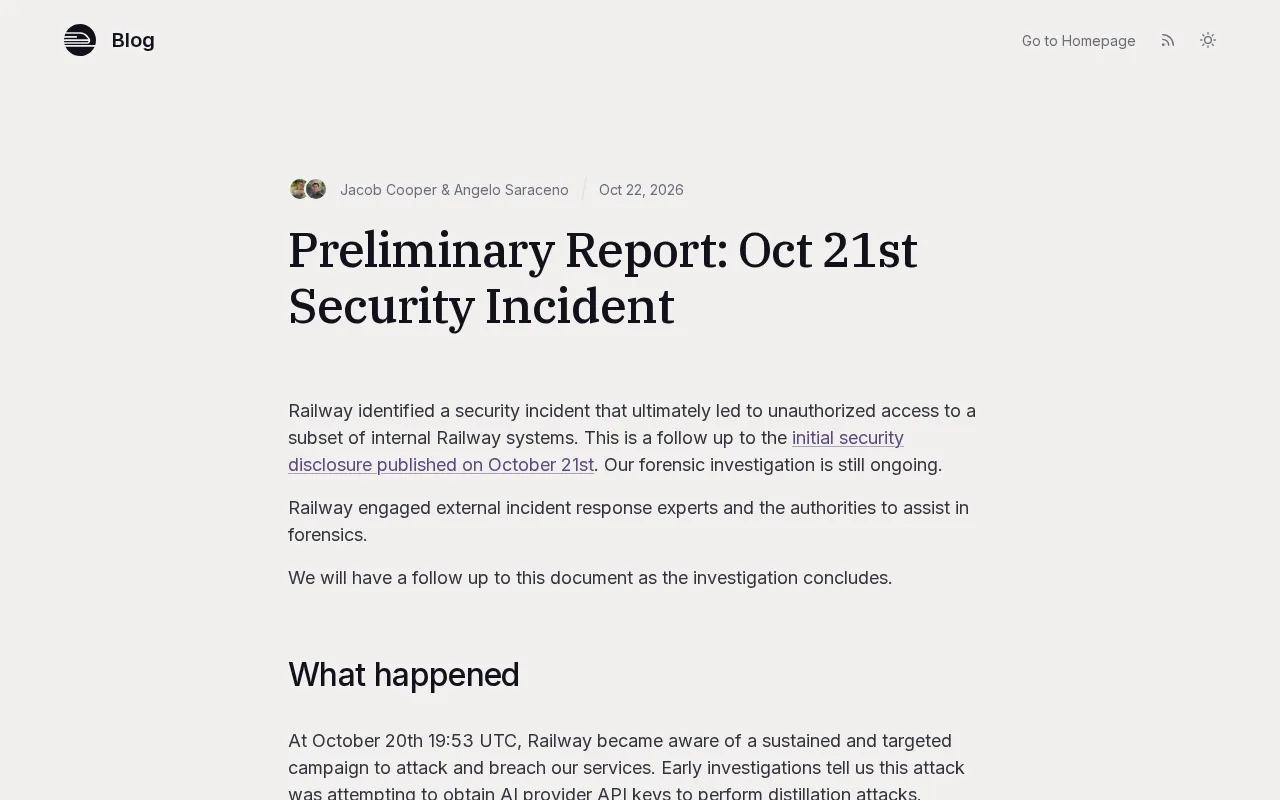
Hacker News discusses a preliminary report on an October 21st security incident, with low activity and limited information.
A Hacker News post titled "Preliminary Report Oct 21st Security Incident" provides only a title and link, without revealing the affected entity, vulnerability type, or scope. The article notes that preliminary reports appear at the earliest stage of incident response, valued for disclosing the timeline, known facts, and handling status rather than final conclusions. The date anchor suggests relatively prompt communication, a positive signal, though content may be revised. A qualified preliminary report should include discovery time, impact scope, containment measures, and update expectations. With only 9 points and 1 comment, community reaction is restrained; readers should follow updates and avoid over-speculation.
A post titled "Preliminary Report Oct 21st Security Incident" has appeared on Hacker News, drawing community attention. The post itself only provides the title and a link to the preliminary report, without revealing the affected entity, vulnerability type, or scope of impact in the title—but the phrase "preliminary security incident report" alone is enough to pique the technical community's curiosity.
Why the Preliminary Report Deserves Attention
A "preliminary report" on a security incident typically appears at the earliest stage of incident response: the organization has confirmed the incident occurred, but root cause analysis, impact assessment, and remediation plans are not yet fully finalized. The value of such documents lies not in providing final conclusions, but in disclosing the timeline, known facts, and current handling status.
Judging from the discussion activity on Hacker News (9 points, 1 comment), this post is still in its early fermentation stage, and the community reaction is relatively restrained. This fits the typical characteristics of preliminary report content—limited information, with discussion focused more on "what happened" rather than "how should we interpret it."
Incident Response is a structured handling process that an organization initiates after confirming a security incident, typically including six phases: preparation, identification, containment, eradication, recovery, and lessons learned. Preliminary reports generally appear at the end of the "identification" phase or the beginning of the "containment" phase, when the organization has confirmed the incident's authenticity but has not yet completed comprehensive forensics. Commonly referenced frameworks in the industry include NIST SP 800-61 and the SANS six-step incident response process, both of which emphasize synchronized external communication in the early stages to avoid information vacuums that breed speculation. Preliminary reports are valued by the security community because they often more authentically reflect an organization's response speed and willingness to communicate than final reports—final reports can be polished repeatedly, but the timestamps and content choices of preliminary reports are difficult to embellish after the fact.
What Can Be Read from the Title
The date "Oct 21st" in the title indicates that this is an incident report with a time anchor, suggesting the organization released information to the public shortly after the incident occurred rather than delaying disclosure for weeks. This timeliness is generally a positive signal in security incident communication, but it may also mean the report's content will be substantially revised as the investigation deepens.
The wording "Security Incident" is relatively broad—it could refer to a data breach, unauthorized access, or involve a supply chain attack or insider threat. In the absence of more details, readers should treat this report as a starting point rather than a conclusion.
"Time anchors" in security incident communication refer to reports that mark the occurrence or disclosure time point with a specific date, making it easier for external observers to establish a timeline. At the compliance level, data breach notification regulations in many jurisdictions (such as GDPR Article 33, which requires notification to supervisory authorities within 72 hours) impose hard deadlines on disclosure, so date anchors also indirectly reflect whether an organization faces compliance pressure. However, there is an inherent tension between quickly publishing a preliminary report and information accuracy: early disclosures may be revised or even overturned as the investigation deepens. Mature organizations typically explicitly note in preliminary reports that "information is subject to change" and provide an expected time for the next update to manage external expectations.
Implications for Security Practitioners
For readers focused on security operations, such preliminary reports are a window into an organization's incident response maturity. A qualified preliminary report should at minimum include: the time the incident was discovered, the currently known scope of impact, containment measures already taken, and the expected time of the next update. Reports missing these elements often leave external observers and affected parties in an information vacuum.
The Hacker News community is known for its technical detail and skeptical spirit in discussions of security incidents. Even though there are currently few comments, if the report discloses more technical details later, the discussion is likely to heat up quickly. It is advisable to follow subsequent updates to the post and whether the report's publisher provides staged progress as promised.
Containment is a key action in incident response to prevent the spread of impact, with common measures including isolating affected hosts, revoking credentials, blocking malicious IPs, or taking compromised services offline. Whether containment measures are disclosed in a preliminary report is an important signal for judging an organization's response maturity: a report that only describes "investigation ongoing" without mentioning any containment actions often means the response is still in a chaotic phase. Additionally, impact scope assessment in the early stages can typically only provide conservative "known affected" numbers because comprehensive investigation has not yet been completed. Security practitioners reading such reports should distinguish between "known facts" and "current judgments," and pay attention to whether the report promises staged updates—this reflects an organization's long-term communication mechanisms better than the level of detail in a single disclosure.
Conclusion
The currently available information is limited to the title and the preliminary report itself, and this article does not excessively speculate on the nature of the incident. For security incidents, the accuracy of early information is often limited, and readers should remain cautious and defer to official follow-up announcements.
One-line Summary
Hacker News discusses a preliminary report on an October 21st security incident, with low activity and limited information so far.
Paragraph Summary
A post titled "Preliminary Report Oct 21st Security Incident" has appeared on Hacker News, providing only the title and a link to the preliminary report without revealing the affected entity, vulnerability type, or scope of impact. The article notes that preliminary reports on security incidents appear at the earliest stage of incident response, and their value lies in disclosing the timeline, known facts, and handling status rather than final conclusions. The date anchor in the title indicates the organization communicated externally relatively quickly after the incident—a positive signal, but it also means the content may be revised. A qualified preliminary report should include the discovery time, scope of impact, containment measures, and update expectations. The current post has only 9 points and 1 comment, with restrained community reaction; readers are advised to follow subsequent updates and avoid excessive speculation about the incident's nature.
Related articles

OpenAI Breaks ETH? P=NP Could Upend the Cryptography World
OpenAI reportedly disproved ETH with a sub-exponential algorithm, sparking P=NP speculation. What it means for RSA, blockchain, and protein folding.
When an Anti-Fingerprinting Script Is …
When an Anti-Fingerprinting Script Is Flagged as a Bioweapon: The Detection Dilemma of Security Tools
An anti-fingerprinting script was flagged as a bioweapon by security scanning, sparking Hacker News debate. This analysis covers the causes of keyword-matching false positives, how developers respond, and the long-term imbalance between automation and precision in security tools.
41,000 DHS Employee Records Leaked, Including Undercover ICE Agents
Data breach exposes 41,000 DHS employees, including undercover ICE agents. Analysis of sensitive data risks, law enforcement security gaps, and protection measures like access control and auditing.