Preparing for AI Certifications: Understanding Concepts Matters More Than Memorization

Ace AI certifications by understanding concepts, not memorizing answers — and always verify against official docs.
Drawn from a Reddit user's study experience, this article argues that memorizing answers instead of understanding concepts is the most common trap in AI certification prep. The author proposes a "wrong answer → trace the concept → verify from a new angle" learning loop, treating practice questions as diagnostic tools rather than answer banks. Because AI tools evolve rapidly, rote memorization has an especially short shelf life in this domain. Third-party platforms like ClaudeMock are valuable for their structured combination of materials and mock exams — but official Anthropic documentation should always serve as the final verification baseline.
Don't Turn Practice into Answer Memorization
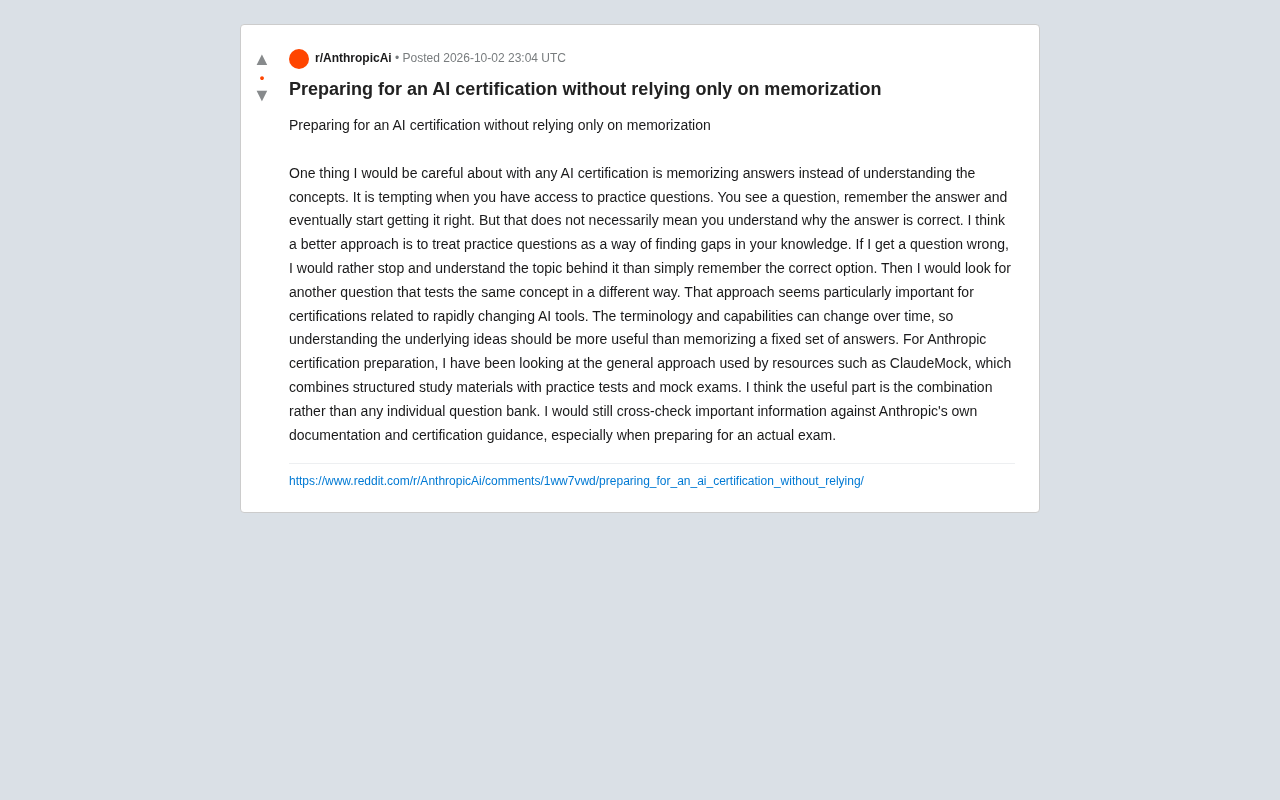
One of the easiest traps when studying for any AI certification is this: memorizing answers instead of understanding concepts. The temptation is especially strong when you have a large bank of practice questions — you see a question, remember the correct option, run through it a few times, and start getting it right consistently. But that doesn't mean you actually understand why that answer is correct.
A Reddit user's study tips highlighted a widely overlooked problem in AI certification prep: the "high scores" built through memorizing question banks are often an illusion of knowledge. The moment exam questions are rephrased or reframed, that accuracy built on muscle memory collapses instantly.
Use Practice Questions as a Diagnostic Tool
A more effective approach is to treat practice questions as a way to identify gaps in your knowledge — not as a collection of answers to accumulate.
The author offers a concrete, actionable methodology: when you get a question wrong, instead of just memorizing the correct option, stop and thoroughly understand the underlying concept. Once you've got it, find another question that tests the same concept from a different angle to verify that you've truly internalized it.
This "wrong answer → trace back the concept → verify from a new angle" loop is fundamentally training your ability to transfer understanding of core principles — not conditioning a reflex response to a specific question format. This approach is slower, but retention and real-world performance are far more reliable.
Why This Is Especially Critical for AI Certifications
The author specifically emphasizes that this understanding-first learning method is especially important for certifications tied to rapidly evolving AI tools.
Terminology, product capabilities, and feature boundaries in the AI space are in constant flux. A "standard answer" you memorize today might no longer be accurate a few months later once the tool has been updated. Understanding the underlying logic and core principles, by contrast, is far more durable — foundational concepts don't become outdated as quickly as feature lists do. In other words, rote memorization has an even shorter "shelf life" for AI certifications than it does in traditional technical fields.
This has concrete real-world backing in the AI certification space. Take Anthropic's Claude-related certifications as an example: the model's capability boundaries, API parameters, safety policies, and best practice documentation are updated with each model iteration — sometimes even within the same certification cycle. Unlike traditional IT certifications (such as networking protocols or database fundamentals), the "correct usage" of AI tools is itself a moving target. What constitutes responsible prompt design or compliant API usage evolves alongside industry consensus and vendor policy. This means that memorizing "how a feature currently behaves" — rather than understanding "the design intent and applicable principles behind that feature" — depreciates exceptionally fast in AI certification prep.
How to Actually Use Study Resources
For preparing for Anthropic-related certifications, the author mentions drawing on resources like ClaudeMock for their overall approach: combining structured learning materials, practice quizzes, and mock exams.
What's worth noting is the author's key insight — the value isn't in any single question bank, but in that combination. A standalone question bank can easily devolve into an answer-memorization tool, whereas a combination of structured materials and mock exams has the potential to support genuine conceptual learning: learning materials build a conceptual framework, practice questions locate blind spots, and mock exams assess overall readiness.
Always Verify Against Official Documentation
Regardless of which third-party resources you use, the author's final piece of advice is clear: cross-reference important information against Anthropic's own official documentation and certification guides — especially when preparing for the actual exam.
This is particularly worth heeding in the AI certification context. Third-party question banks and prep platforms inevitably have information lags or interpretive gaps, while official documentation is the sole authoritative source for capability definitions and exam scope. Using official materials as your final verification baseline effectively prevents you from being misled by outdated or incorrect "standard answers."
ClaudeMock is a third-party prep platform for Anthropic certifications, offering mock question banks and structured learning paths. Platforms like this operate similarly to the prep ecosystems for other technical certifications (such as AWS or Google Cloud): they cover exam syllabus topics through practice questions and help learners identify weak areas before the official exam. However, third-party prep resources have a structural limitation — their content update cycle typically lags behind vendors' official documentation, and their explanations of certain concepts may carry subtle deviations from Anthropic's official stance. This is precisely why the author emphasizes that the combination approach is more valuable than the question bank itself — it's a reminder that how you use a resource determines whether it becomes a scaffold for understanding or a substitute for memory.
A Final Thought
This post is brief, but the learning philosophy behind it applies to almost every technical certification: the certificate itself is just an outcome. What's truly valuable is the genuine understanding built during the process. For AI practitioners, the point of getting certified shouldn't be to obtain a credential with an expiration date — it should be to use the preparation process as an opportunity to systematically organize your understanding of the tools and principles involved.
Treat practice questions as a mirror, not an answer key. Treat third-party resources as supplements, not authorities. Treat official documentation as your baseline. This methodology holds up in any fast-moving technical field.
Related articles

Chain of Thought Isn't Just for AI: How Humans Can Use CoT to Improve Thinking Quality
Chain of Thought isn't just a prompt trick for large models. Starting from a Hacker News discussion, this article analyzes why CoT works for human thinking too, breaks down actionable ways to transfer it, and highlights the key differences between human CoT and machine CoT.
Cloudflare Teams Up with OpenAI: Closi…
Cloudflare Teams Up with OpenAI: Closing the Loop from Vulnerability Discovery to Defense with AI
Cloudflare uses OpenAI Daybreak to investigate security vulnerabilities and generate reviewable remediation plans, while developers use Codex to boost coding efficiency and quality.

Orca Multi-Agent Orchestration in Practice: A Guide to Parallel Collaboration with Claude and Codex
Orca is Stable AI's free open-source agent workbench supporting 34 agents like Claude Code and Codex in parallel. Learn its Git worktree isolation, multi-model orchestration, and mobile management.