Pretrained on Ten Physiological Signals, CARMEN Reshapes Perioperative and Critical Care

CARMEN uses a single encoder pretrained unsupervised on ten cardiopulmonary waveforms, breaking the ECG-centric limitation.
The article introduces CARMEN, a physiological waveform foundation model. Existing models rely almost entirely on ECG and photoplethysmography, mismatching the multi-waveform decisions in perioperative and critical care. CARMEN uses a single encoder pretrained unsupervised on ten cardiopulmonary waveforms across 2.27M modality-hours, accepting any co-recorded signal combination and 10-second to 5-minute windows. Its LSCNorm mechanism restores absolute signal levels erased by normalization; removing it drops intraoperative hypotension AUROC from 0.894 to 0.780. On 19 tasks, the frozen encoder mostly beats supervised models and three foundation models, with no task surpassed; it matches or exceeds signal-specific models using only ECG or photoplethysmography, and maintains performance with missing channels. The authors see a viable path to multi-signal general-purpose foundation models, though cross-population and cross-device generalization needs external validation.
From ECG to ten waveforms: the blind spot of physiological foundation models
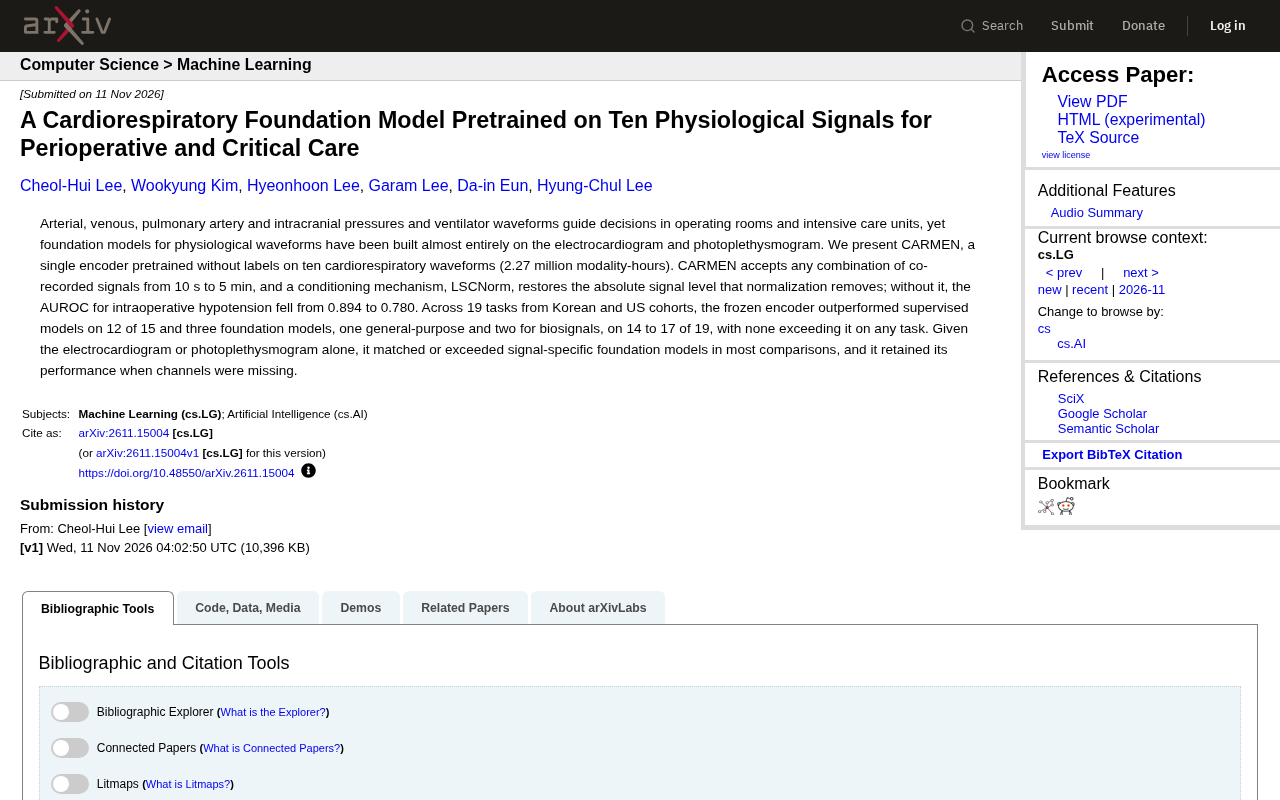
In perioperative and critical care settings, the waveforms clinicians truly rely on go far beyond the ECG. Arterial pressure, venous pressure, pulmonary artery pressure, intracranial pressure, and ventilator waveforms all guide every decision. Yet existing physiological waveform foundation models are built almost entirely on ECG and photoplethysmography. According to a new study, there is a clear mismatch between this single-signal approach and real clinical needs. CARMEN is proposed against this backdrop: a single encoder pretrained in an unsupervised manner on ten cardiopulmonary waveforms, covering 2.27 million modality-hours of data.
One encoder, any signal combination
CARMEN's design goal is not to replace any single specialty model, but to provide a general-purpose backbone that can "read" multiple waveforms. It accepts any combination of co-recorded signals, with time windows flexibly ranging from 10 seconds to 5 minutes. This means the same encoder can handle scenarios with only ECG, or ingest a complete data stream containing multiple pressure and respiratory waveforms, without training a separate model for each combination.
LSCNorm: recovering the absolute levels lost to normalization
The absolute levels of physiological signals carry critical information, but conventional normalization erases them. CARMEN restores this information through a conditional mechanism called LSCNorm. The study provides an intuitive comparison: without LSCNorm, the AUROC for intraoperative hypotension prediction drops from 0.894 to 0.780. This gap shows that for tasks relying on absolute pressure thresholds, such as hypotension, preserving signal levels is not a nice-to-have but the dividing line between a usable and unusable model.
Normalization and absolute levels: In signal processing and deep learning, normalization (such as z-score or min-max) scales each sample or channel to a uniform range to eliminate inter-individual amplitude differences and stabilize training. But it is also a form of "information discard": after z-score, the signal mean is zeroed and variance normalized, flattening absolute levels such as whether the mean arterial pressure is 65 mmHg or 90 mmHg. For morphology-dominant signals like ECG, where amplitude is secondary, the impact is limited; but for signals like blood pressure and intracranial pressure where absolute thresholds drive decisions, it is a fatal loss. LSCNorm's approach is conditional normalization: first perform conventional standardization with statistics, then inject the removed scale and offset as a conditioning vector into the network, so the model can obtain scale-invariant morphological features while also reading absolute levels. This is related to mechanisms like FiLM and conditional BatchNorm, with the difference being that it models each channel's physical dimensions separately in multimodal physiological signals.
AUROC: AUROC is the area under the receiver operating characteristic curve, measuring a binary classifier's ability to distinguish positive from negative samples across thresholds. 0.5 equals random guessing, 1.0 is perfect discrimination. A drop from 0.894 to 0.780 means significantly degraded ranking ability, which clinically translates directly into more missed or false hypotension events.
Foundation models and frozen evaluation: Foundation models are general-purpose models pretrained on large-scale unlabeled data that can be adapted to downstream tasks via fine-tuning or prompting. Their core claim is that representations learned during pretraining are transferable. Frozen encoder evaluation is a rigorous test of this claim: pretrained weights remain completely fixed, and only a simple classification head (such as a linear probe) is trained on their output features. If frozen features already approach or exceed end-to-end trained supervised models, it indicates that pretraining has indeed learned general physiological representations rather than relying on downstream data fitting. The paper's finding that "the frozen encoder outperformed 12 supervised models in 15 comparisons" reflects this logic and lowers the deployment barrier for models in annotation-scarce clinical settings.
Modality-hours: This is a unit for measuring data scale in multimodal pretraining, referring to the sum of durations across modalities. For example, 1 hour of data simultaneously recording ECG, arterial pressure, and respiratory signals counts as 3 modality-hours. It better reflects the total volume of cross-signal combinations the model has seen than sample counts or single-signal duration. 2.27 million modality-hours means a large number of co-recorded segments across ten waveforms were included in training.
Performance on 19 tasks: the frozen encoder is already strong enough
The study evaluated CARMEN on 19 tasks from Korean and US cohorts. The key result: the frozen encoder (without fine-tuning) outperformed 12 supervised models in 15 comparisons; against three foundation models (one general-purpose and two biosignal-specific), it won on 14 to 17 of 19 tasks, with no task where an opponent surpassed it.
In more detail, when only ECG or photoplethysmography was provided, CARMEN matched or exceeded signal-specific foundation models in most comparisons. This weakens the conventional assumption of "specialized models for specialized signals"—a model that has seen ten waveforms is not at a disadvantage in single-signal scenarios. Moreover, CARMEN maintains performance when channels are missing, which has practical significance for real clinical environments where sensors detach or signal quality is poor.
Why multi-signal pretraining matters
The value of this work goes beyond benchmark scores. The decision chain in perioperative and critical care is inherently multimodal: blood pressure, respiration, and intracranial pressure corroborate each other, and a single ECG cannot capture the full picture of circulatory failure or ventilation abnormalities. CARMEN absorbs ten waveforms with a unified encoder, essentially enabling the model to learn the shared physiological structure among these signals rather than their individual surface patterns.
From an engineering perspective, the pretraining scale of 2.27 million modality-hours and the unlabeled strategy point to a scalable path: there is no need to annotate each new signal from scratch—just include it in the pretraining corpus. LSCNorm's ablation results also remind future researchers that normalization strategies are not neutral choices for physiological signals; improper handling can directly harm critical tasks.
Current evidence comes from Korean and US cohorts, and generalization across populations and devices still requires more external validation. But based on existing results, CARMEN provides a compelling starting point for physiological waveform foundation models to move from "ECG-centric" to "multi-signal general-purpose."
Co-recording and missing channels: Co-recording refers to synchronous acquisition of multiple signals within the same time window, which is a prerequisite for multi-signal pretraining and also enables the model to learn temporal coupling relationships between signals (such as blood pressure fluctuating with respiration). But in real clinical settings, sensor detachment, lead disconnection, and poor signal quality can cause some channels to be missing. If the model has seen various channel combinations during training, it can be robust to missing channels at inference, typically achieved through masked training with random channel dropout. CARMEN's reported performance retention with missing channels is a direct benefit of this training strategy, and also explains why a unified encoder outperforms specialized models customized for fixed combinations.
One-line Summary
CARMEN uses a single encoder pretrained unsupervised on ten cardiopulmonary waveforms, breaking the ECG-centric limitation.
Paragraph Summary
The article introduces the physiological waveform foundation model CARMEN: existing models are built almost entirely on ECG and photoplethysmography, creating a mismatch with the multi-waveform decisions actually relied upon in perioperative and critical care. CARMEN uses a single encoder pretrained unsupervised on ten cardiopulmonary waveforms covering 2.27 million modality-hours, accepting any combination of co-recorded signals and time windows from 10 seconds to 5 minutes. Its LSCNorm conditional mechanism restores absolute signal levels erased by normalization; removing it drops intraoperative hypotension prediction AUROC from 0.894 to 0.780. On 19 tasks, the frozen encoder mostly outperforms supervised models and three foundation models, with no task surpassed by opponents; it also matches or exceeds signal-specific models when using only ECG or photoplethysmography, and maintains performance with missing channels. The authors see this as a viable path toward multi-signal general-purpose foundation models, though cross-population and cross-device generalization still requires external validation.
Related articles

Abnormal Error Rate Spike in Claude Mythos 5.2 and Fable 5.2
Claude Mythos 5.2 and Claude Fable 5.2 show an abnormal spike in request error rates, marked as investigating on the official status page. This article covers the incident overview, practical impact on developers, and recommended responses.

ReAct Runtime Context Trimming: Why Claude Code Acts at 70%
A deep dive into ReAct runtime context trimming: why Claude Code compresses at ~70% usage, why tool calls dominate, why messages must be dropped in pairs, and why codebases don't need RAG.

AI Agent vs LLM: How Cursor and Claude Code Actually Work
An in-depth analysis of the essential difference between AI Agents and LLMs: LLMs generate code suggestions, while Agents modify files and run tests via tool calls. Using a Spring Boot bug fix as an example, it breaks down the workflows, permission control, and verification mechanisms of Cursor and Claude Code.