Privacy-First AI Security Log Analyzer: Open-Weight Models in Practice

CyberTools Hub AI uses local open-weight models to give non-experts a privacy-first starting point for log troubleshooting.
CyberTools Hub AI is a privacy-first open-source AI log analysis assistant that lowers the barrier to interpreting security logs. It offers four MVP capabilities—explain, summarize, identify, and advise—framing AI output as investigative guidance rather than authoritative verdicts. Using open-weight models like Gemma for local inference, it ensures data control, cost predictability, and reduced vendor dependence. Built on React + FastAPI + SQLite, it emphasizes separating log parsing from AI interpretation and human verification. Target users include cybersecurity students, indie developers, and small IT teams.
Privacy-First AI Security Log Analyzer: Redefining Log Troubleshooting with Open-Weight Models
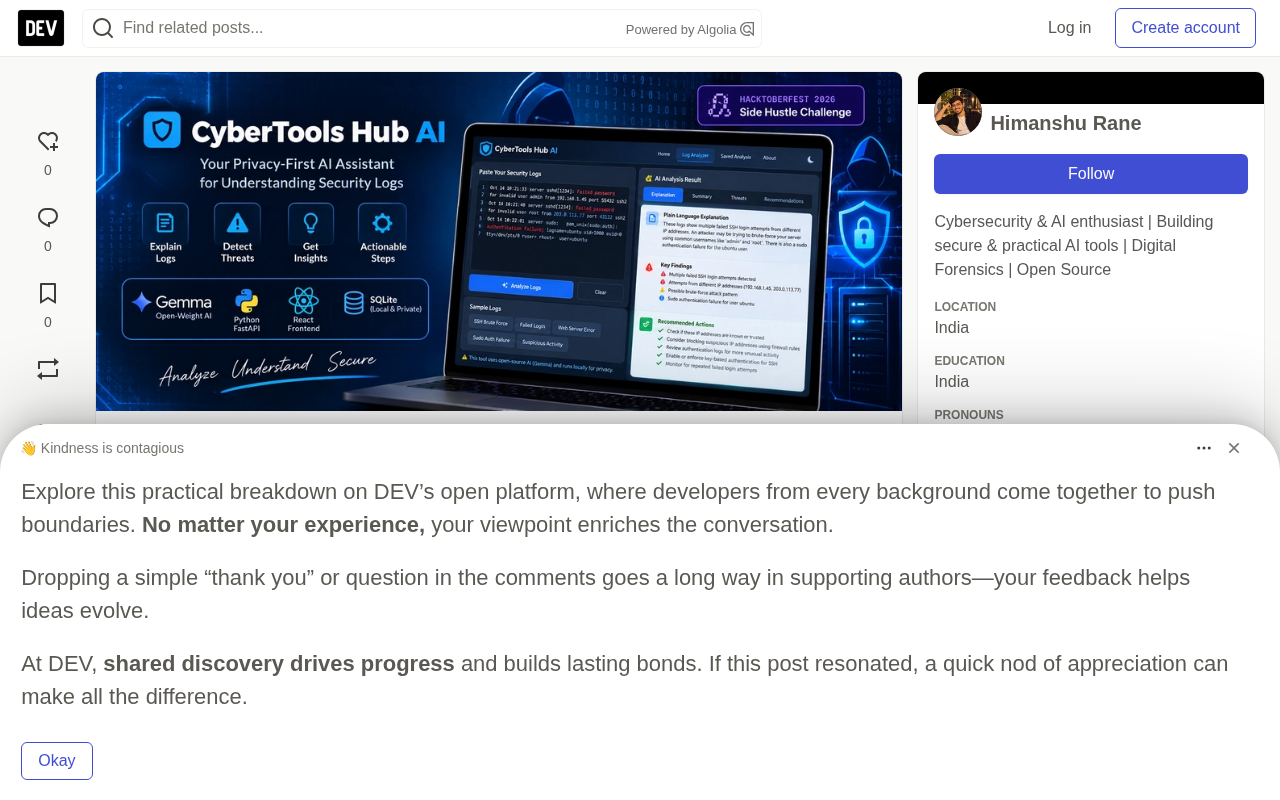
Faced with a cryptic SSH login failure log, an experienced security engineer might judge the risk level in three seconds, but students, indie developers, or small IT teams often spend a great deal of time searching documentation and comparing explanations. CyberTools Hub AI attempts to bridge this cognitive gap using open-weight AI models—its core philosophy is not to replace security analysts, but to give people who don't understand security a trustworthy starting point for troubleshooting.
The Real-World Struggles of Log Analysis
Servers and applications continuously generate logs. These logs record authentication failure attempts, application errors, suspicious access patterns, and a wealth of security events worth noticing. The problem is that this information presents a clear interpretation barrier for developers and ordinary operations staff.
The traditional workflow is: copy the error message → search for it → compare multiple explanations → guess what to check next. This process is time-consuming and prone to missing key clues. Especially for indie developers without a security background, a log line containing Failed password for invalid user admin from 192.0.2.45 might simply be dismissed as "someone mistyped their password," overlooking a possible brute-force attempt behind it.
The project author sums up the motivation for building it: to make technical troubleshooting friendlier for beginners and small teams.
What Is CyberTools Hub AI?
This is a privacy-first AI assistant designed to help users understand security and application logs. The planned MVP focuses on four capabilities:
- Explain: Translate technical log messages into plain language
- Summarize: Extract recurring errors and important events
- Identify: Flag patterns worth further investigation
- Advise: Provide practical defensive troubleshooting steps
The key stance is this: the tool does not claim a given log line "is definitely an attack"—it provides investigative guidance. All AI output is explicitly defined as "suggestions" rather than "authoritative security verdicts."
A Concrete Example: How to Read SSH Authentication Logs
Suppose a developer is faced with the following synthetic SSH log:
Oct 13 10:21:33 server sshd[1234]:
Failed password for invalid user admin
from 192.0.2.45 port 55432 ssh2

Oct 13 10:21:41 server sshd[1235]:
Failed password for root
from 192.0.2.45 port 55433 ssh2

Oct 13 10:22:01 server sshd[1236]:
Failed password for invalid user test
from 192.0.2.45 port 55434 ssh2
These messages show: repeated SSH login failures from the same example IP address, targeting common usernames. AI-assisted analysis can explain that this pattern is consistent with credential guessing attempts, but must also make clear: these logs alone cannot prove the attack succeeded.
Suggested defensive steps then include: check whether there are any successful logins from the same source, confirm whether that source is expected, review SSH configuration and consider enforcing key-based authentication, consider rate limiting or firewall controls depending on the environment, and keep monitoring for related follow-up events.
All example IPs and events are synthetic data. Output should be treated as investigative guidance, not a confirmed threat verdict.
SSH (Secure Shell) is the standard protocol for remote login to Linux servers, listening on port 22 by default. The key fields in the log each have meaning: Failed password indicates password authentication failure; invalid user admin means the attempted username does not exist on the system, which is a typical characteristic of automated scanning tools, since attackers batch-try common account names like admin, root, and test; from 192.0.2.45 port 55432 indicates the source IP and source port, where 192.0.2.0/24 is an address range reserved by RFC 5737 specifically for documentation examples and never appears on the real public internet. The same IP failing repeatedly against different usernames within a short time is a common signal of credential guessing or brute force, but failure records alone cannot distinguish between an attack and a misconfigured client retrying.
Why Choose Open-Weight Models?
The project chose open-weight models (such as Google's Gemma) rather than relying entirely on proprietary hosted AI APIs. This is an architectural decision for four reasons:
Data Control
Security logs may contain sensitive information such as usernames, internal hostnames, and IP addresses. Local inference deployment helps keep log content on the user's machine—provided the application doesn't send logs to external services elsewhere.
Predictable Operating Costs
Locally hosted models can reduce per-request API billing, but still require suitable hardware, memory, power, and maintenance investments. The choice depends on the workload and actual operating costs.
Freedom to Experiment
Open-weight models allow comparing different sizes, testing prompts, evaluating output with synthetic test sets, and adapting the application to specific scenarios. Note that different models have different weights and licenses, and license terms must be confirmed before distribution.
Reduced Vendor Dependence
Through a model abstraction layer, inference engines can be evaluated or swapped without rebuilding the entire application.
The author's understanding of "open innovation" is: having more control over how the product is developed, deployed, and improved.
Open-weight models and open-source code are two concepts easily confused. Open weights means the model's parameter files (typically billions of floating-point numbers) are publicly released in a downloadable, locally runnable form—anyone can load and run inference on their own hardware, but training data, training code, and the full training pipeline are not necessarily public. Gemma, Llama, Mistral, and others fall into this category. By contrast, fully open-source models also publish training data recipes and training scripts, while proprietary APIs (such as GPT-4 and Claude) only provide service interfaces with weights entirely withheld. For security log analysis, weight availability means log text can be inferred without leaving the local machine—this is the technical prerequisite that makes "privacy-first" possible.
Proposed Technical Architecture
The MVP's tech stack is planned as follows:
- Frontend: React
- Backend: Python + FastAPI
- AI inference: Compatible open-weight model (such as Gemma), locally deployed
- Storage: SQLite, for optional local analysis history
- Test data: Synthetic SSH authentication logs and application logs
The application receives log text, validates and prepares analysis input, sends it to the configured inference engine, and returns structured explanations, findings, and suggested actions. The design emphasizes separation of log parsing from AI interpretation—basic pattern detection and input validation can work independently of the model.
AI output must be clearly labeled as suggestions, not authoritative security verdicts.
The model abstraction layer is the implicit key design here. It refers to adding a unified interface between application code and the specific inference engine, decoupling "how to call the model" from "which model to call." A typical implementation defines an abstract method like analyze(log_text) -> structured_result, with the underlying layer switchable between local llama.cpp, Ollama, vLLM, or a remote API, while the upper-level business logic remains unchanged. The benefits: when swapping models, there's no need to rewrite prompt management, result parsing, and error handling; the same evaluation scripts can compare output quality across different weights like Gemma and Mistral; and in some future scenarios, users can choose their own inference backend. For privacy-sensitive tools, the abstraction layer also makes it easier to confirm during code audits "which paths send logs externally," turning privacy promises into an inspectable engineering structure.
Privacy and Responsible Use
Privacy must be a genuine property at the implementation level, not marketing rhetoric. The MVP prioritizes the following measures:
- Prefer local inference when deployment supports it
- Use synthetic logs for demos and testing
- Input validation and reasonable log size limits
- No unnecessary transmission of log content to third-party services
- Clear warnings that AI findings require human verification
The tool is positioned for defensive troubleshooting and authorized system administration.
Potential Users and Commercialization Possibilities
Target users include: cybersecurity students learning incident investigation, indie developers debugging applications, freelancers managing client infrastructure, and small IT teams seeking to simplify their initial analysis workflow.
The future paid version may explore batch analysis, customizable reports, saved investigation records, and team features. These are potential commercialization directions, not promises of existing features. The next step is putting the MVP in front of real users to learn which features save enough time to be worth paying for.
How to Evaluate Project Success
Evaluation uses a small set of synthetic logs covering SSH login failures, repeated authentication attempts, application errors, and normal activity. Useful evaluation criteria include: whether explanations match log evidence, whether suspicious pattern descriptions avoid overclaiming, whether suggested actions are relevant and safe, analysis time on target hardware, and whether users find the results easier to understand than raw logs.
The project should be judged on usefulness and reliability, not merely on whether it can generate fluent AI responses.
Next Steps
The author's near-term priorities are: completing the MVP, validating output with synthetic samples, documenting the setup process, and gathering feedback from professionals who work with real-world logs. The core focus is—whether a locally running open-weight model can provide useful explanations without excessively increasing hardware or setup complexity.
If you work with application logs, security incidents, or open-source AI, you can provide feedback through the project channels: what features would make a privacy-first AI log analyzer genuinely useful to you?
One-line Summary
CyberTools Hub AI uses local inference with open-weight models to give users without security backgrounds a privacy-first starting point for log troubleshooting.
Paragraph Summary
CyberTools Hub AI is a privacy-first open-source AI log analysis assistant aimed at lowering the barrier to interpreting security logs. It offers four MVP capabilities—explanation, summarization, identification, and advice—positioning AI output as investigative guidance rather than authoritative security verdicts. The project chooses open-weight models like Gemma for local inference to ensure data control, cost predictability, experimental freedom, and reduced vendor dependence. The tech stack is React + FastAPI + SQLite, emphasizing separation of log parsing from AI interpretation, synthetic log testing, input validation, and human verification warnings. Target users are cybersecurity students, indie developers, freelancers, and small IT teams, with potential paid directions like batch analysis and team features to explore in the future. The project will be judged on usefulness and reliability rather than AI response fluency.
Related articles

JobRunner MCP Server: AI Agents Can Now Fix Failed Java Jobs
JobRunner launches an open-source MCP server enabling AI agents to view cluster status, diagnose failures, and recover Java jobs—incident response from any cloud coding environment or existing agent.

MLAI Digital Launches 9 Security Agents: MCP Server Safeguards the Full Lifecycle of Agentic AI
MLAI Digital launches Security MCP Server with nine built-in specialized security agents covering vulnerability discovery, attack simulation, prompt injection detection, API and infrastructure assessment, and accelerated remediation—embedding security validation across the full Agentic AI lifecycle from development to production.

Running Isaac Lab on H100 GPUs: Exploring Better Approaches
Exploring optimization methods for running Isaac Lab on NVIDIA H100 GPUs, including MIG configuration, mixed precision, TensorRT acceleration, and community experience to improve robotics simulation and reinforcement learning efficiency.