Proactive AI Agent Monitoring: Stop Fighting Fires, Catch Bugs Before Your Customers Do

How one team built a proactive AI Agent that catches bugs before customers ever notice them.
A developer team shifted from reactive firefighting to proactive monitoring by building an AI Agent called Oogway. It automatically scans after every job, investigates anomalies, creates tickets, and updates a self-growing knowledge Wiki — turning the fundamental question from "how fast can we respond?" to "who finds the problem first?"
When Your Customers Find Bugs Before You Do
In software operations, the most embarrassing monitoring system isn't a slow dashboard — it's your customers. A developer in the Reddit r/aiagents community shared a frustratingly common situation: when something goes wrong with their product, customers notice first, then tell the team, and then the team fixes it.
"We respond quickly, but the people we serve are the ones catching our mistakes for us," the developer wrote. Their diagnosis was sharp: this isn't a customer support problem — it's a product problem.
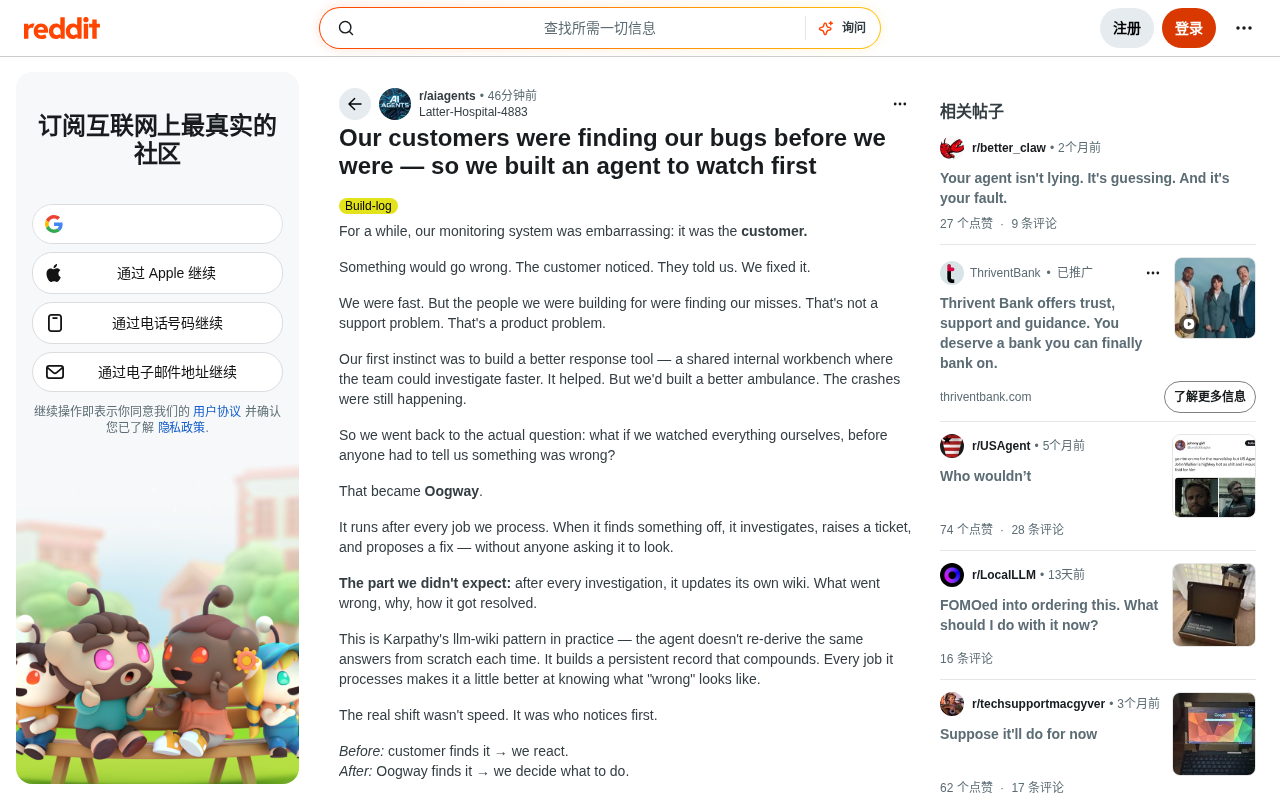
This observation deserves serious reflection from every engineering team. When customers become your de facto monitoring system, the cost of exposing problems has shifted from internal to external — damaging not just your response time, but user trust.
Underlying this is a classic failure mode in monitoring architecture. The concept of Observability traces back to control theory, introduced into engineering by Hungarian mathematician Rudolf Kálmán in the 1960s, and later systematized for software engineering by cloud-native pioneers like Google's SRE team and Netflix. The key distinction from traditional monitoring is this: monitoring tells you whether a system is healthy, while observability lets you infer a system's internal state from its external outputs — even for failure modes you've never encountered before. In observability engineering, system health is typically measured through three signal types: Metrics (quantitative indicators like QPS, latency, and error rates), Logs (discrete event records), and Traces (distributed request path reconstruction). Charity Majors and others describe these three as the "three pillars" of observability.
The rise of the OpenTelemetry project marks a significant milestone in observability standardization. Governed by the CNCF (Cloud Native Computing Foundation), it unifies the collection protocols for all three signal types, enabling interoperability between tools from different vendors and dramatically lowering the barrier to building observability infrastructure. Yet even with all three signal types in place and a mature toolchain, traditional monitoring still has a blind spot around "Known Unknowns" — you can only set alert rules for scenarios you've already thought of. For anomaly patterns you haven't anticipated, the system simply can't proactively detect them. This is precisely why customers find bugs before the engineering team does: real user behavior covers edge cases that developers never considered when writing their alert rules.
Build a Better Ambulance, or Prevent the Crash?
The team's first instinct was to build a better response tool — an internal shared "workbench" for faster investigation and root cause analysis. That helped, but the author reflected on it with a sharp analogy:
"We built a better ambulance. But the accidents kept happening."
This gets at the fundamental limitation of most operations tooling: it optimizes for response speed, not for preventing problems in the first place. No matter how efficient your incident response process becomes, if problems are still first discovered on the customer side, the reactive nature of your operation hasn't changed. In SRE (Site Reliability Engineering), this is known as "Firefighting Culture" — teams burn enormous energy extinguishing incidents that have already occurred, rather than systematically reducing the rate at which incidents happen. Google's SRE practice introduced the famous "Error Budget" concept precisely to shift team attention from reactive firefighting toward proactive reliability investment: once the error budget is exhausted, teams are required to pause new feature releases and focus on stability improvements, curbing the spread of firefighting culture at an institutional level.
So the team returned to the most fundamental question: What if we could monitor everything ourselves, before anyone told us something was wrong?
This shift in thinking gave birth to what they called "Oogway" — an AI Agent.
Oogway: An AI Agent That Actively Patrols
Oogway represents a proactive AI Agent, belonging architecturally to the rapidly evolving "Agentic AI" paradigm. This paradigm has a clear technical lineage: from the introduction of the ReAct (Reasoning + Acting) framework around 2022, to the widespread attention AutoGPT attracted in 2023, to the gradual maturation of Agent orchestration frameworks like LangGraph and CrewAI — Agentic AI has made the leap from academic concept to engineering practice. Unlike traditional single-pass inference, AI Agents have four core capability modules: Planning, Tool Use, Memory, and Action. Planning typically relies on prompting techniques like Chain-of-Thought or Tree of Thoughts; Tool Use connects LLMs to external systems via Function Calling interfaces; and the Memory module addresses the fundamental limitation of stateless LLM inference.
From the ReAct framework to modern Agent orchestration frameworks, the core engineering breakthrough of Agentic AI was solving the "interface problem" between LLMs and the external world. The Function Calling (now called Tool Use) mechanism allows LLMs to invoke external APIs in a structured way, rather than relying on non-deterministic text parsing. Frameworks like LangGraph introduced stateful graph execution models, enabling complex multi-step workflows to be precisely controlled and debugged — a critical property for production reliability. In Oogway's case, its "active patrol" maps to planning capability, its "root cause investigation" relies on tool calls (such as querying logs or executing code), and its "Wiki updates" are a direct embodiment of persistent memory. This architecture enables the Agent to complete multi-step composite tasks without human instruction, essentially internalizing workflows that previously required manual orchestration into autonomous Agent behavior.
Unlike traditional alerting systems, Oogway operates proactively rather than reactively. Its core mechanism operates on three levels:
Full-Cycle Automated Patrol
Oogway runs automatically after every job the team processes. Like a tireless quality inspector, it scans each processing result and continuously looks for anomaly signals.
Autonomous Investigation and Fix Suggestions
When it detects something off, it doesn't just fire off an alert. It completes an entire sequence of actions:
- Investigates the root cause;
- Automatically creates a ticket;
- Proposes a fix — all without anyone telling it to look.
This "detect → investigate → suggest" loop elevates the AI Agent from an alarm system to a junior problem analyst, dramatically lowering the threshold for human involvement. This model aligns closely with the "Shift Left Testing" philosophy in software engineering — moving quality assurance earlier in the delivery process, from the user-facing side to inside the system.
An Unexpected Bonus: A Wiki That Evolves Itself
What genuinely surprised the author was a feature they hadn't anticipated.
After each investigation, Oogway updates its own Wiki — recording what went wrong, why it happened, and how it was ultimately resolved.
The author notes this is a real-world embodiment of the llm-wiki pattern proposed by Andrej Karpathy: instead of rederiving the same answers from scratch every time, the Agent builds a continuously accumulating knowledge base.
The llm-wiki pattern addresses a core limitation of large language models: the finite context window. While mainstream LLMs have expanded from early 4K-token windows to hundreds of thousands or even millions of tokens, two unavoidable problems remain. First, extremely long contexts cause inference costs to rise exponentially and introduce the "Lost in the Middle" phenomenon — models pay significantly less attention to information in the middle of the context. Second, LLMs have no persistent memory across sessions; every inference is a stateless "fresh start." The llm-wiki approach equips the Agent with an external knowledge base. After each inference, key findings are written in a structured way, and the next time a similar problem arises, the Agent retrieves this knowledge base as context. This is closely related to RAG (Retrieval-Augmented Generation), but with an important distinction: RAG typically retrieves human-curated, static external documents (such as enterprise knowledge bases or technical manuals), while llm-wiki is a dynamic knowledge system that the Agent generates, maintains, and retrieves itself — the quality and coverage of knowledge directly reflects the Agent's actual operational experience, rather than human-preset prior knowledge.
Another important distinction between llm-wiki and RAG lies in the ownership of knowledge production: traditional RAG depends on human effort to build and maintain the knowledge base, with quality capped by labor input; llm-wiki grants the Agent itself the right to produce knowledge, creating a flywheel where "usage equals learning." In practice, this model must address two engineering challenges: knowledge conflicts (inconsistent conclusions recorded for the same issue across multiple entries) and knowledge decay (historical experience becoming invalid as the environment changes). These typically require version control and periodic knowledge auditing mechanisms. This "self-authored manual" model means the Agent's capability boundary expands continuously with runtime, rather than being frozen at the model's training data knowledge cutoff.
The Compounding Effect: Gets Smarter the More It Runs
This mechanism produces a compound effect:
"Every job it processes makes it a little smarter at recognizing what 'wrong' looks like."
The Agent's capability isn't static — it grows continuously over time. Every troubleshooting session crystallizes into reusable experience, making the system's anomaly detection increasingly precise. This stands in sharp contrast to traditional monitoring rules that require constant human maintenance of thresholds — the latter depends on human labor input, while the former relies on automatic accumulation. From an information-theoretic perspective, this is fundamentally a process of continuously reducing the system's "cognitive entropy": each new failure pattern recorded decreases the system's uncertainty about the unknown state space.
The Real Transformation: Who Finds the Problem First
The author ultimately emphasizes that the core value of this transformation isn't speed — it's the fundamental change in who notices a problem first:
- Before: Customer finds bug → team reacts passively
- After: Oogway finds bug → team decides proactively
This shift may seem small, but it fundamentally reshapes the team's entire working posture. When problems are caught internally before they reach customers, the team gains not just a time window, but agency — the ability to calmly "decide what to do" rather than scrambling under the pressure of customer complaints. In product management, this maps to the underlying logic of NPS (Net Promoter Score) and user retention: research shows that the satisfaction from proactively resolved issues is significantly higher than satisfaction from reactively addressed complaints, because the former makes users feel valued, while the latter has already created an erosion of trust.
The Rise of Proactive AI Agents
This case reflects an important trend in AI Agent applications: the shift from reactive to proactive.
Most traditional automation tools are passively triggered — they act only after a user asks a question, a system fires an alert, or an event occurs. A new generation of Agents is beginning to demonstrate the capacity for "active patrol": not waiting for instructions, but continuously observing and proactively intervening. This trend already has multiple early examples in the industry: GitHub Copilot has evolved from code completion to proactively identifying security vulnerabilities; Datadog's AI assistant has evolved from passive querying to proactive anomaly detection. All of these point in the same direction — AI systems shifting in role from "tool" to "teammate."
Combined with persistent memory patterns like llm-wiki, proactive AI Agents demonstrate two key advantages: uninterrupted monitoring coverage and automatic accumulation of experience. These have broad implications for scenarios including AIOps, quality monitoring, and security auditing (SecOps).
Of course, these systems also face real engineering challenges that deserve serious consideration. First, False Positive control: if the Agent's criteria for judging "anomalies" are too broad, it will generate large volumes of noise tickets, consuming team attention and causing "Alert Fatigue" — a phenomenon well-documented in traditional monitoring, where engineers face hundreds of alerts per day, a significant portion of them false positives, leading to degraded sensitivity to genuine alerts over time. Second, resource consumption: automatically triggering an investigation after every job means LLM inference costs scale linearly with processing volume. In high-throughput scenarios, token costs can spiral out of control, requiring sampling strategies or tiered trigger mechanisms.
Third, idempotency and safety boundaries: once an Agent gains the ability to "automatically create tickets" or even "propose fixes," it's essential to clearly define Human-in-the-Loop (HITL) intervention points. In engineering practice, HITL isn't simply "human review" — it's a finely calibrated decision-authority allocation mechanism. It's typically structured by the reversibility of the action's consequences: read-only operations (such as querying logs or generating reports) can be fully autonomous; low-risk write operations (such as creating tickets or sending notifications) can follow a "default execute + human rollback" model; high-risk operations (such as changing configuration or deploying code) must go through explicit human approval. This tiered authorization framework allows the Agent's autonomy and safety boundaries to be maintained simultaneously, preventing automated processes from triggering cascading failures due to incorrect judgments — and represents a concrete, practical embodiment of current AI Alignment research in production engineering.
The author closed their post with a question to the community: "Has anyone else built something like this — an Agent that actively observes rather than passively responds?"
That question may be the common direction many engineering teams are now exploring.
Key Takeaways
- When customers become the de facto monitoring system, it signals "Known Unknown" blind spots in your observability architecture — traditional alert rules can't cover unanticipated edge cases. Standards like OpenTelemetry solve signal collection interoperability but can't compensate for the cognitive limits of rule design.
- Optimizing response speed (building a better ambulance) and eliminating root causes (preventing the crash) are fundamentally different types of investment. The Error Budget mechanism in SRE practice exists precisely to redirect team attention from the former to the latter.
- Proactive AI Agents like Oogway internalize the "detect → investigate → suggest" workflow into autonomous behavior through four core capability modules: Planning, Tool Use (Function Calling), Memory, and Action. Stateful graph execution frameworks like LangGraph make these workflows controllable and debuggable in production.
- The llm-wiki pattern provides Agents with a dynamically self-growing external knowledge base. Its fundamental difference from static RAG documents is that knowledge originates from the Agent's own operational experience, accumulating over time to produce a compounding effect — but version control and knowledge auditing mechanisms are needed to handle knowledge conflicts and decay.
- Engineering deployment requires careful attention to false positive control, token cost management, and the design of Human-in-the-Loop intervention points — the latter should use tiered authorization based on action reversibility, seeking a dynamic balance between Agent autonomy and human oversight, rather than a simple binary approval mechanism.
Related articles

Felix Rieseberg Personal Homepage
Felix Rieseberg's personal homepage sparks attention on Hacker News. This article covers the Slack engineer's technical background, the rise and fall of nativefier, and the value of a developer homepage as a tech calling card.

@ai-sdk/vue 3.0.306 Patch Release Syncs with [email protected] Update
@ai-sdk/vue 3.0.306 released, synced with [email protected]. A routine patch release for the Vercel AI SDK ecosystem with no public API changes; the Vue adapter layer stays version-aligned with the core package.

Gemini 4 Argon API Launches: The Era of Million-Token Output Begins
Google launches Gemini 4 Argon with sparse MoE architecture, up to 1M output tokens, and a 68.90% Vals Index score, available across API, AI Studio, and the Gemini app.