Proactive Task Assistants: Don't Let Timers Blind You to Video Evidence

New research reveals a video blind spot in proactive AI assistant benchmarks, with a timer baseline unexpectedly outperforming all published models.
The study finds that current benchmarks for evaluating proactive AI assistants (such as Ego-MC-Bench and QICD) have serious flaws: a timer baseline that never watches the video and issues alerts based solely on elapsed time achieves an error F1 score of 0.373 on Ego-MC-Bench, higher than all published results (highest only 0.27). The researchers formalize this as the "video-blind frontier" and propose Evidence-Contrastive Training (ECT), which pairs positive and negative samples from the same recording and same elapsed time, forcing the model to rely on video content rather than temporal cues. A 2B-parameter model trained with ECT crosses the frontier across all four random seeds and confirms 59% of error-free steps after transfer to Ego-MC-Bench (baseline only 30%). Ablation experiments prove the ECT model indeed makes decisions based on video evidence.
Title
Proactive Task Assistants: Don't Let Timers Blind You to Video Evidence
Meta Description
New research finds a video blind spot in proactive task assistant benchmarks: a simple timer can outperform all published models. Evidence-Contrastive Training (ECT) enables a 2B model to genuinely judge step completion and errors based on video frames, significantly improving cross-benchmark performance.
Article Content
Proactive AI assistants guiding people through physical tasks need to judge every few seconds whether a step is complete or an error has occurred. But a new study reveals an unsettling fact: current benchmarks used to evaluate such assistants largely reward "knowing the time" rather than "seeing the content."
A Timer Can Beat All Published Models
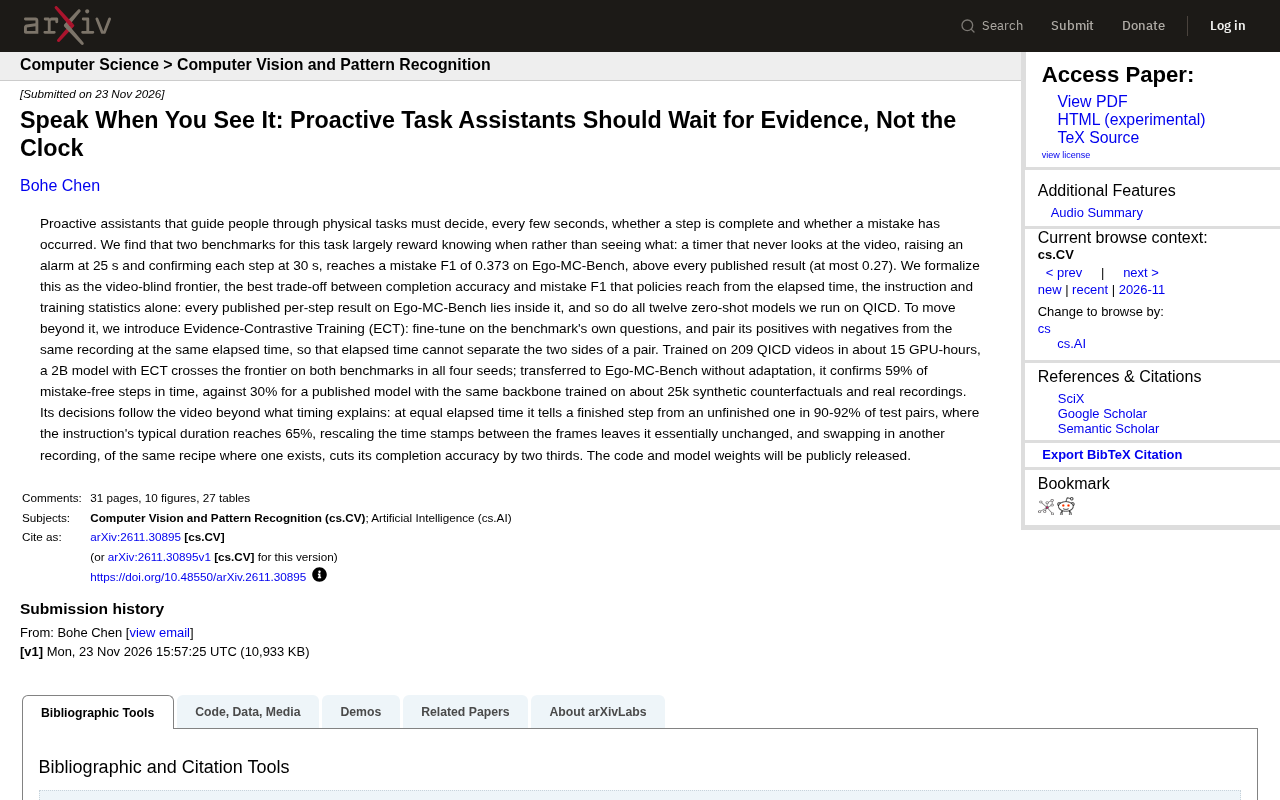
The research team designed a "never watches the video" timer baseline: regardless of the actual frames, it issues an error alert at the 25th second and confirms each step's completion at the 30th second. This simple strategy, which completely ignores video content, achieved an error F1 score of 0.373 on Ego-MC-Bench—higher than all published results (the highest being only 0.27).
This result points directly to a design flaw in the benchmarks. If leading performance can be achieved using only elapsed time, instruction text, and training statistics, what exactly are these benchmarks measuring? The researchers formalize this phenomenon as the "video-blind frontier"—the best trade-off between completion accuracy and error F1 that a policy can achieve using only temporal information. They found that all published per-step results on Ego-MC-Bench fall within this frontier, and none of the twelve zero-shot models evaluated on the QICD benchmark are exceptions.
Error F1 is a common metric for evaluating error detection tasks, combining precision and recall with values between 0 and 1; higher values indicate more accurate error detection. In step-by-step task assistance scenarios, error F1 measures whether a model can correctly identify at each step whether the user's action is erroneous. The timer baseline, with its fixed temporal strategy (alert at second 25, confirm completion at second 30), achieves an error F1 of 0.373, while the highest value among all previously published models is only 0.27—a significant gap. This indicates that in the benchmark samples, the occurrence of errors is highly correlated with step duration, and models can achieve high scores without analyzing video content.
Ego-MC-Bench is a benchmark for evaluating proactive AI assistants' step-by-step guidance capabilities in physical tasks, containing first-person videos of multi-step daily tasks (such as cooking and assembly), requiring models to judge every second whether the current step is complete or erroneous. QICD is another related benchmark focusing on quality inspection and error identification. Both benchmarks provide per-step annotations, but the researchers found that their evaluation results may be dominated by temporal cues rather than genuine visual understanding. Zero-shot models refer to models that have not been fine-tuned on the specific task but are trained on other data and directly transferred to the benchmark; none of the twelve zero-shot models surpassed the video-blind frontier, further confirming the benchmark's limitations.
Evidence-Contrastive Training: Forcing Models to Actually "See" the Video
To break through the video blind spot, the researchers propose Evidence-Contrastive Training (ECT). The core idea is clever: fine-tune the model on the benchmark's own questions while pairing positive samples with negative samples from the same recording and the same elapsed time, so that elapsed time cannot distinguish the two sides of the pair. In this way, the model must rely on the video frames themselves, rather than temporal cues, to answer correctly.
The training cost is not high: training on 209 QICD videos for about 15 GPU hours, a 2B-parameter model with ECT crosses the video-blind frontier on both benchmarks across all four random seeds. After transferring the model to Ego-MC-Bench without adaptation, it confirms 59% of error-free steps within the time limit, compared to only 30% for a published model with the same backbone trained on about 25,000 synthetic counterfactuals and real recordings.
Contrastive learning is a self-supervised learning method that trains models by pulling similar samples closer and pushing dissimilar samples apart in representation space. In evidence-contrastive training, positive and negative samples come from the same recording and have the same elapsed time, differing only in video content (one step completed, one not). This design prevents the model from using temporal information to distinguish positive from negative samples, forcing it to rely on visual evidence. During training, the model receives both instruction text and video frames and outputs step status. By minimizing the contrastive loss, the model learns to associate visual features with step completion status. The method requires only about 15 GPU hours on 209 QICD videos—a low cost suitable for broader adoption.
Decisions Indeed Follow Video Evidence
A series of ablation experiments further validates the behavior of the ECT model. Given the same elapsed time, it can distinguish completed from incomplete step pairs with 90% to 92% accuracy, whereas the typical duration of instructions alone achieves only 65%. After rescaling the timestamps between frames, the model's performance remains largely unchanged, indicating it does not rely on absolute time. When another recording is substituted (if a recording of the same recipe exists), its completion accuracy drops by about two-thirds, proving that the model is indeed making judgments based on video content.
These results send a clear signal: proactive task assistants should wait for evidence, not the clock. The design of current benchmarks needs to be re-examined; otherwise, we may unknowingly train a generation of assistants that "don't look at the screen." The researchers state that code and model weights will be publicly released, providing a foundation for the community to improve evaluation methods.
Ablation experiments are a method in machine learning for evaluating the contribution of each model component by removing or modifying specific parts and observing performance changes. In this study, ablation experiments include: testing the model's ability to distinguish completed/incomplete step pairs given the same elapsed time; rescaling inter-frame timestamps to test whether the model relies on absolute time; and substituting another recording (a different recording of the same recipe) to test whether the model relies on video content. Results show that the ECT model maintains high accuracy when temporal information is controlled or perturbed, while performance drops substantially when recordings are swapped, proving that its decisions are indeed based on video evidence rather than temporal cues.
One-line Summary
New research reveals a video blind spot in proactive AI assistant benchmarks, with a timer baseline unexpectedly outperforming all published models.
Paragraph Summary
The study finds that current benchmarks for evaluating proactive AI assistants (such as Ego-MC-Bench and QICD) have serious flaws: a timer baseline that never watches the video and issues alerts based solely on elapsed time achieves an error F1 score of 0.373 on Ego-MC-Bench, higher than all published results (highest only 0.27). The researchers formalize this phenomenon as the "video-blind frontier"—the best performance achievable using only temporal information. To break through this frontier, they propose Evidence-Contrastive Training (ECT), which pairs positive and negative samples from the same recording and same elapsed time, forcing the model to rely on video content rather than temporal cues. A 2B-parameter model trained with ECT crosses the video-blind frontier across all four random seeds, and after transfer to Ego-MC-Bench confirms 59% of error-free steps (baseline model only 30%). Ablation experiments prove that the ECT model indeed makes decisions based on video evidence rather than time. The researchers call for re-examining benchmark design and promise to release code and model weights.
Related articles

Michael Nielsen Takes Down His Classic Neural Network Textbook, Sparking Community Discussion
Michael Nielsen's classic free textbook Neural Networks and Deep Learning has been taken offline, sparking discussion on Hacker News about the reasons and impact.

Inside the AI Training Data Market: The Trade-off Between Exclusivity and Discounts
G2i founder Gabe Greenberg reveals the dual-track pricing of the AI training data market: labs pay a premium for exclusive data or accept discounts that allow others to buy it.

SessionGraph: Unifying All Coding Agent Sessions in One Interactive Graph
SessionGraph aggregates coding agent sessions into an interactive graph, helping developers review, debug, and manage AI coding workflows across sessions. This article examines its positioning, value, and open questions.