Probing the "Consciousness" of Vision-Language Models with Jacobian Lenses: Selective Access and Global Workspace

MC-Lens probes VLM internal concept representations, showing they align with Global Workspace Theory.
Drawing on Global Workspace Theory, the study proposes MC-Lens to map VLM intermediate states into a shared semantic space and probe how concepts are selected, integrated, and used. Findings: concepts are readable and selectively accessed by task; counterfactual interventions show accessed concepts participate in downstream reasoning; selective access develops later than concept accessibility; shared functional patterns exist across VLM families.
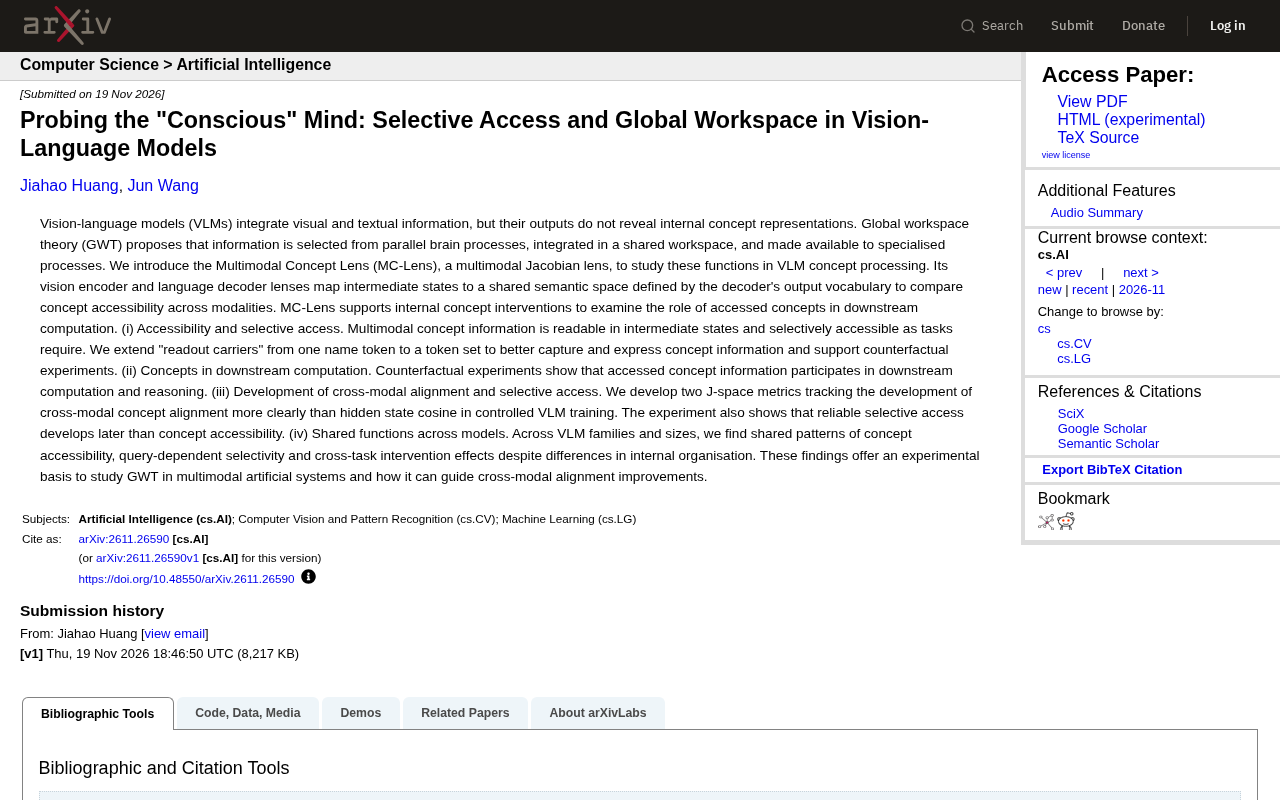
Vision-language models (VLMs) can look at images and talk about them, but their internal concept representations have always been a black box. A recent study draws on the Global Workspace Theory (GWT) from cognitive science and proposes the Multimodal Concept Lens (MC-Lens), attempting to open this black box and observe how conceptual information is selected, integrated, and utilized within VLMs.
Global Workspace Theory Meets VLMs
GWT posits that the brain's parallel processing streams filter information, integrate it into a shared workspace, and then make it available to specialized processing modules. The research team wanted to know whether VLMs exhibit a similar functional architecture.
Their proposed MC-Lens is a multimodal Jacobian lens comprising a vision-encoder lens and a language-decoder lens, which map intermediate states into a shared semantic space defined by the decoder's output vocabulary. This enables cross-modal comparison of concept accessibility and supports intervention experiments on internal concepts.
The key innovation of this approach is that it does not rely on model outputs but directly probes intermediate-layer representations, providing a new tool for understanding the internal computations of VLMs.
Jacobian lens is a technique for interpreting the internal representations of neural networks. Its core idea is to use the Jacobian matrix of the model output with respect to intermediate-layer activations (i.e., the partial derivatives of the output with respect to the intermediate state) to map the activation vectors of intermediate layers into the output space (such as vocabulary space), thereby interpreting the contribution of each intermediate neuron or dimension to the final output. Unlike probe methods that rely solely on forward propagation, the Jacobian lens can capture the local linear relationship between intermediate states and outputs, revealing how the model transforms internal concepts into concrete predictions. In MC-Lens, the researchers extend this idea to the multimodal setting by constructing lenses for the vision encoder and the language decoder separately and mapping both into a shared semantic space, thus enabling cross-modal concept comparison and intervention.
Conceptual Information Is Readable and Selectively Accessible
The first finding of the experiments is that multimodal conceptual information is readable in intermediate states and is selectively accessed according to task demands.
The research team extended "readout carriers" from single name tokens to token sets to better capture and express conceptual information and to support counterfactual experiments. This means that the internal concept representations of the model do not exist in isolation but are organized as sets, allowing flexible adaptation to different task requirements.
For example, when the model needs to identify an object in an image, the relevant conceptual information is preferentially accessed; in other tasks, this information may be suppressed. This selective access mechanism is consistent with the predictions of GWT.
Counterfactual experiments in interpretability research refer to artificially intervening on the internal states of a model (such as activation values or concept directions) and observing how the output changes, thereby inferring whether that state has a causal role in the model's behavior. Unlike probing methods that only observe correlations, counterfactual interventions can establish causality: if modifying a concept representation causes the output to change as expected, then that concept participates in the computation. In MC-Lens, after locating conceptual information using readout carriers, the researchers modify it in a targeted way (e.g., replacing or suppressing it) and observe changes in the model's reasoning results, thereby verifying the downstream functional role of the accessed concepts.
Accessed Concepts Participate in Downstream Computation and Reasoning
The second finding is more compelling: counterfactual experiments show that the accessed conceptual information indeed participates in downstream computation and reasoning processes.
By intervening on internal concept states, the researchers observed changes in model outputs. The results show that altering the accessed concepts significantly affects the model's reasoning results, demonstrating that these concepts are not bystanders but actual participants in the computational process.
This finding is crucial for understanding the reasoning mechanisms of VLMs. It indicates that the model does not simply memorize training data but genuinely constructs and manipulates concept representations internally.
Development of Cross-Modal Alignment and Selective Access
The study also traced the development of cross-modal concept alignment and selective access. The team developed two J-space metrics, which, in controlled VLM training, reflected the progress of cross-modal concept alignment more clearly than hidden-state cosine similarity.
An interesting finding is that reliable selective access develops later than concept accessibility. In other words, the model first learns to "know" concepts and only then learns to "invoke" them on demand. This is similar to human cognitive development, where knowledge accumulation precedes the maturation of executive control abilities.
J-space metrics are evaluation measures designed by the research team to quantify cross-modal concept alignment and selective access. Compared with traditional hidden-state cosine similarity, J-space metrics are computed in the semantic space after Jacobian lens mapping and can more directly reflect the accessibility and task dependence of concepts in the output vocabulary space. Specifically, these metrics measure the consistency of the representations of the same concept across different modalities (such as images and text) in the shared semantic space, as well as whether the model can selectively activate relevant concepts according to query demands. In controlled training experiments, J-space metrics showed clearer developmental trends than cosine similarity, indicating that they are better suited for tracking the dynamic development of concept alignment.
Shared Patterns Across Different Models
Finally, the research team validated their findings across different VLM families and scales, finding that despite differences in internal organization, there are shared patterns in concept accessibility, query-dependent selectivity, and cross-task intervention effects.
This suggests that these functional properties may be general attributes of VLMs rather than products of specific architectures. This provides an experimental basis for the applicability of GWT in multimodal artificial systems and offers potential directions for improving cross-modal alignment.
Implications for AI Research
The value of this work lies not only in proposing a new probing tool but also in providing a theoretical framework for understanding the internal mechanisms of VLMs. By introducing theories from cognitive science into AI interpretability research, the researchers have opened a new path.
Of course, this does not mean that VLMs truly possess "consciousness"—the quotation marks in the title remind us that this is only an analogical framework. But by studying these functional similarities, we may be able to better understand and improve these models, making their internal computations more transparent and controllable.
In the future, such methods may help us discover biases, erroneous reasoning patterns, and even guide more efficient training strategies in models. For AI safety and interpretability research, this is undoubtedly a direction worth attention.
One-line Summary
Research proposes MC-Lens to probe internal concept representations in VLMs, verifying that they align with Global Workspace Theory.
Paragraph Summary
Drawing on the Global Workspace Theory from cognitive science, the study proposes the Multimodal Concept Lens (MC-Lens) to probe how conceptual information is selected, integrated, and utilized by mapping VLM intermediate states into a shared semantic space. Experiments find that conceptual information is readable in intermediate layers and selectively accessed according to task; counterfactual interventions prove that accessed concepts actually participate in downstream reasoning; selective access develops later than concept accessibility; and shared functional patterns exist across different VLM families. This work provides a new tool and theoretical framework for understanding the internal mechanisms of VLMs.
Related articles

From 0 to 1: Vibe Coding an AI Knowledge Base — A Practical Retrospective and Tech Stack Breakdown
A retrospective on building the AI knowledge base OilBook from scratch with Vibe Coding: Next.js+Neon stack, Oil Dev Skill workflow, Stripe paywall security, interview-style writing, AI-flavor control, and Vercel deployment.

GLM-5.4 Hands-On: Native Vision Meets a New Vibe Coding Workflow
Hands-on with Zhipu GLM-5.4: native vision tested across a 3D product demo, pure-code video generation, and remote-control Vibe Coding, compared with GPT-6.2 and Gemini Neon.

AI and Humans Claim to Prove the Riemann Hypothesis: Machine-Verified, Yet Nobody Can Understand It
Anthropic mathematician and AI Claude claim to prove the Riemann Hypothesis with 17 million lines of Lean code, machine-verified but unreadable by humans. This article analyzes the event, the zero proportion record from 41.6% to 67.2%, and the gap between machine verification and human understanding.