ProductBridge: AI-Powered Customer Support and Feedback Integration for Evidence-Driven Roadmaps
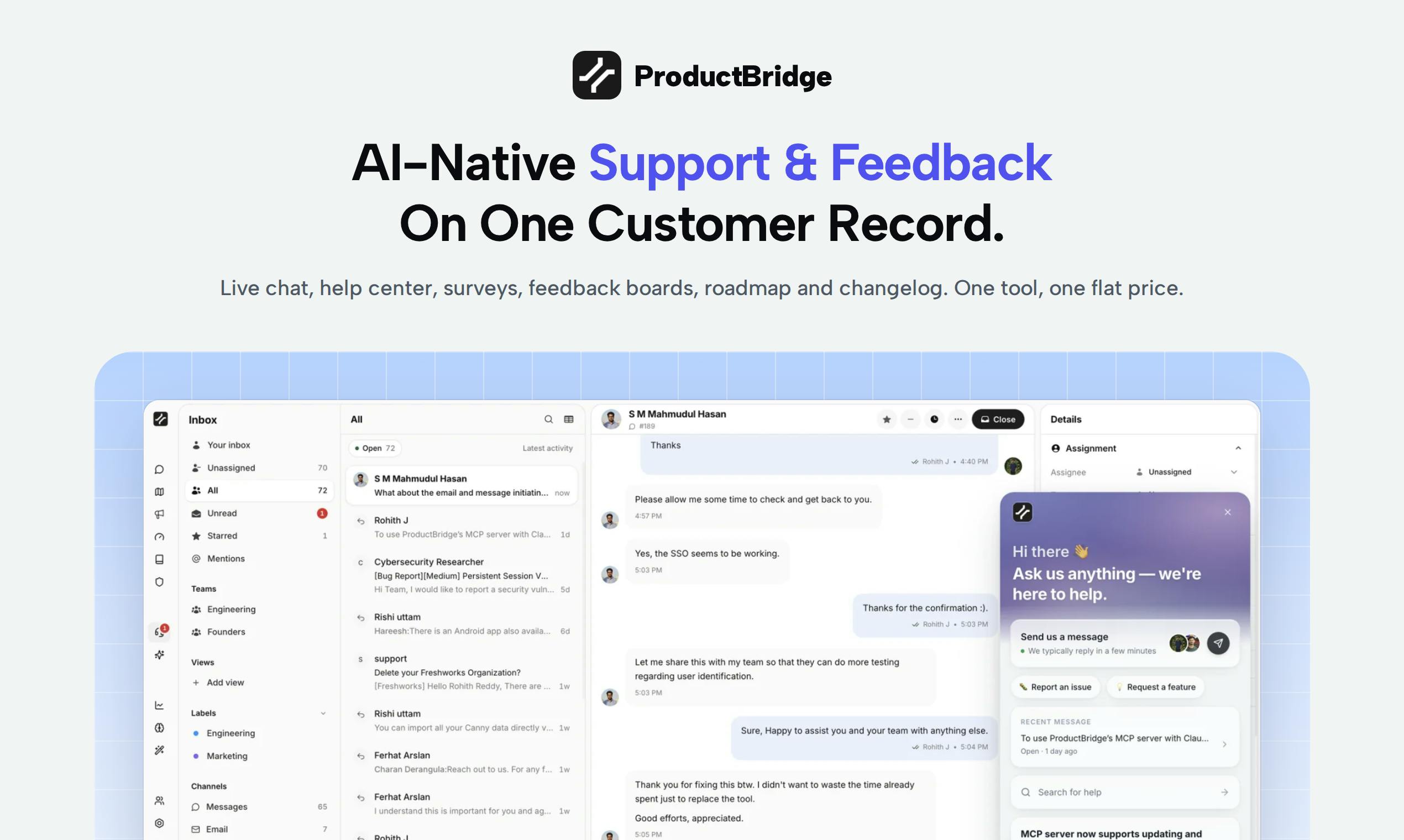
ProductBridge unifies AI support, user feedback, and product roadmaps into one evidence-driven system.
ProductBridge is an AI-native all-in-one platform for product teams, built around an AI support agent that can access business APIs via tool calls, workflows, and MCP. It consolidates customer support, feedback collection, and product decision-making into a single system, eliminating the pain of shuttling data between multiple tools. All chats, surveys, and votes are automatically deduplicated and scored by user reach and associated revenue, helping product managers prioritize roadmaps with evidence rather than gut feeling. When a feature ships, the system automatically notifies every user who requested it — closing the feedback loop. It supports MCP for Claude, ChatGPT, and Cursor, offers flat pricing, and launched on Product Hunt with 139 upvotes.
One System to Replace Three Tools
For most product teams, daily work means endless copy-pasting between support ticket systems, feedback boards, and research tools. Feature requests mentioned in chat get manually migrated to a feedback board; survey results need separate collation into the roadmap. This fragmented workflow is not only time-consuming — it also buries the user signals that matter most.
ProductBridge aims to solve this with a single system. It consolidates customer support, feedback collection, and product decision-making into one platform, centered around an AI support agent: the agent reads your help center knowledge, directly handles support conversations, calls your APIs via tools, workflows, and MCP when needed, and seamlessly hands off to a human when it can't resolve something. The product launched on Product Hunt to 139 upvotes and a #7 ranking, under the Customer Success and OpenAI Day categories.
The AI Agent Does More Than Answer Questions
The core problem with traditional chatbots is that they only handle simple, repetitive inquiries — the moment a query requires fetching back-end data or executing an action, they fall flat. ProductBridge takes a different approach: its AI agent can "call your APIs via tools, workflows and MCP," meaning it actually accesses your business systems through tool calls, workflow orchestration, and the MCP protocol.
This means the agent isn't just a text Q&A bot — it can genuinely help users look up orders, change configurations, and trigger processes. When it determines it can't handle something adequately, it proactively hands off to a human agent. This "do it if possible, escalate if necessary" boundary design is a key maturity indicator for modern AI support products.
Notably, its support for MCP (Model Context Protocol) covers Claude, ChatGPT, and Cursor. This allows developers to tap into ProductBridge's capabilities directly within their preferred AI tools — a fitting match for the OpenAI Day theme.
MCP (Model Context Protocol) is an open standard proposed by Anthropic in late 2024 to address the fragmentation of integrations between AI models and external tools and data sources. Think of it as a "USB port" for AI — developers expose a single MCP-compliant interface, and any supporting AI client (such as Claude or Cursor) can call it directly, without building separate adapters for each tool. ProductBridge's MCP support means developers never have to leave their familiar AI coding environment to access support and feedback data — significantly reducing context-switching costs in real workflows. The MCP ecosystem is expanding rapidly, with more and more SaaS products adopting it as a developer-friendly integration standard.
Making Your Roadmap "Run on Evidence"
One of ProductBridge's most compelling pitches is turning "listening to users" into a quantifiable process. The product's official description sums it up in one line: "your roadmap runs on evidence, not opinions."
How does it work? Every chat, survey, and vote is captured by the system, then deduplicated and scored. The scoring dimensions are "reach and revenue" — how many users it touches and how much revenue it's associated with. This means product managers no longer face a scattered list of complaints; instead, they see evidence ranked by impact. Which feature gets repeatedly mentioned by the most paying users becomes immediately clear.
Taking it a step further, when the team actually ships a feature, every user who previously requested it is automatically notified. This closed-loop design is clever: it makes users feel genuinely heard, and it turns "we listened to your feedback" from an empty promise into an automatically executable action.
The "score by reach and revenue" mechanism draws on classic product management prioritization frameworks — similar in spirit to RICE (Reach, Impact, Confidence, Effort) or the Kano model, which both try to convert subjective feature discussions into comparable quantitative metrics. ProductBridge focuses on "reach" (how many users mentioned the same need) and "revenue" (how much revenue those users represent) — a lightweight approach directly tied to business outcomes. Deduplication is the prerequisite for this to work: the same underlying request might appear across a dozen chat logs with different phrasing, and without semantic merging, the counts will be misleading. This is precisely where AI earns its place — performing semantic aggregation, not simple keyword matching.
Pricing and Positioning
ProductBridge uses flat pricing and offers a free plan. Compared to traditional support tools that charge per seat or per conversation, flat pricing is far more accessible for early-stage and growth-stage teams, and the free tier lowers the barrier to trying it out even further.
Competitively, it straddles several hot categories at once: AI customer support, user feedback management, and product roadmap tooling. Each space has strong incumbents, but few products integrate all three into a single system. ProductBridge's differentiation lies precisely in that integration — not building a smarter chatbot, but eliminating the data shuffling between disconnected tools.
A Few Observations
The pain point ProductBridge addresses is real: the information loss caused by tool fragmentation is a hidden cost that nearly every product team has experienced firsthand. Its product logic holds together — the AI agent handles front-end interactions, the data layer accumulates evidence, and the notification mechanism closes the loop.
That said, as a new launch fresh off Product Hunt, real-world performance still needs validation. Whether the agent's API-calling capability holds up in complex business scenarios, whether the deduplication and scoring algorithms accurately reflect true priorities, and what the cost of migrating data from existing tools looks like — these are all questions prospective users need to evaluate before committing. 139 upvotes and 26 comments show it's caught the community's attention, but there's still a meaningful gap between interest and becoming a team's daily driver.
For product and customer success teams struggling with tool-switching overhead, this kind of "all-in-one AI-native" solution offers at least one new option worth trying out.
Related articles
Free Open-Source Tool Rejected: The Community Controversy Sparked by r/DnD's AI Ban
A free open-source DnD campaign tool was rejected by r/DnD's AI ban — yet the same tool was approved a year ago. The case highlights the blurry line between AI tools and AI-generated content.

What LLMs Can You Run with 1.9TB of RAM? Exploring the Ceiling of Local AI Deployment
A Reddit user with 1.9TB of RAM sparked debate about local LLM deployment. We break down what massive RAM enables, where CPU inference falls short, and the real bottlenecks.
Researchers Use Claude to Hack OpenAI Systems: A New Wake-Up Call for AI Security
Security researchers used Anthropic's Claude to breach OpenAI systems, taking over employee accounts and accessing internal repos. What this means for AI security.