Production-Grade Agentic RAG in Practice: An Open-Source Course from Retrieval to Intelligent Agents
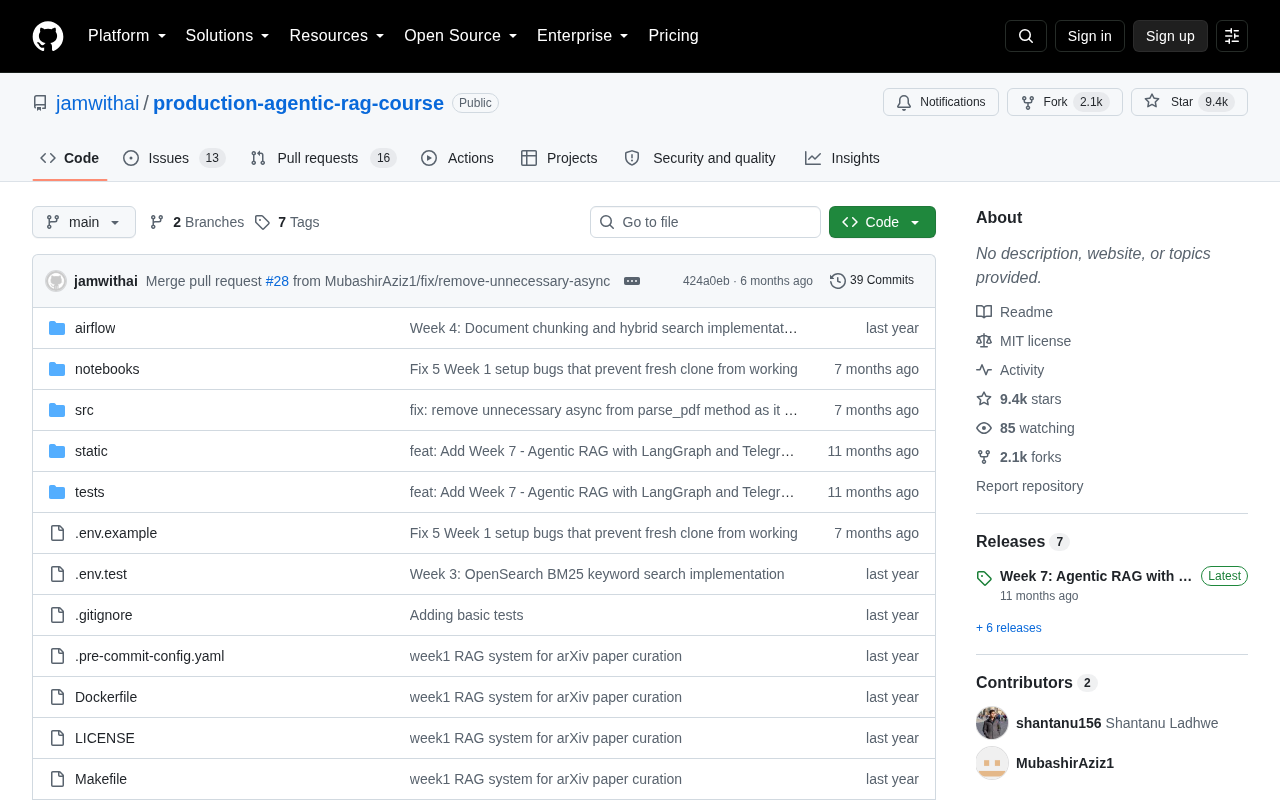
An open-source Python course on production-grade Agentic RAG with nearly 10K Stars and strong AI community interest.
The open-source project `production-agentic-rag-course` has rapidly gained 9,410 Stars and 2,071 Forks, reflecting strong demand for production-grade Agentic RAG in the AI engineering community. Unlike traditional linear RAG, Agentic RAG introduces agent-based decision-making — enabling systems to autonomously time retrievals, rewrite queries, and invoke external tools for complex multi-step reasoning. Built in Python, the course focuses not on demos but on engineering challenges like retrieval quality evaluation, latency control, and observability, making it ideal for engineers and teams ready to move beyond prototypes and ship AI systems to production.
An Open-Source RAG Learning Project Worth Your Attention
On GitHub, an open-source project called jamwithai/production-agentic-rag-course is rapidly gaining traction. The repository has already accumulated 9,410 Stars and 2,071 Forks, with 193 new Stars added in a single day — a clear signal of strong community interest in production-grade Agentic RAG.
Built primarily in Python, this project is positioned as an engineering-focused tutorial series on Retrieval-Augmented Generation (RAG). Its emphasis isn't on conceptual demos, but on pushing RAG systems toward real-world production readiness. For developers and teams transitioning from prototype to deployment, this kind of "production-grade" tutorial tends to offer far more practical value than scattered blog posts.
Why Agentic RAG
Traditional RAG follows a relatively linear flow: a user asks a question, the system retrieves relevant documents, and the results are stitched into a prompt for the LLM to generate a response. This works reasonably well for simple Q&A scenarios, but falls short when tasks require multi-step reasoning, integrating information across multiple data sources, or dynamically adjusting retrieval strategies based on intermediate results.
The core idea behind Agentic RAG is to bring the decision-making capabilities of an Agent into the retrieval process. Instead of a one-shot retrieve-then-generate pipeline, the system can autonomously decide when to retrieve, what to retrieve, whether to re-retrieve or rewrite a query, and even call external tools to fill in missing information. This shift from a "passive pipeline" to an "active decision-maker" is precisely what the term Agentic emphasizes in this course's name.
The word production in the project name adds another layer of value: many RAG tutorials stop at a working prototype, while production environments also demand attention to retrieval quality evaluation, latency and cost control, error handling, observability, and a host of other engineering concerns. Combining an Agentic architecture with production-level requirements is what sets this course apart from typical introductory tutorials.
From a technical implementation standpoint, Agentic RAG typically relies on the ReAct (Reasoning + Acting) framework or Tool Use mechanisms, enabling the LLM to iteratively execute a "think → act → observe" loop before generating a final response. For example, the model might first analyze whether a question should be decomposed into multiple sub-queries, retrieve results for each separately, and then synthesize them into a final answer. Agentic RAG is also commonly paired with modules like Query Rewriting, Self-Critique, and Routing — when retrieved results lack relevance, the system can automatically rewrite the query or switch to a different vector database. While these mechanisms significantly enhance the system's ability to handle complex queries, they also introduce higher latency and unpredictability. Striking the right balance between capability and engineering stability is a central challenge that production-grade tutorials need to address.
Project Momentum and Community Signals
The numbers speak for themselves: nearly 10,000 Stars combined with over 2,000 Forks suggests that not only are a large number of developers bookmarking this project — a significant proportion are forking it to run the code themselves or build on top of it. A single-day growth rate of 193 Stars also indicates the project is currently in a strong upward trend.
When evaluating whether an open-source learning resource is worth investing time in, community activity is an important signal. A high Fork-to-Star ratio typically indicates strong hands-on usability — people aren't just clicking a thumbs up; they're actually pulling the code and running it. The use of Python as the primary language also lowers the barrier to entry for AI engineers, since the dominant RAG and LLM ecosystems (such as LangChain, LlamaIndex, etc.) are largely Python-centric.
Who Is This Course For
Given the project's positioning, this course is likely a good fit for the following audiences:
- Engineers who already understand basic RAG and want to level up: If you can already build a simple Q&A bot but aren't sure how to make it reliable in a real business context, this production-focused tutorial can help fill in the engineering gaps.
- Teams building AI applications: Product teams that need to combine retrieval with agent-based decision-making to handle complex queries or multi-source scenarios can find useful architectural references here.
- AI learners and researchers: Those who want a systematic understanding of how Agentic RAG works in practice, rather than staying at the conceptual level.
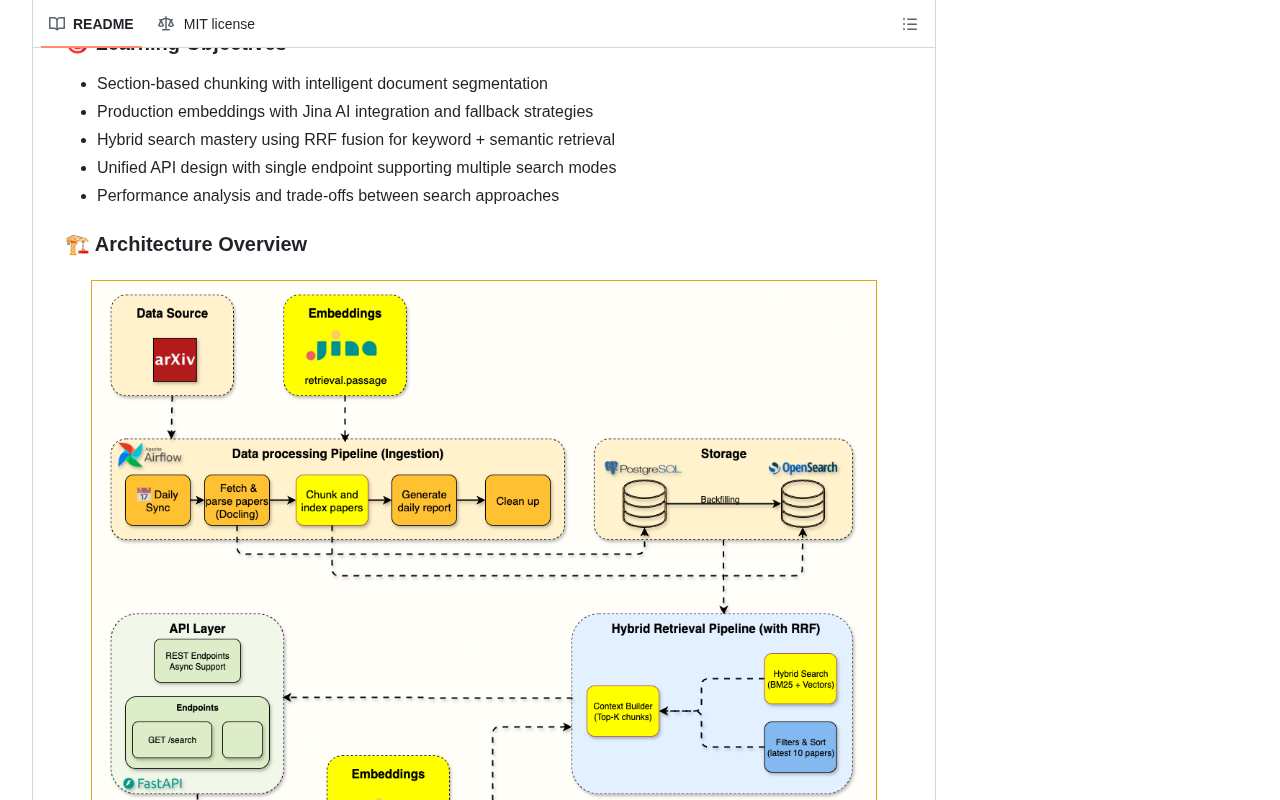
It's worth noting that since the currently available public information is primarily based on the repository's basic metadata (language, Star count, Fork count), the specific chapter structure, technology stack, and hands-on content of the course require further exploration of the repository itself. Interested readers are encouraged to visit the GitHub repo directly and review the README and directory structure to determine whether it fits their needs.
In terms of technical prerequisites, understanding this course typically requires: familiarity with Python async programming, basic experience with vector databases (such as Pinecone, Weaviate, Chroma, etc.), and some exposure to LLM API calls (such as OpenAI, Anthropic, etc.). Vector databases are a core component of any RAG system — they store text as high-dimensional vectors and use Approximate Nearest Neighbor (ANN) search to quickly surface semantically similar document chunks. Their retrieval efficiency and indexing strategies directly affect the overall latency and quality of a RAG system. Readers who haven't yet worked with vector search are advised to build that foundation before diving into this course, as it will make the Agentic decision-making layer much easier to follow.
Conclusion
The rise of production-agentic-rag-course reflects a clear trend across the AI engineering community: moving from "working demos" to "deployable systems," and from "single-pass retrieve-then-generate" to "agent architectures capable of autonomous decision-making." For developers who want to bring RAG into production, open-source courses like this one — focused on real engineering practice — are exactly the kind of scarce and valuable learning resources the field needs right now.
Related articles

How Big Can Stars Really Get? The Physical Limits of the Largest Stars
Red supergiants are the largest stars by volume, with radii up to 2,000 times the Sun, engulfing the inner solar system. But there is no precise upper limit on stellar size—models predict up to 15,000 solar radii. The most massive blue stars are far smaller than red supergiants—biggest and heaviest are two different things.

Apple HomeView Smart Display Full Feature Breakdown: Wall-Mount or Desktop, $299
Apple launches HomeView, a $299 smart display with wall-mount and desktop options, 12MP camera for facial recognition, smart home control, music playback, and recipe step-by-step cooking. Full breakdown of watch faces, apps, privacy, and cooking integration.

Where Did the Promised New Studio Go? Craft Computing Answers After Five Years
Craft Computing's host responds to viewer questions: the new studio promised five years ago was shelved as construction costs soared from $30,000 to $75,000, and was replaced by a 168-square-foot garage conversion.