Production-Grade ML System Design: Nine Engineering Challenges Beyond the Model

Nine critical engineering challenges that make production ML systems far harder than model building.
Production ML systems face far more complexity beyond model training. This article examines nine key engineering challenges—training/serving skew, feature freshness, data quality, GPU utilization, inference latency, cost optimization, model drift, feedback loops, and experimentation platforms—revealing how their interactions create the real difficulty in building reliable, scalable machine learning systems.
Introduction: The Real Challenges Lie Beyond the Model
In the public narrative of machine learning, models tend to take center stage—whether it's a new architecture, larger parameter counts, or accuracy scores topping the leaderboards. However, any engineer who has actually deployed an ML system in production will tell you a counterintuitive truth: modeling is one of the easiest parts of the entire system; the real challenges lie in the complex engineering infrastructure surrounding the model.
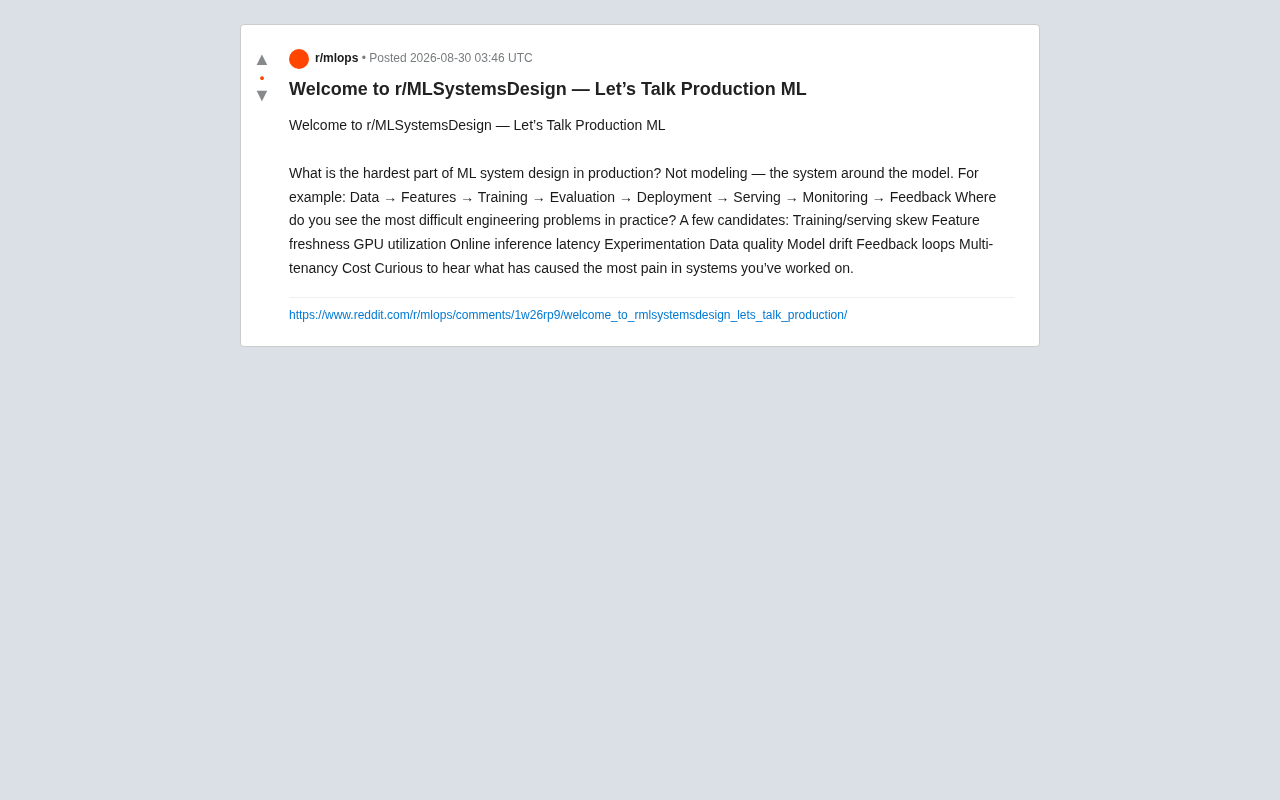
Recently, the newly established r/MLSystemsDesign community on Reddit sparked a wide-ranging discussion with a provocative question: What is the hardest part of ML system design in production? The poster deliberately emphasized "not the modeling, but the system around the model," and outlined a complete data pipeline:
Data → Features → Training → Evaluation → Deployment → Serving → Monitoring → Feedback
This seemingly linear pipeline actually conceals countless easily overlooked yet costly engineering pitfalls. This article examines the nine candidate challenges listed in the post, analyzing one by one why each is so painful in practice.
Data and Feature Layer: Where All Problems Originate
Training/Serving Skew
This is arguably the "nightmare number one" for all ML systems engineers. When the data distribution and feature computation logic used during training are inconsistent with what actually happens in online serving, models that perform brilliantly in offline evaluation can degrade dramatically after deployment.
The most classic scenario: the training pipeline computes features in batch using Python/Pandas, while the online serving system computes the same features in real-time using a separate Java/Go codebase. Subtle differences between the two codebases—such as missing value imputation strategies, time window boundaries, or rounding methods—can accumulate into significant prediction bias. The typical solution is to introduce a unified Feature Store that allows training and serving to share the same feature definitions and computation logic.
Feature Freshness
For scenarios with high real-time requirements like recommendations, fraud detection, and advertising, feature "freshness" directly determines model effectiveness. A user's click behavior from three seconds ago may have more predictive value than behavior from three hours ago. But providing the latest features within millisecond-level latency means building complex streaming computation pipelines (such as Flink or Kafka Streams) and making difficult trade-offs between storage costs, computation latency, and data timeliness.
Data Quality
"Garbage in, garbage out" is a well-worn saying, but in production environments, data quality issues are often insidious and fatal. Upstream tracking changes, log format drift, sudden spikes in null values, dirty data injection—these problems may not be indirectly discovered until weeks later through declining model performance. Mature teams embed automated data validation and anomaly alerting into their data pipelines rather than relying on post-hoc debugging.
Training and Serving Layer: The Performance vs. Cost Trade-off
GPU Utilization
With the advent of the large model era, GPUs have become the most expensive scarce resource. Yet in practice, average GPU utilization is often shockingly low—data loading bottlenecks, communication overhead, and improper batch size settings can leave expensive GPUs "idling" most of the time. Squeezing every last bit of compute through pipeline parallelism, data prefetching, mixed precision training, and other techniques is a core battleground for reducing costs and improving efficiency.
Online Inference Latency
For user-facing online services, inference latency directly impacts experience and conversion rates. P99 latency must be kept within strict SLA bounds, which requires trade-offs between model complexity and response speed. Common optimization techniques include model quantization, distillation, caching, and dynamic batching. But each optimization can introduce new complexity and potential accuracy loss.
Cost
Cost is the invisible constraint that runs through every layer. The expense of training a large model once, the ongoing cost of online inference, the bills for feature storage and computation—these numbers scale rapidly at production volumes. ML system design is fundamentally a continuous optimization exercise in finding the right balance among effectiveness, latency, and cost.
Monitoring and Feedback Layer: Long-Term System Health
Model Drift
A model isn't something you deploy once and forget. The real world is constantly changing—user behavior, market conditions, and data distributions all drift over time, causing model performance to decay. Detecting data drift and concept drift in a timely manner, and triggering automated retraining and update workflows, is critical to ensuring long-term system effectiveness.
Feedback Loops
This is one of the most subtle and dangerous problems. A model's predictions influence user behavior, and that user behavior then becomes the next round of training data, forming a closed loop. If handled poorly, this feedback loop continuously amplifies bias—for example, a recommendation system that only recommends content users have already clicked on, causing filter bubbles to narrow further and further, or even creating a vicious cycle of model self-reinforcement.
Experimentation and Multi-Tenancy
Experimentation capability determines a team's iteration speed. A reliable A/B testing framework, traffic allocation, and metric attribution form the infrastructure for data-driven decision-making. Multi-tenancy, on the other hand, is a platform-level challenge: how to serve multiple business units and multiple model versions within the same system while ensuring resource isolation, fair scheduling, and security.
Conclusion: Systems Thinking Is the Core of ML Engineering
Returning to the Reddit community's original question—where does it hurt the most? The answer often varies by scenario, but the community discussion revealed a consensus: the complexity of ML systems doesn't come from any single component, but from the coupling and interactions between these components.
Training/serving skew results from misalignment across data, features, and engineering implementation; feedback loops span both the serving and training sides. This means that excellent ML systems engineers need not only algorithmic skills but also end-to-end systems thinking—understanding how data flows, how failures propagate, and how costs accumulate.
For practitioners looking to enter this field, rather than chasing the latest model architectures, it's better to invest time in deepening your understanding of the entire pipeline. Because in production, making a model run stably, reliably, and cost-effectively to continuously deliver value is far more difficult—and far more important—than training a high-scoring model.
Related articles

Chain of Thought Isn't Just for AI: How Humans Can Use CoT to Improve Thinking Quality
Chain of Thought isn't just a prompt trick for large models. Starting from a Hacker News discussion, this article analyzes why CoT works for human thinking too, breaks down actionable ways to transfer it, and highlights the key differences between human CoT and machine CoT.
Cloudflare Teams Up with OpenAI: Closi…
Cloudflare Teams Up with OpenAI: Closing the Loop from Vulnerability Discovery to Defense with AI
Cloudflare uses OpenAI Daybreak to investigate security vulnerabilities and generate reviewable remediation plans, while developers use Codex to boost coding efficiency and quality.

Orca Multi-Agent Orchestration in Practice: A Guide to Parallel Collaboration with Claude and Codex
Orca is Stable AI's free open-source agent workbench supporting 34 agents like Claude Code and Codex in parallel. Learn its Git worktree isolation, multi-model orchestration, and mobile management.