Programmer's Survival Guide in the AI Era: Who Gets Left Behind, Who Becomes More Valuable?

AI won't replace programmers, but it will eliminate those who lack depth and AI fluency.
AI cannot fully replace programmers — programmers are best positioned to leverage AI tools. The future demands two core competencies: data structures & algorithms, and foundational AI knowledge. As AI breaks down language barriers, π-shaped cross-domain talent gains an edge. Yet AI still has fundamental limitations in business understanding, debugging, code quality, architecture design, and solution delivery — and that's exactly where high-value programmers shine.
AI Won't Replace Programmers — But It Will Eliminate the Weak Ones
"Will AI replace programmers?" The answer is actually pretty clear: a complete replacement is impossible.
The reason is simple — the people who can get the most out of AI will ultimately be programmers. Programmers understand the underlying principles, algorithms, and logic behind how AI generates content. They know how to write effective prompts. By comparison, someone in HR or administration simply can't leverage AI tools as deeply as a programmer can.
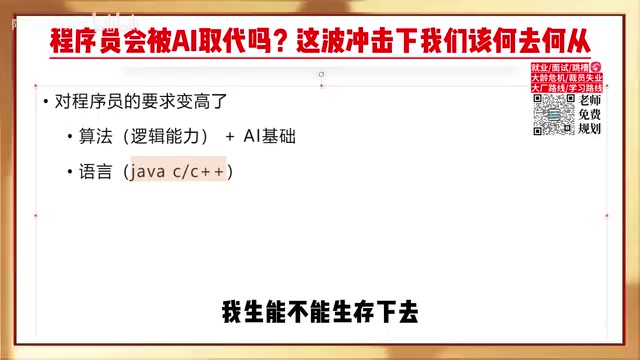
But here's the reality: the bar for programmers in the AI era has risen. It's no longer enough to just be a programmer — you need to be a programmer who understands AI and knows how to use it.
The Two Pillars of the Future Programmer
Pillar One: Data Structures and Algorithms
At its core, this is about logical thinking — the fundamental skill of programming. Data structures and algorithms haven't changed in decades, because they're rooted in mathematics and logic. In the AI era, this skill will only grow in importance, not diminish.
It's worth noting that data structures and algorithms aren't just interview gatekeepers — they're the underlying benchmark for evaluating AI-generated code. When AI generates a sorting or graph traversal algorithm, only a programmer who truly understands time complexity (Big-O) and space complexity can judge whether that code is production-ready or just a trap that "looks like it runs."
Pillar Two: Foundational AI Competency
Understanding how large models work, knowing the limits of AI tools, and knowing how to collaborate with AI on complex tasks — these are becoming essential skills for programmers.
Today's mainstream large language models (LLMs) are built on the Transformer architecture. They learn statistical associations between tokens through self-supervised pretraining on massive text datasets. The core mechanism is "next-token prediction" — the model doesn't truly "understand" semantics. Instead, it uses the Attention Mechanism to calculate the weight of each word in context and outputs the highest-probability next token. This makes LLMs remarkably capable at language generation, but exposes fundamental limitations when genuine causal reasoning, domain expertise, or dynamic business rules are required. Understanding this is what lets you know which tasks to hand off to AI and which ones demand your own judgment.
As for programming language choice, that's ultimately a tooling decision. Java or C++ are recommended (they dominate the market — think of them as the "mainstream cuisines"), though Go, Swift, and others are viable paths with a narrower range of job opportunities.
AI Is Breaking Down Technical Boundaries
One trend worth paying attention to: AI is dissolving the walls between programming languages.
In the past, a Java developer who wanted to work on a C++ project faced a steep climb, and vice versa. But now, with AI assistance, picking up a new language has become much easier — you can have AI walk you through code line by line and reach an intermediate level surprisingly fast.
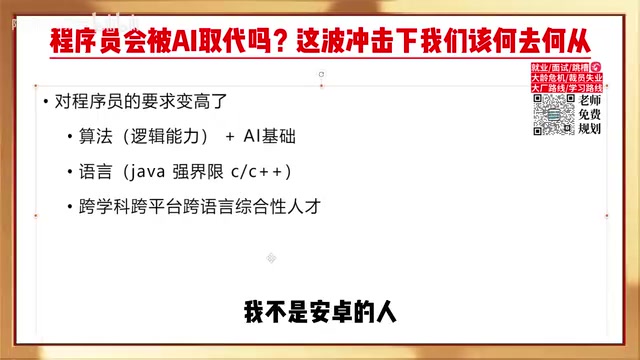
What does this mean? It means cross-disciplinary, cross-platform, and cross-language versatility matters more than ever before.
In terms of talent models, this corresponds to the rise of the "π-shaped" professional. A T-shaped developer has deep expertise in one domain (the vertical bar) plus broad awareness across fields (the horizontal bar). A π-shaped developer has deep expertise in two or more domains, with the ability to connect them horizontally. In the AI era, π-shaped programmers hold a distinct competitive edge — for example, someone who is proficient in both backend architecture and machine learning engineering can design AI systems that are both efficient and deployable. That kind of compound capability is precisely what AI tools themselves lack.
A telling example: Alibaba International slashed a large number of frontend positions. The reason is that frontend work is mostly about the presentation layer — and for UI rendering, you can sketch a design or describe it in plain language, and AI can generate code that matches or even exceeds what a professional frontend developer would produce, often with greater consistency. A backend developer who understands code can now handle frontend page development with AI by their side.
5 Things AI Still Can't Do
1. Deep Business Understanding
Can AI understand the logic behind every business domain? No, it can't.
Why is VAT collected? How is personal income tax calculated? What are the rules under China's Golden Tax Phase IV? All of this needs to be fed into AI by a developer before it can write the corresponding program. Business compliance, risk assessment — these are areas AI won't be able to handle for a long time to come.
From a technical standpoint, today's large models are fundamentally probability-based text generation systems. They find the next token to output through statistical patterns, not logical deduction. This means they cannot proactively detect changes in business rules (like tax law amendments), nor can they identify compliance risks without explicit input. The input, validation, and updating of business knowledge will always require a human.

2. Debugging and Fault Diagnosis
Anyone who has used Cursor, Claude Code, or other AI coding tools knows: no piece of AI-generated code goes straight to production without issues.
Tools like Cursor, GitHub Copilot, and Claude Code are essentially the product of deeply integrating large language models into IDEs. They use Retrieval-Augmented Generation (RAG) to read the current codebase context and generate completions or refactoring suggestions based on user instructions. These tools are highly efficient for boilerplate code generation, unit test writing, and documentation — but when it comes to complex engineering problems like cross-module dependencies, concurrency race conditions, or distributed transaction consistency, experienced programmers are still needed to review and correct the output.
Programmers spend a huge amount of time tracking down bugs — especially business-layer bugs that AI simply can't diagnose. That said, formatting code, writing unit tests, and generating documentation? Those are easy wins for AI.
3. Code Quality Control
AI-generated code is fast, but it can contain logical flaws. Concurrency handling, transaction management, security vulnerabilities — code review and quality assurance are areas where AI still falls short.
Take concurrency as an example: race conditions, deadlocks, and memory visibility issues in multi-threaded scenarios often only surface under specific timing conditions and are hard to catch through static analysis. AI-generated code might work perfectly in single-threaded tests but cause serious failures in high-concurrency production environments. Identifying and fixing these issues requires a programmer's deep understanding of underlying concurrency models — not pattern matching on language syntax.
4. System Architecture Design
How should a system be layered? How do you decouple components? How do you deploy? How do services coordinate? How does data flow? How do you ensure high concurrency, consistency, and scalability?
These represent some of the most valuable skills in the industry today — and they remain beyond AI's reach. System architecture design involves trade-offs around the CAP theorem (you can't simultaneously guarantee consistency, availability, and partition tolerance), microservice decomposition granularity, database selection (relational vs. NoSQL vs. NewSQL), message queue selection, and cache strategy design — all decisions that require a global perspective. These choices depend not just on technical knowledge, but on a holistic judgment of business growth trajectories, team size, and operational costs. An architect's value lies in making optimal engineering trade-offs under constraints. That ability to "make decisions under uncertainty" is something current AI cannot replicate.
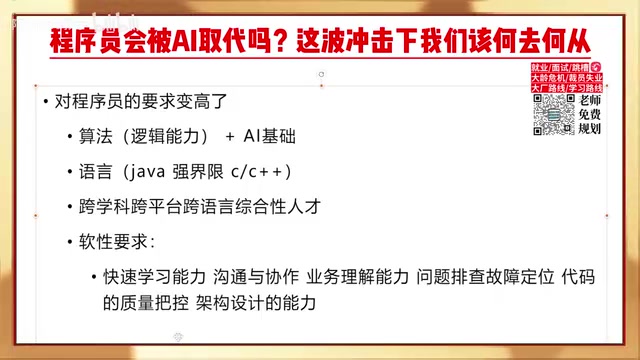
5. Translating Requirements into Deliverable Solutions
Turning vague business requirements into clear, actionable, and verifiable solutions — this isn't something the average programmer can pull off.
Many of the people you'll work with on requirements are non-technical. When someone says "add a pinch of salt," you need to translate that into "add exactly 5.5 grams of salt."
Related articles
 Expert Opinions
Rethinking Scaling Laws: Parameters Are Not the Only Answer
Deep analysis of Scaling Law evolution from Kaplan to Chinchilla to the MoE era, exploring why blindly stacking parameters is a mistake, and how GLM-5.3 proves scaling has multiple knobs.
When AI Treats Humans as Subagents: Ro…
When AI Treats Humans as Subagents: Role Reversal and Hidden Risks in Human-AI Collaboration
Exploring the paradigm shift where humans become "subagents" in AI Agent architectures. Analyzes human node design in LangChain and AutoGen, and the risks of ceding control and cognitive atrophy.
 Expert Opinions
The Lazy Person's Productivity Theory: Why Being 'Lazy' Actually Drives Peak Performance
Explore the engineering philosophy behind 'lazy people are most productive': how constructive laziness drives automation, AI tools amplify efficiency, and systems thinking eliminates wasted effort.