Programmers Transitioning to AI Agent Development: A Path to 30% Higher Salaries

AI Agent roles grow 100%+ yearly with 30% higher salaries; programmers can transition via Java frameworks, but implementation experience is key.
As large models become infrastructure, enterprises need engineering talent who can bring AI into business scenarios. Based on 2,000+ AI Agent job descriptions, Agent roles grow over 100% annually with salaries 30%+ higher than traditional development. The core isn't algorithms but business architecture and orchestration — Java developers can use Spring AI and LangChain4j to enter at low cost. A four-stage path is outlined, with implementation experience as the key asset.
A New Opportunity for Programmers: AI Agent Development
As large models gradually become infrastructure, what enterprises truly lack is no longer algorithm talent to train models, but engineering talent who can bring AI capabilities into specific business scenarios. A Bilibili full-stack Agent development tutorial cites data analysis from a recruitment platform, based on statistics from over 2,000 AI Agent job descriptions: Agent positions are growing at over 100% annually, with salaries 30%+ higher than traditional development roles, starting monthly salaries of 15,000 to 25,000 RMB, and those with 1 to 3 years of implementation experience earning 25,000 to 50,000 RMB.
Behind these numbers is a clear industry signal: large models are the brain of AI, while AI Agents are the hands and feet that bring business to life. What enterprises need are people who can make these "hands and feet" actually move.
Why Agent Development Doesn't Require Algorithm Expertise
A Bilibili content creator offers an insightful judgment in their video: the core of Agent development is not complex algorithms and mathematical derivations, but business architecture and implementation orchestration. This means programmers' existing engineering skills in system design, interface development, and databases can be directly reused, making the transition threshold far lower than pivoting to algorithm research.
This view aligns with analyses from multiple YouTube tech channels on Agent position skill requirements — mainstream job descriptions repeatedly feature keywords like framework usage, business orchestration, and system integration, rather than model training or paper publication.
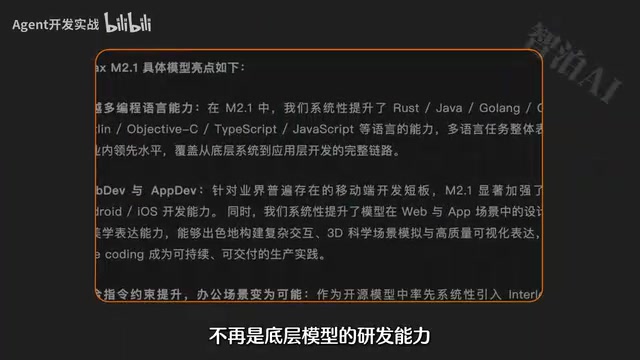
For Java developers, mature frameworks like Spring AI and LangChain4j provide low-cost entry channels. There's no need to learn the Python ecosystem from scratch — existing development experience can be leveraged to quickly build Agent applications.
Function Call is the core mechanism for interaction between large models and external systems. Developers pre-define a set of functions (such as querying a database, calling a weather API, sending emails) and inform the large model of the function signatures and descriptions. When a user asks a question, the model determines based on semantics whether a function needs to be called, which function to call, and what parameters to pass. The application then executes that function and returns the result to the model, which generates the final answer accordingly. This mechanism upgrades large models from "only able to chat" to "able to operate real systems" — it's the foundation of an Agent's ability to act, and one of the key capabilities encapsulated by frameworks like Spring AI.
ReAct (Reasoning + Acting) is a chain-of-thought paradigm that has large models alternate between "reasoning" and "acting." The model first outputs a reasoning step (Thought), deciding what to do next; then executes an action (Action), such as calling a tool or retrieving information; then observes the action result (Observation) and enters the next round of reasoning. This cycle repeats until the task is complete. ReAct enables Agents to handle complex tasks requiring multi-step reasoning and external information coordination, rather than giving an answer all at once.
RAG (Retrieval-Augmented Generation) is a common solution to address outdated knowledge and hallucination issues in large models. Its process: enterprise documents, knowledge bases, and other materials are segmented and vectorized into a vector database; when a user asks a question, the question is first vectorized and the most relevant document fragments are retrieved; these fragments are then assembled as context into the prompt, allowing the model to generate answers based on real materials. RAG enables Agents to reference private knowledge and is the core technology for scenarios like intelligent knowledge bases and enterprise Q&A.
Memory refers to an Agent's ability to retain and utilize historical information during multi-turn conversations or long-term operation. Short-term memory typically refers to the context window of the current session, used to maintain conversational coherence; long-term memory stores user preferences, historical task results, etc. through vector databases or external storage for subsequent retrieval. Memory mechanisms enable Agents to no longer "start from scratch with every conversation," but instead accumulate experience and maintain consistency — an indispensable component of enterprise-grade Agents.
Four-Stage Learning Path
The video outlines a systematic learning path tailored for programmers, divided into four stages.
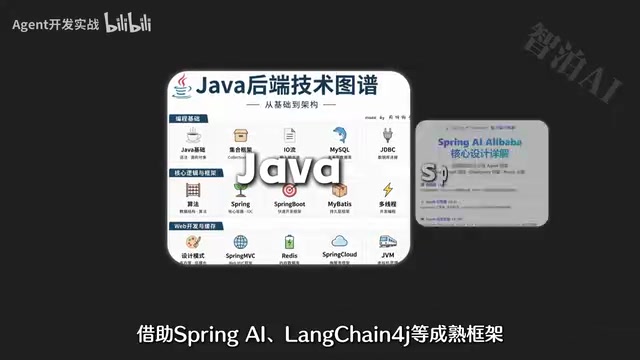
Stage One: AI Engineering Fundamentals
Building on existing Java foundations, the focus is on mastering prompt engineering and the core Function Call mechanism, proficiently using Spring AI to connect with mainstream large model APIs, and implementing model adaptation to business instructions. The goal of this stage is to complete the foundational transition from traditional development to AI engineering development.
Stage Two: Agent Core Architecture
Master the three core technologies of ReAct chain-of-thought, RAG retrieval augmentation, and model memory; clarify the capability boundaries of large models; and understand the core architecture design of AI Agents. This stage addresses the question of "knowing what an Agent can and cannot do."
Multi-Agent Collaboration refers to breaking down complex tasks among multiple Agents with different specialties, completing goals together through division of labor, negotiation, or pipeline approaches. Common patterns include: a supervisor Agent responsible for task decomposition and scheduling, execution Agents handling sub-tasks like retrieval, coding, and review respectively, with Agents sharing intermediate results through message passing. Compared to single Agents, multi-agent systems are better suited for enterprise scenarios with long processes and multiple roles, but they also introduce engineering challenges such as coordination costs, state consistency, and error propagation — therefore typically learned after gaining hands-on single-Agent experience.
Stage Three: Business Project Decomposition
Benchmarking against mainstream enterprise-level projects like intelligent knowledge bases and automated approval, this stage involves hands-on business logic orchestration using LangChain4j, accumulating practical implementation experience and establishing standardized AI engineering thinking.
Stage Four: Complex System in Practice
Learn multi-agent collaboration, task decomposition, and workflow orchestration; independently build enterprise-grade AI Agent projects; optimize system stability; and consolidate implementable practical results.

A Rational View of the Transition Hype
Titles like "Get a Job Right After Learning" and "From Beginner to Expert in Seven Days" carry obvious marketing flavor. According to the Bilibili creator's analysis, Agent positions are indeed growing, but enterprises' emphasis on implementation experience means that learning purely from tutorials is not enough to directly land a high-paying offer.
Another YouTube tech channel offers a similar view: interviews for Agent development positions typically require candidates to demonstrate actual project experience, not merely prove they've taken relevant courses.
For programmers considering a transition, the suggestion is to combine the learning path with actual needs from work — first validating Agent capabilities in small projects, then gradually advancing into complex systems. Opportunities for technological leaps do exist, but implementation capability is always the core bargaining chip.
Enterprise-grade Agent projects differ from tutorial demos mainly in non-functional requirements: handling model call rate limiting and degradation under high concurrency, ensuring idempotency and timeout retries for tool calls, performing permission checks and auditing for sensitive operations, controlling token consumption to reduce costs, and establishing evaluation systems to continuously measure response quality. When interviewers assess implementation experience, they're often looking at whether candidates have encountered and solved these kinds of real engineering problems — not just whether they've run through a demo.
One-line Summary
AI Agent positions are growing at over 100% annually with 30% higher salaries; programmers can transition using Java ecosystem frameworks, but implementation experience is the core bargaining chip.
Paragraph Summary
The article points out that as large models become infrastructure, what enterprises lack is engineering talent who can bring AI capabilities into business scenarios. Based on statistics from over 2,000 AI Agent job descriptions, Agent positions are growing at over 100% annually, with salaries 30%+ higher than traditional development. The article emphasizes that the core of Agent development is not complex algorithms but business architecture and implementation orchestration, and programmers' existing system design and interface development skills can be directly reused. For Java developers, frameworks like Spring AI and LangChain4j provide low-cost entry channels. The article also outlines a four-stage learning path: AI engineering fundamentals, Agent core architecture, business project decomposition, and complex system in practice. Finally, it reminds readers to view the transition hype rationally — enterprises value actual project implementation experience over course completion, and implementation capability is always the core bargaining chip.
Related articles

Chain of Thought Isn't Just for AI: How Humans Can Use CoT to Improve Thinking Quality
Chain of Thought isn't just a prompt trick for large models. Starting from a Hacker News discussion, this article analyzes why CoT works for human thinking too, breaks down actionable ways to transfer it, and highlights the key differences between human CoT and machine CoT.
Cloudflare Teams Up with OpenAI: Closi…
Cloudflare Teams Up with OpenAI: Closing the Loop from Vulnerability Discovery to Defense with AI
Cloudflare uses OpenAI Daybreak to investigate security vulnerabilities and generate reviewable remediation plans, while developers use Codex to boost coding efficiency and quality.

Orca Multi-Agent Orchestration in Practice: A Guide to Parallel Collaboration with Claude and Codex
Orca is Stable AI's free open-source agent workbench supporting 34 agents like Claude Code and Codex in parallel. Learn its Git worktree isolation, multi-model orchestration, and mobile management.