Programming with Paint Brushes, Not Pencils: A Mindset Shift for AI-Assisted Development

AI tools are shifting programming from precise line-by-line writing to bold, iterative, paint brush-style creation.
As AI coding assistants like Cursor and GitHub Copilot transform software development, the programming mindset is evolving from pencil-like precision to paint brush-style rapid iteration. This article explores how "paint brush thinking" lowers experimentation costs, enables creative exploration, and shifts developer core competencies toward architectural design, code aesthetics, and judgment — while cautioning that engineering rigor remains essential.
From Pencils to Paint Brushes: A Shift in Programming Philosophy
"Program with Paint Brushes, Not Pencils" — this vivid metaphor captures a profound transformation in software development in the age of AI-assisted programming. In the traditional view of coding, source code is more like something written with a pencil — every line must be precise and deliberate. A mistake means carefully erasing and rewriting. It's a linear, word-by-word process of craftsmanship.
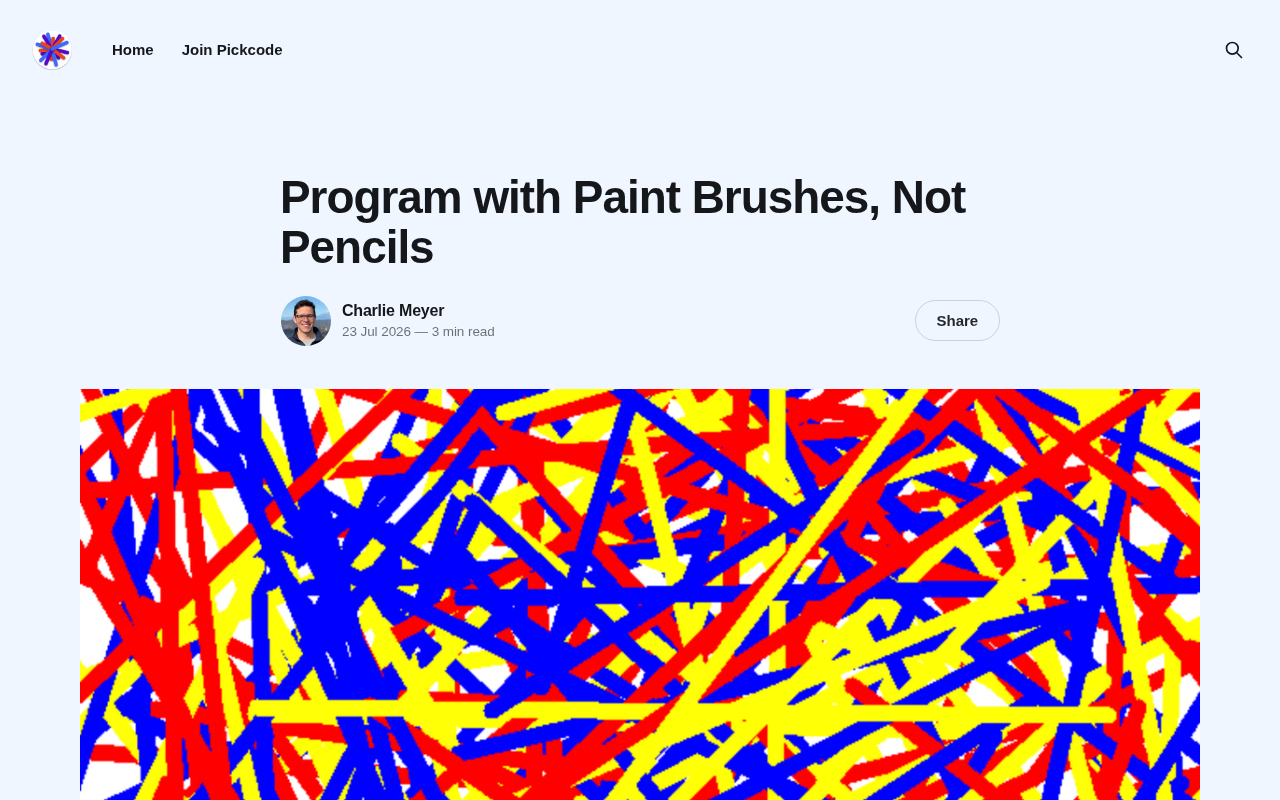
The "paint brush," by contrast, evokes an entirely different creative mindset: bold, iterative, layered, focused on the overall composition rather than pixel-perfect precision. A painter doesn't produce a perfect line on the first stroke. Instead, they build up layers — painting over, correcting, refining — gradually converging on their vision. This shift from "pencil thinking" to "paint brush thinking" is the core experiential change that AI programming tools are bringing to developers today.
Why Traditional Programming Is Like Using a Pencil
The Shackles of Precision
Before AI assistance, programming was fundamentally a high-precision intellectual activity. Developers had to construct a complete mental model of logic, then translate it line by line into code. A single typo, a missing semicolon, or a type mismatch could prevent the entire program from running.
This extreme demand for precision is rooted in how computers work at a fundamental level. Compilers and interpreters are strict formal systems that parse source code character by character according to language specifications — any character that violates syntax rules triggers an error. This stands in stark contrast to the fault tolerance of natural language: a human reader can overlook a typo and still grasp the meaning, but a compiler cannot. Type systems, syntax parse trees, lexical analysis, and other mechanisms collectively form the precision framework of programming languages. Statically typed languages (like Java and Rust) catch type mismatches at compile time, while dynamically typed languages (like Python and JavaScript) offer more flexibility during writing but defer errors to runtime — at the cost of harder-to-debug, hidden bugs. It is this zero-tolerance for imprecision at the machine level that makes programming more akin to "drawing engineering blueprints with a fine pencil" — you must think through every detail before putting pen to paper.
The High Cost of Trial and Error
Another hallmark of pencil thinking is the high cost of experimentation. When you want to try a new implementation approach, you often have to spend significant time rewriting code and restructuring. This cost pushes developers toward "getting it right the first time" rather than rapidly exploring multiple possibilities. The result? Many potentially creative ideas are shelved under the weight of "it's too much trouble."
This phenomenon is closely tied to the practice of "refactoring" in software engineering. Refactoring refers to improving a software system's internal structure without changing its external behavior — Martin Fowler systematized this practice in his classic book Refactoring: Improving the Design of Existing Code. Yet even with mature refactoring methodologies, large-scale structural changes remain time-consuming and risky: they can introduce regression bugs and require extensive test coverage as a safety net. This is why many teams lean conservative on architectural decisions — once a technical approach is chosen, the cost of modification grows exponentially as the project progresses, a phenomenon commonly known as "technical debt" accumulation. It is this heavy cost of experimentation that keeps traditional programming firmly trapped in pencil thinking.
Paint Brush Thinking: A New Way to Program in the AI Era
From Local Precision to Holistic Expression
The emergence of AI programming assistants (such as code generation tools like Cursor and GitHub Copilot) has dramatically shortened the distance from "idea" to "running code." These tools are powered by Large Language Model (LLM) technology — by training on massive open-source codebases and technical documentation, the models learn to understand programming language syntax, design patterns, and common implementation paradigms. GitHub Copilot is built on OpenAI's Codex model (later upgraded to the GPT-4 family), while Cursor is a code editor with deeply integrated AI capabilities that can perceive an entire project's context and provide cross-file code generation and refactoring suggestions.
With these tools, developers no longer need to obsess over the syntactic precision of every line. Instead, they can use natural language or rough intent descriptions to quickly generate code scaffolding. It's like a painter sketching the overall composition with a broad brush before gradually refining the details. This workflow of "describing intent in natural language to generate code" is known in academic circles as "Intent-Driven Programming." In fact, the dream of having humans direct computers using natural language dates back to the 1960s, but limitations in natural language understanding technology kept this vision confined to the laboratory. It wasn't until the breakthroughs in large language models in the 2020s that it moved from theory into daily practice. Of course, the current implementation isn't a perfect "natural language to program" direct conversion — it's closer to a form of human-machine collaboration through "prompt engineering," where developers craft carefully constructed prompts to guide AI toward producing code that meets expectations.
In this model, the developer's role shifts from "word-by-word writer" to "intent expresser" and "reviewer-corrector." Your focus becomes "what effect do I want" rather than "how should each character be written." AI handles the implementation details; humans steer the direction and guard quality.
Rapid Iteration and Low-Cost Experimentation
The core advantage of paint brush thinking lies in the dramatic reduction of experimentation costs. When generating code takes only seconds, exploring multiple implementation approaches becomes genuinely feasible. You can ask AI to generate three different architectural proposals and quickly compare their strengths and weaknesses. You can "paint over" unsatisfactory results without bearing the psychological burden of a full rewrite. This low-friction iteration loop returns programming to its essence: creative exploration.
The Mindset Shift Matters More Than the Tools
Embracing Imperfect First Drafts
The key to adopting paint brush thinking is accepting that "the first draft won't be perfect." A painter never expects the first stroke to be flawless, and programmers should learn to tolerate imperfections in the first version of AI-generated code. The real value lies not in getting it right on the first try, but in the ability to iterate quickly and refine continuously. This requires developers to let go of their obsession with "perfect code" and instead pursue a process of "rapidly converging on correctness."
Taste and Judgment Become Core Competencies
As the act of "writing code" is dramatically simplified by AI, developers' core competencies shift to a higher level. Just as a painter's value lies not in "knowing how to hold a brush" but in their aesthetic sense, compositional ability, and artistic judgment, a programmer's value will increasingly be reflected in architectural design, code aesthetics, requirements understanding, and quality control.
The "code aesthetics" mentioned here is not a vague, subjective concept — it has a rich theoretical foundation. Decades of software engineering have produced a wealth of consensus principles about "good code": the SOLID principles (Single Responsibility, Open-Closed, Liskov Substitution, Interface Segregation, Dependency Inversion) define core norms for object-oriented design; DRY (Don't Repeat Yourself) emphasizes eliminating duplication; KISS (Keep It Simple, Stupid) pursues simplicity. Robert C. Martin's Clean Code elevates code readability to the level of professional craftsmanship. In the age of AI-assisted programming, these principles are more important than ever — AI-generated code often runs, but it doesn't necessarily follow best practices. The ability to distinguish between "code that works" and "elegant code" is precisely where a developer's aesthetic judgment shines.
Whether you can hand-write a loop is no longer critical. Whether you can judge if an AI-generated solution is sound and appropriate for the current context — that is the real dividing line of capability.
Limitations and Reflections on Paint Brush Thinking
While the metaphor is vivid, it has its boundaries. Software is not painting — a piece of code that can't run is meaningless no matter how "beautifully painted" it may be. Programming ultimately must return to precision at some stage; the "rough sketch" generated by AI must eventually be polished into a "precise finished product" that runs correctly.
It's worth noting that the quality and security challenges of AI-generated code are real and serious. A 2022 Stanford University study found that developers using AI code assistants actually wrote less secure code than a control group that didn't use AI — partly because developers developed excessive trust in AI output. Common risks include: AI may generate code containing known vulnerability patterns (such as SQL injection or buffer overflows); it may introduce open-source code snippets with license compliance issues; and it may produce logic errors that appear correct but fail under edge conditions — so-called "hallucinated code." These risks make code review, automated testing, and static analysis tools even more indispensable in the AI programming era.
A more accurate understanding, then, might be this: modern AI-assisted programming is a composite process of "sketching with a paint brush first, then refining with a pencil." AI enables us to explore and build rapidly in paint brush mode, but the hard requirements of engineering quality, security, and maintainability still demand pencil-like rigor from developers. The truly effective developer is one who can switch fluidly between these two modes.
Conclusion
"Programming with paint brushes, not pencils" is more than a tactical tip — it represents a fundamental mindset shift for the AI era. It reminds us that when the barrier to using creative tools drops, creators need to elevate their taste, judgment, and holistic vision. The pencil era cultivated precise craftspeople; the paint brush era calls for visionary creators. This dual transformation — of both tools and mindset — is redefining what it means to be an "excellent programmer."
Related articles

Techietribe AI Review: An All-in-One Online Presence Management Platform for Small Businesses
In-depth review of Techietribe AI, an all-in-one online presence platform for small businesses, covering AI website building, business profiles, and integrated directories.
Ressearch AI: A Deep Dive into the AI-Powered Reproducible Research Workbench
Ressearch AI is an AI workbench for reproducible research, integrating literature search, data analysis, Python/R coding, visualization, and scientific writing. A deep dive into its cloud sandbox, traceable workflows, and more.

A Startup's Field Guide to AWS Cognito: Hidden Costs and Alternatives You Should Know
A deep dive into the real pain points of AWS Cognito for startups — hidden costs, vendor lock-in, and developer friction — plus a comparison of Auth0, Clerk, and other alternatives.