Prompt Engineering for Beginners: Core Concepts from Prompts to Engineering

Prompt engineering is a systematic methodology that improves AI output quality but has inherent limitations and must be combined with code.
Based on the first lecture of Bilibili UP host "Zhibo AI Broker's" Prompt Engineering course, this article systematically explains core concepts of prompts and prompt engineering. Prompts serve four functions: communication bridge, task navigation, style control, and boundary constraints. Prompt engineering is a six-step methodology solving categories of problems, aiming to improve accuracy, reduce hallucinations, enhance stability, and lower costs. The article also notes over 90% of users only use basic Q&A, and that prompts have inherent limitations requiring enterprise solutions to combine prompts with code.
In an era where AI capabilities are evolving rapidly, most people still interact with AI in the most basic way—send a message, wait for a response. But with the same model, some people use it to write elementary school essays while others generate professional industry reports. The difference isn't in the AI itself—it's in the instructions you give it. In the first lecture of his "Prompt Engineering" series on Bilibili, UP host "Zhibo AI Broker" systematically laid out the core concepts of prompts and prompt engineering. This article provides an in-depth analysis based on that course content.
What Is a Prompt: Far More Than "Sending a Message to AI"
A prompt is, simply put, any instruction we give to AI—whether it's a question, a description, or a request, it all falls under the category of prompts. The host used a vivid analogy: a prompt is like a neuron signal you send to AI—whatever signal you send, AI responds in that direction.
This sounds simple, but in practice, many people stumble right at the first step. The ideas in your head are vague, while AI can only understand explicit instructions. The core function of a prompt is to translate those unclear needs into language AI can comprehend.
Specifically, prompts serve four functions:
Communication bridge is the most fundamental layer. Just as you can't order takeout by only saying "give me some food"—you need to specify the dish, spice level, and whether to add rice—prompts do the same translation work.
Task navigation determines AI's execution direction. A single "help me process this document" leaves AI with no idea whether you want statistical analysis, visualization, or a summary. A good prompt gives AI clear goals and boundaries, just as navigation needs an accurate destination—otherwise it will drive everywhere aimlessly.
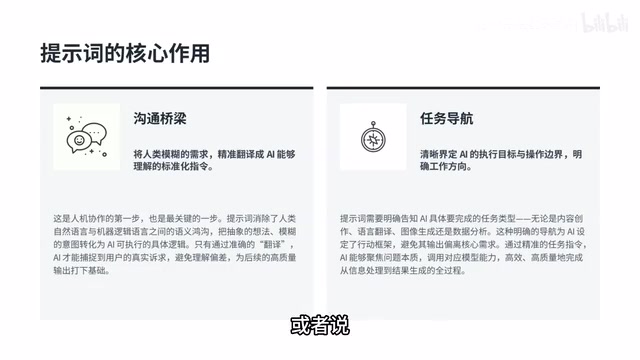
Style control is a step many overlook but is extremely critical. Business emails and social media posts have completely different styles. Through prompts, you can have AI mimic Lu Xun's tone to write commentary, or write a diary in a schoolchild's voice, saving enormous time on post-editing.
Boundary constraints are an effective means of dealing with AI's tendency to "talk nonsense." An unrestricted AI can ramble from one point to something completely unrelated, and will fabricate information that doesn't exist. Explicitly telling it what can and cannot be said keeps the output focused.
The host demonstrated an intuitive comparison in the course: with the basic prompt "write an article about spring," AI can only guess—which season's spring? North or south? Essay or argumentative piece? The final result is generic. But an optimized prompt specifies the identity (prose writer), word count (800 words), setting (spring in Jiangnan), and style (beautiful language, lyrical, misty rain over a water town), and the output quality immediately stands apart.
Prompts vs. Prompt Engineering: One-off Tricks vs. Systematic Methods
This is the most critical conceptual dividing line in the course. Many people conflate these two concepts, but they are vastly different.
A prompt is one-off—like writing a single line of code that executes once and solves one problem. It works this time, but may fail on a different problem. The host stated bluntly: "Many people say they have a universal prompt—that's all fake. There's no universal prompt, only prompts suited to specific scenarios."
Prompt engineering, on the other hand, is a complete methodology. Without modifying AI's code or parameters, it designs input instructions to make general-purpose AI models reliably output the results you want. It doesn't rely on inspiration—it relies on a scientific process.
This process consists of six steps: requirement decomposition, solution design, execution and testing, effect evaluation, strategy iteration, and consolidation for reuse. From analyzing the problem, to continuous optimization, to consolidating into reusable solutions—you're no longer solving a single problem, but a category of problems. The host pointed out that this process is very similar to software development, except what you're writing isn't code—it's natural language.
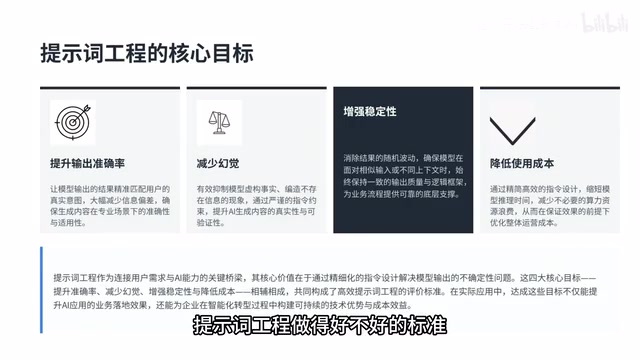
The ultimate goals of prompt engineering can be summarized in four dimensions: improving accuracy, reducing hallucinations, enhancing stability, and lowering costs. Getting the best results with the fewest tokens—these four goals are also the criteria for evaluating whether a prompt engineering solution is successful.
Token is the basic unit of text processing in large language models, roughly understood as a "word fragment." In English, a single word may be split into multiple tokens; in Chinese, one character typically corresponds to 1-2 tokens. Models charge by token count and also limit context length by token count. Therefore, the longer the prompt, the more tokens consumed and the higher the cost; when a prompt exceeds the model's maximum context window, the model "forgets" the earliest content. Understanding the token mechanism explains why redundant prompts not only waste money but may also degrade output quality—irrelevant information dilutes the truly important instructions.
Why You Must Learn Prompt Engineering Now
The reason is quite straightforward. Current AI capabilities are already strong enough, yet data shows over 90% of users only use AI for basic Q&A. The host made an analogy: it's like buying a sports car but only driving it in first gear.
The barrier to learning prompt engineering is extremely low—no programming background needed, no need to understand algorithms. As long as you can speak and articulate things clearly, you can learn it. But the returns are considerable. The most direct benefit is efficiency improvement—work that used to take a full day can now be completed in an hour.
Beyond efficiency, prompt engineering has tangible commercial value. Enterprises and content creators need people who can use AI to optimize prompts or generate content—it costs almost nothing and can be done in spare time. At the entrepreneurial level, projects that previously required a team can now be advanced by one person with AI, with extremely low trial-and-error costs and rapid idea validation. In the content creation space, this is even more true—where you used to write 10 articles a month, now with AI you can produce dozens without compromising quality.
Context Window is the maximum number of tokens a model can "remember" in a single conversation, including system instructions, conversation history, and current input. Early models had context windows of only a few thousand tokens; today's mainstream models have expanded to tens of thousands or even hundreds of thousands of tokens. But no matter how large the window, there's still a limit, and models have weaker attention to information in the middle—a phenomenon known as "lost in the middle." Therefore, common strategies for handling long documents include chunked summarization, Retrieval-Augmented Generation (RAG), or external vector databases, rather than cramming everything into a single prompt.
The Limitations of Prompts: They're Not a Master Key
In the final section of the course, the host spent considerable time discussing limitations—and this part is actually the most worthy of serious attention.
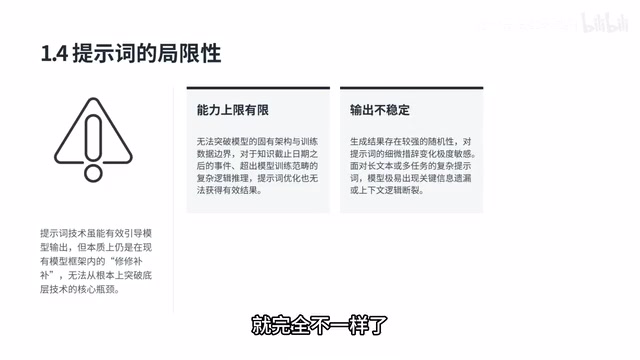
The capability ceiling cannot be broken through. AI's training data has a cutoff date; ask it about things after that date and it cannot give reliable answers. No matter how complex the math problem, if AI can't calculate it, no amount of prompt optimization will help.
Output is unstable. Sometimes changing a single word produces a completely different result. When prompts are too long, AI "forgets" things—requirements stated earlier are no longer remembered later.
Hallucinations cannot be eliminated. Prompt optimization can only reduce hallucinations, not completely eradicate them. As long as it's a large model, it will inevitably fabricate things—important matters must be verified by humans.
From a technical perspective, there are three structural limitations: context length is constrained by the model's "memory capacity"; complex multi-step tasks tend to skip steps and break logic, requiring decomposition into smaller tasks before handing them to AI; and every conversation is brand new to AI—it has no true long-term memory and cannot remember your preferences or background. This problem can only be solved through external databases.
There are pitfalls at the implementation level too. Safety and alignment restrictions sometimes misjudge and block completely legitimate requests; personal use is fine, but when building a product for hundreds or thousands of users, prompts alone cannot provide version management and issue tracking—enterprise-level applications must combine prompts with code. Cost traps are also easily overlooked—AI charges by token, longer prompts cost more, and hidden costs can be alarmingly high with frequent API calls.
These limitations are not meant to deny the value of prompt engineering, but rather to establish a clear understanding: it is a useful tool, but not a master key. What should be done by humans still needs to be done by humans.
This article is based on and analyzes the first lecture of the "Prompt Engineering" series by Bilibili UP host "Zhibo AI Broker." The course has 100 episodes, systematically teaching prompt engineering methodology from zero fundamentals to advanced topics.
Hallucination refers to large language models generating content that seems plausible but is actually incorrect or fabricated—such as inventing non-existent papers, legal provisions, or statistics. The root cause is that models are fundamentally predicting the next token based on probability, rather than querying a factual database, so they prioritize language fluency over factual accuracy. Prompt optimization can reduce the frequency of hallucinations—for example, by asking the model to "say you don't know if uncertain" or "only answer based on the given materials"—but cannot fundamentally eliminate them. In high-risk scenarios such as healthcare, law, and finance, AI output must be verified by humans before use.
One-line Summary
Prompt engineering is a systematic methodology that improves AI output quality but has inherent limitations and must be combined with code for real-world implementation.
Paragraph Summary
Based on the first lecture of the "Prompt Engineering" course by Bilibili UP host "Zhibo AI Broker," this article systematically explains the core concepts of prompts and prompt engineering. A prompt is an instruction given to AI, serving four functions: communication bridge, task navigation, style control, and boundary constraints—essentially translating vague needs into explicit instructions AI can understand. Prompt engineering is a six-step systematic methodology that solves "a category of problems" rather than a single problem, aiming to improve accuracy, reduce hallucinations, enhance stability, and lower costs. The article also notes that over 90% of users currently only use basic Q&A, and that learning prompt engineering has a low barrier but high commercial value. Meanwhile, prompts have inherent limitations: they cannot break through AI's capability ceiling, output is unstable, and hallucinations cannot be eliminated, along with technical implementation issues such as limited context, no long-term memory, and cost traps. Enterprise-level applications require combining prompts with code.
Related articles

How Big Can Stars Really Get? The Physical Limits of the Largest Stars
Red supergiants are the largest stars by volume, with radii up to 2,000 times the Sun, engulfing the inner solar system. But there is no precise upper limit on stellar size—models predict up to 15,000 solar radii. The most massive blue stars are far smaller than red supergiants—biggest and heaviest are two different things.

Apple HomeView Smart Display Full Feature Breakdown: Wall-Mount or Desktop, $299
Apple launches HomeView, a $299 smart display with wall-mount and desktop options, 12MP camera for facial recognition, smart home control, music playback, and recipe step-by-step cooking. Full breakdown of watch faces, apps, privacy, and cooking integration.

Where Did the Promised New Studio Go? Craft Computing Answers After Five Years
Craft Computing's host responds to viewer questions: the new studio promised five years ago was shelved as construction costs soared from $30,000 to $75,000, and was replaced by a 168-square-foot garage conversion.