Prompt Engineering for Beginners: From Concepts to Practice, All You Need Is This One Article

A prompt is a single instruction; prompt engineering is a reusable methodology with clear boundaries and limitations.
Based on the first lesson of a popular Bilibili tutorial, this article systematically explains prompts and prompt engineering. A prompt is a single instruction to AI with four roles: communication bridge, task navigation, style control, and boundary constraints. Prompt engineering is a reusable methodology that, without modifying model parameters, designs inputs to make AI reliably output results. It follows a six-step process—requirement decomposition, solution design, execution and testing, effect evaluation, strategy iteration, and accumulation and reuse—aiming to improve accuracy, reduce hallucinations, enhance stability, and lower costs. The article also stresses its limitations: it cannot exceed AI's capability ceiling, output is unstable, and hallucinations cannot be eliminated, plus technical constraints like context length and lack of long-term memory, and implementation issues like security alignment, difficulty in engineering, and token costs. Enterprise applications require combining prompts with code.
Prompt Engineering is becoming one of the most talked-about skills in the AI era. But many people's understanding of it still stops at "sending messages to AI," which is far from enough. There is a tutorial on Bilibili that netizens call "the only one that explains prompt engineering thoroughly." Based on its first lesson, this article systematically sorts out the core concepts, methodology, and limitations of prompts and prompt engineering, helping you build a clear cognitive framework.
1. Prompts: The "Neuron Signals" You Send to AI
A prompt is any instruction we give to AI, whether a question or a description. It's like the neuron signals you send to AI—whatever signal you send, AI thinks in that direction.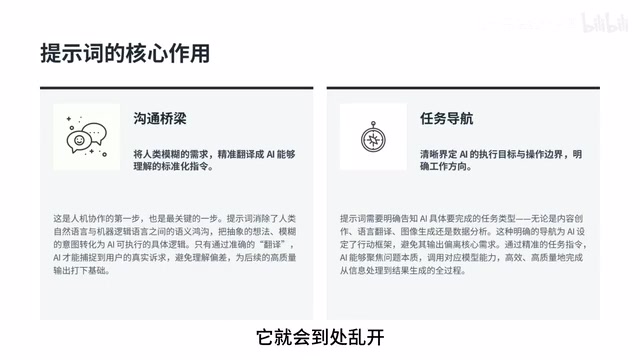
With the same AI, some people can only get it to write elementary-school essays, while others can get it to produce professional industry reports. The difference isn't in the AI itself, but in the input prompt. Only through directive language can we establish effective communication with AI and guide it to produce the results we want.
The Four Roles of Prompts
Communication bridge: Translating vague needs into clear instructions that AI can understand. It's like ordering takeout—you can't just say "bring me some food"; you have to specify the dish, spice level, and whether to add rice.
Task navigation: Telling AI exactly what to do. "Help me process the file" is too vague—AI can only pick a processing method at random, which is most likely not what you want.
Style control: Getting AI to write comments in Lu Xun's style, keep a diary in an elementary student's tone, or write a paper in academic language. AI defaults to a generic style, and style control can save a lot of revision time.
Boundary constraints: One of the most effective ways to solve AI's "talking nonsense." Tell AI what it can and cannot say—for example, when analyzing data, limit it to specific quarterly financial reports and don't drag in macroeconomic policy, and the output will be more focused.
From Basic to Optimized: An Intuitive Comparison
The basic prompt "Write an article about spring" is too broad—northern or southern? Prose or narrative? How long? What style? AI can only guess blindly, resulting in cookie-cutter output.
The optimized prompt includes: identity (you are a prose writer), word count (800 words), setting (spring in Jiangnan), and style (beautiful language, focusing on the misty and rainy water-town atmosphere). From a vague request to executable rules, the output quality is naturally different.
2. Prompt Engineering: A Reusable Methodology
Many people conflate prompts with prompt engineering, but the difference is significant. A prompt is a one-off thing, like writing a line of code and executing it once; prompt engineering is a complete methodology—without modifying AI code or parameters, it uses designed input instructions to make AI reliably output the desired results.
The claim "I have a universal prompt" is deceptive. There is no universal prompt, only prompts suited to specific scenarios. Prompt engineering doesn't solve a single problem; it solves a class of problems.
The Six-Step Process
- Requirement decomposition: Break complex, large problems into small problems that AI can solve.
- Solution design: Design prompts and roles for the decomposed problems.
- Execution and testing: Actually run it to see the effect.
- Effect evaluation: Judge the results with specific criteria.
- Strategy iteration: Continuously optimize what isn't good.
- Accumulation and reuse: Save useful solutions for direct use later.
This process is very similar to software development, except what you're writing isn't code, but natural language.
The Four Goals
Improve accuracy (AI says exactly what you want), reduce hallucinations (less making things up), enhance stability (results are similar regardless of who uses it or when), and lower costs (get the best results with the fewest tokens). These four points are also the criteria for evaluating how well prompt engineering is done.
Token is the basic unit of measurement for how large models process text, and can be roughly understood as a "word fragment": in English, a word may be split into 1–2 tokens, while in Chinese a single character usually takes about 1–2 tokens. A model's context window, billing, and generation speed are all calculated in tokens. This means the longer the prompt and the more conversation history, the more context is occupied and the higher the cost, while the less room is left for the model to "think." Understanding tokens helps explain two phenomena mentioned in the article: first, long prompts make AI "forget things" because earlier content may be pushed out of the context window; second, costs don't grow linearly—with input and output tokens combined, high-frequency calls quickly accumulate expenses. Therefore, when designing prompts, concise and structured expression is not just a matter of style, but an engineering means of controlling cost and stability.
Hallucination refers to large models generating content that looks plausible but is actually factually incorrect or fabricated out of thin air. The root cause is that the model is essentially predicting the next token based on probability rather than querying a factual database, so when there is insufficient context or in domains with sparse training data, it easily "confidently fabricates." In prompt engineering, boundary constraints, requiring the model to cite sources, limiting the scope of answers, and requiring it to clearly state when uncertain are all common mitigation methods. But hallucination is bound to the model's generation mechanism and can only be reduced in probability, not eliminated. This also explains why the article emphasizes that important matters must be manually verified—especially in high-risk scenarios such as law, healthcare, and finance, where no unverified AI output can be directly trusted.
3. Why Learn Prompt Engineering Now
Data shows that over 90% of users only use AI for basic Q&A. It's like buying a sports car but only driving in first gear—such a waste.
The barrier to learning prompt engineering is extremely low—you don't need to know programming or algorithms; as long as you can speak and express things clearly, you can learn it. The most direct benefit is efficiency improvement: what used to take a day might be done in an hour, and you can also complete tasks that AI previously couldn't do, such as professional reports and complex data analysis.
The commercial value is also considerable. Helping companies or self-media optimize prompts and using AI to generate content can be a side hustle in your spare time; when starting a business, one person can do the work of an entire team, with low trial-and-error costs and fast idea validation; for self-media, going from 10 posts a month to dozens can quickly build followers and monetize. Prompt engineering is not just a skill, but an opportunity in the AI era.
4. Limitations You Must Recognize
Prompts are not omnipotent; they have clear boundaries.
Cannot exceed AI's capability ceiling: Training data only goes up to a certain point in time, and it doesn't know what happened after; no matter how optimized the prompt is, it won't help with the most complex math problems.
Unstable output: Changing one word can produce a completely different result; if the prompt is too long, AI "forgets things"—it doesn't remember what was said earlier.
Hallucination cannot be eliminated: Prompt optimization can only reduce hallucinations, not completely eliminate them. Always verify important matters yourself.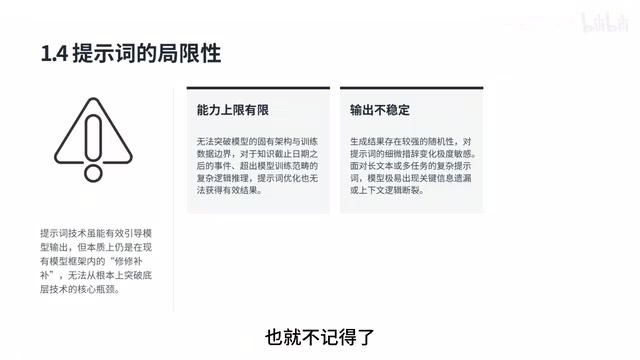
Three Technical Limitations
- Limited context length: Like a phone's RAM—open too many apps and it clears background processes. If the prompt is too long or the conversation goes on too long, AI forgets the original requirements.
- Instability on complex tasks: One-step tasks are fine, but multi-step calculations easily skip steps and break logic, so you must first break them into small tasks.
- No true long-term memory: Every conversation is brand new; it can't remember your preferences and background, which can only be solved with an additional database.
These three problems are determined by the underlying technology; prompts can only optimize and mitigate them, not cure them.
Context Window refers to the upper limit of the total number of tokens a model can "see" simultaneously in a single conversation, including the system prompt, historical conversation, and current input. It's similar to working memory: early content beyond the window is truncated or compressed, and the model can no longer reference it. Window sizes vary greatly across models, ranging from a few thousand to over a million tokens. This directly determines the feasibility of long-document analysis and complex multi-turn conversations, and is also the technical reason behind "AI forgets things when the prompt is too long" and "forgets the original requirements after chatting too long" mentioned in the article. Common practical responses include: placing key constraints at the beginning and end, regularly summarizing historical conversations, splitting long tasks into multiple short sessions, or using external retrieval to dynamically inject relevant content into the window instead of piling all information into the prompt at once.
Three Pitfalls in Implementation
- Security and alignment restrictions: Illegal or non-compliant content is absolutely not allowed, but completely legitimate requests may also be mistakenly blocked—a common problem for all large models.
- Pure prompts cannot be engineered: Using them yourself is fine, but making them into a product for hundreds or thousands of users won't work—there's no version management or issue tracing, and it can't handle large-scale batch tasks. Enterprise-level applications must combine prompts with code.
- Cost trap: AI charges by token, so the longer the prompt, the more expensive it is, and costs don't grow linearly—hidden costs are staggering with high-frequency calls. Always write prompts concisely.
Build a correct understanding of prompt engineering: it is indeed a useful tool, but not a master key—what should be done manually still has to be done manually. Understanding these pitfalls in advance is the way to avoid detours.
One-line Summary
A prompt is a single instruction; prompt engineering is a reusable methodology with clear boundaries and limitations.
Paragraph Summary
Based on the first lesson of a popular Bilibili tutorial, this article systematically sorts out the core understanding of prompts and prompt engineering. A prompt is a single instruction given to AI, with four roles: communication bridge, task navigation, style control, and boundary constraints; prompt engineering is a class of problem-solving solutions that, without modifying model parameters, only designs inputs to make AI reliably output results. It includes a six-step process—requirement decomposition, solution design, execution and testing, effect evaluation, strategy iteration, and accumulation and reuse—with the goals of improving accuracy, reducing hallucinations, enhancing stability, and lowering costs. The article also emphasizes its limitations: it cannot exceed AI's capability ceiling, output is unstable, and hallucinations cannot be eliminated, and it is subject to technical limitations such as context length, complex-task stability, and lack of long-term memory, as well as implementation issues like security alignment, difficulty in engineering, and token costs. Enterprise-level applications require combining prompts with code.
Related articles

Chain of Thought Isn't Just for AI: How Humans Can Use CoT to Improve Thinking Quality
Chain of Thought isn't just a prompt trick for large models. Starting from a Hacker News discussion, this article analyzes why CoT works for human thinking too, breaks down actionable ways to transfer it, and highlights the key differences between human CoT and machine CoT.
Cloudflare Teams Up with OpenAI: Closi…
Cloudflare Teams Up with OpenAI: Closing the Loop from Vulnerability Discovery to Defense with AI
Cloudflare uses OpenAI Daybreak to investigate security vulnerabilities and generate reviewable remediation plans, while developers use Codex to boost coding efficiency and quality.

Orca Multi-Agent Orchestration in Practice: A Guide to Parallel Collaboration with Claude and Codex
Orca is Stable AI's free open-source agent workbench supporting 34 agents like Claude Code and Codex in parallel. Learn its Git worktree isolation, multi-model orchestration, and mobile management.