Prompt Engineering for Beginners: From Writing Instructions to Designing AI Workflows

Prompt engineering is a methodology for turning vague requirements into reusable processes, not a universal template.
Based on a Bilibili tutorial, the article systematically organizes prompt engineering fundamentals: prompts aren't just messages but a control mechanism for communication, task navigation, style control, and boundary constraints, translating vague needs into executable rules. It distinguishes one-off prompts from prompt engineering—a reusable six-step process (requirement decomposition, design, testing, evaluation, iteration, reuse) measured by accuracy, hallucination control, stability, and cost—and honestly lists technical limits and implementation pitfalls, concluding that prompts are tools, not master keys.
Many people think prompting is just sending a message to AI and getting an answer to whatever they ask. But with the same model, some people can only get elementary-school essays out of it, while others produce professional industry reports—the difference isn't the model itself, but the instructions you feed it. This tutorial from Bilibili lays out the fundamentals of prompt engineering quite systematically, and this article organizes and extends the video's content.
Prompting Isn't Just "Sending a Message"—It's Four Control Levers for AI
The video opens with a very intuitive metaphor: prompts are like the neuron signals you send to AI—whatever signal you send, that's the direction AI thinks in. This captures the essence: prompts are the most direct means we have to establish effective communication with AI and guide it toward the target output.
Broken down, prompts serve four types of functions:
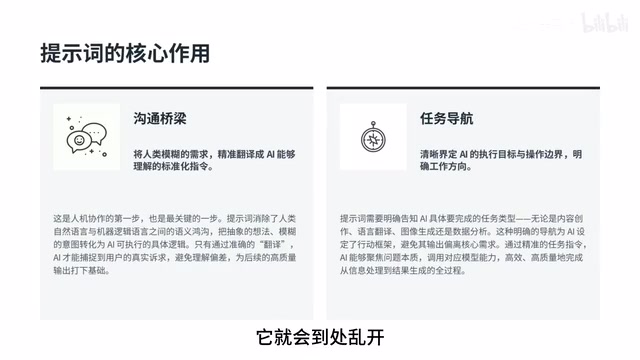
Communication bridge is the most basic layer. The ideas in your head are often vague, but AI only understands explicit instructions. You can't just say "bring me some food" when ordering delivery—you have to specify the dish, spice level, and whether you want extra rice. What prompts do is translate the fuzzy requirements in your head into clear language AI can execute.
Task navigation determines whether AI goes off track. A vague "help me process this file" leaves AI with no idea whether you want statistical analysis, visualization, or a summary—it can only pick one at random, and it's probably not what you wanted. Good prompts provide clear goals and boundaries, like entering an accurate destination into a GPS.
Style control is an easily overlooked aspect. The tone of a business email and a social media post are worlds apart, and AI's default general-purpose style is neutral but characterless. Through prompts, you can switch the model into a prose writer, rigorous academic language, or even a specific persona, reducing the amount of post-editing needed.
Boundary constraints are one of the effective ways to deal with "making things up." AI is incredibly talkative—without limits, it can ramble from one point to a thousand miles away, and it will fabricate nonexistent content. Clearly telling it what it can and cannot say keeps the output focused.
The video gives a comparison: the basic prompt is "write an article about spring," and the problem is it's too broad—spring in the north or south? Prose or preface? How long? What style? AI can only guess, and the results are cookie-cutter. The optimized version first assigns an identity: "You are a prose writer," sets a length of 800 words, limits the scene to "spring in Jiangnan," and requires the style to be "beautiful, lyrical language, focusing on the misty, rainy ambiance of the water towns." From vague requirements to executable rules—naturally the output is different.
Role Prompting is the technique behind "You are a prose writer" in the optimization example above. It works by presetting an identity for the model, activating the corpus distribution associated with that identity in the training data, thereby constraining the tone, depth of knowledge, and expression habits of the output. Role prompting is effective because large models have seen massive amounts of text patterns like "a writer writing prose" or "a lawyer drafting a contract" during pretraining—identity prompts essentially retrieve these patterns during generation. In practice, the more specific the role, the better—"senior financial journalist" locks in style better than "professional," but you should also note that roles cannot break through the model's inherent capability boundaries.
Prompts vs. Prompt Engineering: The Difference Between One-Off Inspiration and a Reusable Process
This is the most critical conceptual distinction in the article. Many people conflate the two, but the difference is significant.
A prompt is one-off—like writing a line of code to execute once and solve one problem. What works this time may fail with a different problem. The video states it directly: so-called "universal prompts" are all scams; only prompts suited to specific scenarios exist.
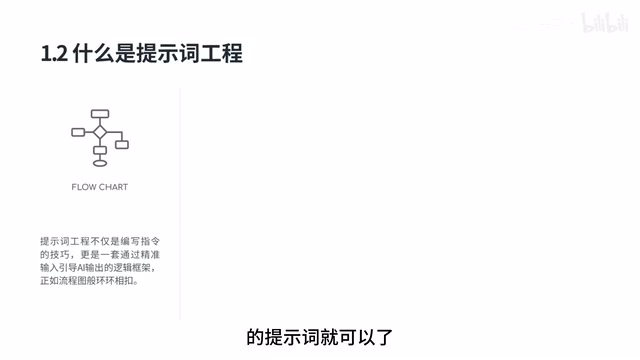
Prompt engineering, on the other hand, is a complete methodology—without modifying AI's own code or parameters, it designs input instructions to make a general-purpose model reliably produce the desired output. It doesn't rely on inspiration; it relies on process. It solves not one problem but a class of problems.
The video breaks the process into six steps: requirement decomposition (breaking a big problem into small problems AI can handle), solution design (designing corresponding prompts and roles), execution testing (actually running it), effect evaluation (judging quality with specific criteria), strategy iteration (revising if it's not good), and consolidation for reuse (saving good solutions for direct use in similar scenarios). This process is very similar to software development—except you're writing natural language instead of code.
To measure whether prompt engineering is done well, the video offers four goals: improve accuracy, reduce hallucinations, enhance stability (results are similar regardless of who uses it or when), and lower cost (get the best results with the fewest tokens).
Token is the smallest unit of text that large models process, roughly understood as a "word piece": in English, a common word is about one token, while in Chinese, one character typically occupies 1 to 2 tokens. A model's context window, billing method, and "forgetfulness" phenomenon are all directly related to tokens—context length is the total number of tokens the model can hold at once, and content beyond that gets truncated or discarded. This is also the technical root of what the article says about "prompts too long, AI forgets things" and "billing by token, with non-linear cost growth." Controlling redundant phrasing in prompts and processing long documents in segments are essentially about managing token budgets.
Why Learn This Now: Low Barrier and High Leverage Coexist
The video cites a statistic: over 90% of users only use AI for basic Q&A. The analogy of driving a sports car in first gear is quite apt.
The barrier to learning prompt engineering is indeed low—no programming or algorithm background needed; if you can talk and articulate things clearly, you can get started. The direct benefit is efficiency—what used to take a day might be done in an hour. On the commercial value side, the video lists several directions: helping businesses and independent media optimize prompts or generate content as a side hustle, using AI to do a whole team's work alone to reduce startup trial-and-error costs, and using AI to mass-produce content to accelerate independent media growth. Whether these directions suit everyone is another matter, but the judgment that AI collaboration skills are becoming a general-purpose skill holds true.

The Limits of Prompting: It's Not a Master Key
The latter half of the video specifically addresses limitations—this part is more down-to-earth than most tutorials.
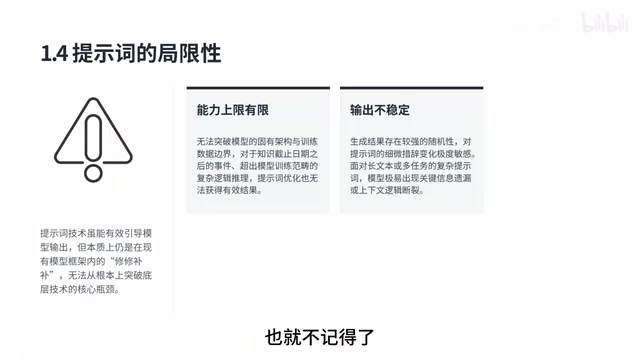
Capability ceilings cannot be broken. AI training data has a cutoff date, and it doesn't know things that happened afterward; no matter how complex a math problem is, if it can't calculate it, it can't—optimizing prompts won't help.
Output is unstable. Changing one word can produce completely different results; prompts too long cause AI to "forget things," not remembering what was said earlier.
Hallucinations cannot be eradicated. Prompt optimization can only reduce hallucinations, not eliminate them completely. As long as it's a large model, it will make things up—important matters must be verified yourself.
At the technical level, there are three hard constraints: limited context length, like a phone's RAM—chat too long and it will "clear the background" and forget the initial requirements; instability on complex tasks—multi-step calculations and proposal writing tend to skip steps and break logic, so tasks must be broken into smaller ones first; and no true long-term memory—each conversation is brand new, unable to remember your preferences and background, which can only be compensated for with external databases. These three problems are determined by the underlying technology; prompts can only mitigate them, not cure them.
At the implementation level, there are three more pitfalls: safety and alignment restrictions occasionally misjudge and block completely legitimate requests; pure prompting cannot be engineered—fine for personal use, but when made into a product for hundreds or thousands of users, it can't handle version management and issue traceability; enterprise-grade applications must combine prompts with code; and the cost trap—AI charges by token, longer prompts cost more with non-linear cost growth, and hidden costs can be scary high with frequent calls, so prompts should be concise.
Hallucination refers to the model generating content that seems plausible but doesn't match facts—such as fabricating nonexistent literature, data, or people. It's not a program bug but an inherent product of the autoregressive generation mechanism: the model's goal is to predict "the next most likely token" rather than retrieve truth, so it will still fluently "complete" an answer when lacking reliable evidence. Common industry mitigation methods include Retrieval-Augmented Generation (RAG, which looks up information before answering), requiring the model to flag uncertainty and cite sources, and reducing sampling randomness—but all can only lower the probability, not bring it to zero, which is why the article emphasizes that "important matters must be verified yourself."
Summary
The value of this tutorial lies in pulling "prompt engineering" back from mysticism into methodology: it has a clear process, measurable goals, and real boundaries. For beginners, first establishing the understanding that "one-off prompts ≠ engineering capability," then walking through the process from requirement decomposition to consolidation for reuse, is far more useful than hoarding so-called universal templates. Also remember the video's final reminder: prompts are tools, not master keys—what needs human verification still needs human verification.
One-line Summary
Prompt engineering is a methodology for translating vague requirements into reusable processes, not a universal template.
Paragraph Summary
Based on a Bilibili tutorial, the article systematically organizes the fundamentals of prompt engineering: prompting isn't just sending messages but a control mechanism serving four functions—communication bridge, task navigation, style control, and boundary constraints—the core being to translate vague requirements into clear, AI-executable rules. The article focuses on distinguishing "prompts" from "prompt engineering"—the former being one-off instructions, the latter a reusable six-step process including requirement decomposition, solution design, execution testing, effect evaluation, strategy iteration, and consolidation for reuse, measured by four dimensions: accuracy, hallucination control, stability, and cost. The article also notes the low learning barrier but high leverage, while honestly listing technical limitations such as model capability ceilings, output instability, and eradicable hallucinations, as well as implementation pitfalls like safety misjudgments, inability to engineer, and token costs—concluding that prompts are tools, not master keys.
Related articles

Xenon Flash Bug Returns: Radxa Dragon Q8B Affected
The Xenon flash bug resurfaces, this time on the Radxa Dragon Q8B board. This article reviews early Hacker News discussion and analyzes the potential impact and community concerns.

ChatGPT Plus Subscription Guide for Users in China: Official Top-Up Channel Walkthrough and Comparison
A complete guide to subscribing to ChatGPT Plus from China via official top-up platforms: plan selection, account login, copying account info, payment verification, plus a comparison of top-up, proxy, and self-supplied card channels.

The Complete Guide to Subscribing to ChatGPT Plus in China: Hands-On Walkthrough of Third-Party Top-Up Channels and Risk Analysis
How can users in China subscribe to ChatGPT Plus? This article breaks down the complete process of third-party top-up platforms, analyzes account security, renewal sustainability, and risk-control risks to help you decide which subscription option suits you better.