Prompt Engineering for Beginners: From Writing Prompts to Building AI Collaboration Skills

Prompt engineering is a systematic method for translating fuzzy needs into AI-executable instructions—with boundaries and value.
Based on a Bilibili prompt engineering course, this article systematically outlines the path from writing prompts to building AI collaboration skills. It clarifies the nature of prompts—the most direct means of controlling AI—serving four functions: communication bridge, task navigation, style control, and boundary constraints. It distinguishes prompts from prompt engineering (a six-step process), explains the practical significance and business value, and focuses on three layers of limitations plus technical hard constraints and the cost trap, concluding that prompts are "a tool, not a master key."
Prompt Engineering for Beginners: From Writing Prompts to Building AI Collaboration Skills
The same AI—some people can only get it to write elementary-school essays, while others can get it to produce professional industry reports. The difference isn't in the model itself, but in the instructions you feed it. A course on Bilibili that systematically explains prompt engineering starts from the most basic concepts, attempting to break down "sending a message to AI" into a learnable, reusable methodology.
A Prompt Is More Than Just "Sending a Message"
The course offers a simple definition: a prompt is any instruction we give to AI, whether a question or a description. But its analogy is more worth pondering—prompts are like "neuron signals" sent to AI; whatever signal you send, AI thinks in that direction. It's the most direct means of controlling AI.
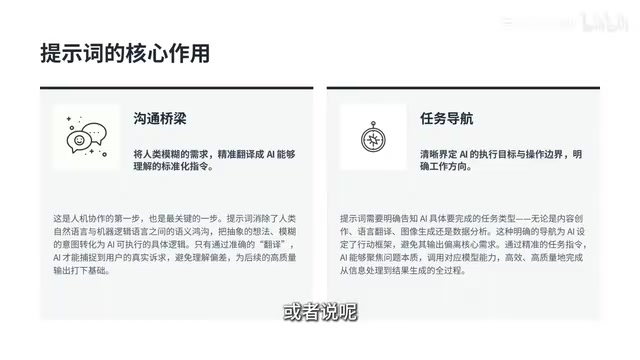
Behind this definition lies a key distinction: what's in your head is vague, but AI can only understand what's explicit. The role of prompts is to translate fuzzy needs into language AI can comprehend. If this translation step isn't done well, the output will likely be wrong.
Specifically, prompts serve four functions:
- Communication bridge: Translating "get me some food" into "what dish, spice level, rice or not."
- Task navigation: Saying "help me process this file" leaves AI unsure whether to do statistical analysis or write a summary—it'll just pick one at random. A good prompt provides clear goals and boundaries, like entering an accurate destination in navigation.
- Style control: Business emails and social media posts have different styles; prompts can make AI write commentary in Lu Xun's style, or write papers in rigorous academic language, reducing revision costs.
- Boundary constraints: One of the most effective ways to address AI "hallucinations." When analyzing industry data, limiting to "only look at a certain quarter's financial report, don't bring in macro policy" makes output more focused.
The course uses "writing about spring" as a comparison: A basic prompt only says "write an article about spring," leaving AI to guess region, genre, length, and style—resulting in generic output. An optimized version specifies identity (prose writer), word count (800 words), setting (spring in Jiangnan), and style (beautiful language, focusing on the misty, rainy charm of waterside towns), turning vague requirements into executable rules.
The Boundary Between Prompts and Prompt Engineering
Many people conflate these two concepts. The course emphasizes: a prompt is single-use—write one line, execute once; it may not work for a different question. So-called "universal prompts" don't exist—only prompts suited to specific scenarios. Prompt engineering, on the other hand, is a process—without modifying model code or parameters, designing input instructions to make general models consistently produce desired results.
This process is broken into six steps: requirement decomposition (breaking big problems into small ones AI can solve), solution design (matching prompts with roles), execution and testing, effect evaluation (using concrete criteria to judge quality), strategy iteration, and accumulation for reuse. The course compares it to software development, except you're writing in natural language. It solves not one problem, but a class of problems.
To measure whether this process succeeds, the course sets four goals: improving accuracy, reducing hallucinations, enhancing stability (similar results regardless of who uses it or when), and lowering costs (getting the best results with the fewest tokens).
Token is a key concept for understanding cost constraints. When large models process text, they don't count by "characters" or "words" but split input and output into tokens—in English, one token roughly corresponds to 0.75 words; in Chinese, one character typically takes 1 to 2 tokens. APIs bill separately for input and output tokens, with output usually more expensive. This means longer prompts with more examples and background material increase per-call costs; in high-frequency scenarios, this overhead gets amplified. Tokens also directly correspond to context window capacity—content beyond the limit gets truncated or requires extra processing, which is the technical root of "AI forgets things when prompts are too long."
Why Learn Now, and Its Business Value
The course cites a statistic: over 90% of users only use AI for basic Q&A—like buying a sports car but only using first gear. The barrier to prompt engineering is low—no programming or algorithm knowledge needed; if you can explain things clearly, you can learn it.

Direct benefits are efficiency: tasks that took a day might be done in an hour, and you can handle professional reports, complex data analysis, and other tasks AI couldn't do before. On the business side, the course lists several paths: helping enterprises and content creators optimize prompts or generate content as a side hustle; one person doing the work of a former team, reducing trial-and-error costs and quickly validating ideas; content output increasing from ten pieces a month to dozens, accelerating audience growth and monetization.
Prompts Are Not a Master Key: Three Layers of Limitations
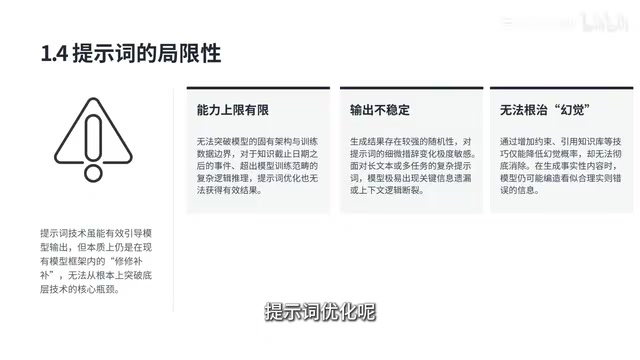
The final part of the course is most worth heeding—the limitations of prompts. First, they cannot exceed model capability limits: training data cuts off at a certain point, so it doesn't know later events; complex math problems it can't solve—no amount of prompt optimization helps. Second, output is unstable: changing one character can produce completely different results; overly long prompts make AI "forget." Third, hallucinations can only be reduced, not eliminated—important matters must be manually verified.
Technically, there are three hard constraints: limited context length, like phone RAM—open too many apps and the system clears background ones; complex multi-step tasks are unstable, prone to skipping steps and breaking logic, so must be broken into smaller tasks; no true long-term memory—each conversation is brand new, unable to remember preferences and background, relying only on external databases.
At the implementation level, there are also three pitfalls: safety and alignment restrictions may mistakenly block legitimate requests; pure prompts can't be engineered—fine for personal use, but for products serving hundreds or thousands, version management, issue tracing, and batch tasks can't hold up; enterprise applications must combine prompts with code; the cost trap—AI charges by token; longer prompts cost more, and costs grow non-linearly, with hidden costs astonishing in high-frequency calls.
The course's conclusion is restrained: prompts are a useful tool, but not a master key—what should be done by humans still must be. For beginners, the value of this chapter isn't teaching you to write some "god-tier prompt," but building a judgment framework—knowing what prompts can and cannot do, and when to upgrade prompts into an engineering methodology.
Hallucination refers to model-generated content that seems plausible but is factually incorrect or fabricated—like inventing nonexistent literature, data, or citations. Its cause lies in the model essentially predicting the next token based on context, pursuing "sounding real" rather than "being real." Thus, when training data is sparse or questions exceed its knowledge, it easily fills gaps with fluent language. In prompt engineering, boundary constraints, requiring source citations, and specifying "say you don't know if you don't know" can reduce hallucination probability but cannot eradicate it mechanistically. This is why the course emphasizes manual verification for important matters—especially in high-risk scenarios like law, medicine, and finance, where model output can only serve as a draft, not a final basis.
One-line Summary
Prompt engineering is a systematic method for translating fuzzy needs into AI-executable instructions—with boundaries and value.
Paragraph Summary
Based on a Bilibili prompt engineering course, this article systematically outlines the path from writing prompts to building AI collaboration skills. First, it clarifies the nature of prompts: they are the most direct means of controlling AI, serving four functions—communication bridge, task navigation, style control, and boundary constraints—translating fuzzy needs into explicit instructions AI can understand. Second, it distinguishes "prompts" from "prompt engineering"—the former is a single instruction, the latter a six-step process including requirement decomposition, solution design, execution testing, effect evaluation, strategy iteration, and accumulation for reuse, with success measured by accuracy, reduced hallucinations, stability, and cost. The article also explains the practical significance and business value of learning, and focuses on three layers of limitations: inability to exceed model capability limits, unstable output, and irreducible hallucinations, plus technical hard constraints like context length, multi-step tasks, and long-term memory, and the cost trap—concluding restrainedly that prompts are "a tool, not a master key."
Related articles

PPO Algorithm Cracks the Moving Sofa Problem, Reconstructing Gerver's Optimal Solution
Developer uses PPO reinforcement learning to reconstruct Gerver's optimal solution to the Moving Sofa Problem, showcasing AI's potential in geometric optimization and its limitations.

PPO Algorithm Cracks the Moving Sofa Problem, Reconstructing the Classic Gerver Sofa
Explore how the PPO algorithm uses reinforcement learning to reconstruct the classic Gerver sofa solution to the moving sofa problem, showcasing AI's potential and limits in geometric optimization and mathematical discovery.

Qwen4-27B Accidentally Exposed: vLLM PR Leaks Clues About New Model
Reddit community discovers vLLM XPU repository PR #22 potentially leaking clues about Qwen4-27B, involving KV cache specs and Intel platform adaptation; this article reviews PR information, community reaction, and reference value for developers.