Prompt Engineering from Beginner to Practitioner: Bilibili Tutorial Explains Core Concepts

Prompt engineering is not template techniques but a systematic methodology from requirement decomposition to precipitation and reuse.
Based on the first lesson of a systematic Bilibili prompt tutorial, the article corrects the misconception that "a prompt is just a message to AI," explaining four layers of prompts: communication bridge, task navigation, style control, and boundary constraints. It distinguishes single-instruction "prompts" from procedural "prompt engineering," which includes six steps—requirement decomposition, solution design, execution testing, effect evaluation, strategy iteration, and precipitation/reuse—aiming to improve accuracy, reduce hallucinations, enhance stability, and lower costs. It also highlights practical value and commercial opportunities, and unusually details limitations: cannot break model ceilings, unstable output, hallucinations unavoidable, context limits, difficulty engineering pure prompts, and token cost traps.
Prompt engineering is increasingly seen as a core skill in the AI era, but most discussions remain at the level of "how to write a good prompt." A systematic tutorial series on Bilibili attempts to clarify this from a conceptual level—not teaching you a few templates, but helping you build a reusable methodology. This article is based on the first lesson of that tutorial, combined with common industry observations, to outline the core concepts, practical workflow, and real boundaries of prompt engineering.
Prompts Are More Than "Sending a Message to AI"
The tutorial opens by correcting a common misconception: many people think a prompt is just sending a message to AI, but it's far more than that. A prompt is essentially the instruction signal you give to AI—whatever signal you send, AI thinks in that direction. With the same model, some people can only get it to write elementary school essays, while others can generate professional industry reports. The difference isn't the AI itself, but the input instructions.
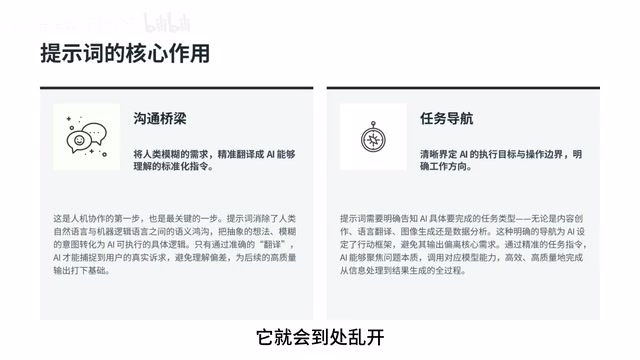
The role of prompts can be broken down into four layers. The most basic is communication bridge: your ideas are vague, AI can only understand clear instructions, and prompts translate fuzzy needs into language AI can understand. The second layer is task navigation: telling AI specifically what to do and where the boundaries are, like entering an accurate destination in navigation—otherwise it will "drive around randomly." The third layer is style control: getting AI to write commentary in Lu Xun's style or papers in academic language, saving extensive post-editing. The fourth layer is boundary constraints: clarifying what can and cannot be said, an effective means of curbing AI's off-topic rambling and fabrication.
The tutorial uses an example of writing about "spring" for comparison: a basic prompt says only "write an article about spring," leaving AI to guess region, genre, length, and style, resulting in uniformity; an optimized prompt assigns the identity of "prose writer," limits to 800 words, specifies a Jiangnan setting, requires beautiful lyrical language, and emphasizes the misty, rainy water-town atmosphere—immediately producing different quality output. From vague requirements to executable rules—this is the first watershed in prompt design.
Token is the basic unit of text processing in large models, roughly understood as a "word piece." In English, one token corresponds to about 0.75 words; in Chinese, one character typically occupies 1 to 2 tokens. Model context windows, billing, and generation speed are all measured in tokens. This explains two phenomena mentioned later: first, longer prompts consume more tokens and cost more; second, there is an upper limit to context length, beyond which the model discards earlier content, manifesting as "forgetting." Understanding tokens helps in making trade-offs when designing prompts—placing the most critical information at the beginning and end, compressing redundant descriptions, rather than piling in all background.
Prompts vs. Prompt Engineering: Single Technique vs. Systematic Method
Many people conflate these two concepts, but the tutorial clearly distinguishes them: a prompt is a single instruction; prompt engineering is a complete methodology.
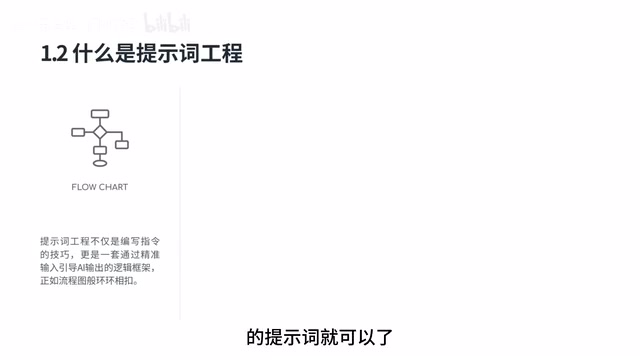
A prompt is like writing one line of code and executing it once—it works this time, but may fail with a different problem. So-called "universal prompts" don't exist; only prompts adapted to specific scenarios. Prompt engineering doesn't rely on inspiration but on process: from analyzing problems, designing solutions, testing effects, to continuous optimization, ultimately precipitating reusable solutions. It solves not one problem but a class of problems.
The tutorial breaks prompt engineering into six steps: requirement decomposition (breaking complex problems into small ones AI can handle), solution design (designing prompts and roles for each sub-problem), execution testing (actually running effects), effect evaluation (judging good or bad with specific criteria), strategy iteration (revising if not good), precipitation and reuse (saving good solutions for later use). This process resembles software development, except what's written is natural language, not code.
The ultimate goals are four: improve accuracy, reduce hallucinations, enhance stability, lower costs—getting the best results with the fewest tokens. These four points are also the criteria for evaluating whether a prompt engineering solution is successful.
Why Learn Prompt Engineering Now
The tutorial's judgment is direct: current AI capabilities are already strong, but most people don't know how to use them. Data shows over 90% of users only use AI for basic Q&A, like buying a sports car but only driving in first gear.

The barrier to learning prompt engineering is extremely low—no programming, no algorithm knowledge needed, just the ability to articulate things clearly. The returns are quite direct: work that originally took a day might be compressed to an hour, and tasks AI previously did poorly—professional reports, complex data analysis—become achievable.
Commercial value is also significant. Enterprises and self-media have continuous demand for "people who know how to use AI"; helping others optimize prompts or generating content with AI can be entered at almost zero cost. In entrepreneurial scenarios, one person with AI can accomplish what a team used to do, greatly reducing trial-and-error costs; self-media content production can expand from a fixed monthly number of articles to batch output. The tutorial's positioning: prompt engineering is not just a skill, but an opportunity window in the AI era.
Limitations of Prompts: It's Not a Master Key
The tutorial spends considerable time on limitations, which is rare in similar content. Prompts cannot break through AI's inherent capability ceiling: training data has a cutoff date, so it doesn't know about events after that; complex math problems can't be solved no matter how you optimize the prompt.

Output instability is another hard flaw—changing one word can produce completely different results; prompts too long cause AI to "forget," not remembering what was said earlier. Hallucinations can only be reduced, not eliminated; any generative model will fabricate content, and important matters must be manually verified.
At the technical level, there are three limitations: context length is limited, like phone RAM—open too many apps and they get cleared, chat too long and AI forgets initial requirements; complex tasks are unstable, multi-step calculations easily skip steps and break logic, so must be split into small tasks; no true long-term memory, each conversation starts fresh, unable to remember user preferences and background, solvable only via external databases. These three problems are determined by the technical foundation; prompts can only alleviate, not cure.
At the implementation level, there are three pitfalls.
Safety and alignment restrictions: illegal or non-compliant content is absolutely not allowed, but completely legitimate requests may also be misclassified and blocked—a common issue across all large models. Pure prompts cannot be engineered: fine for personal use, but not for products serving hundreds or thousands—version management, issue tracing, and large-scale batch tasks can't be handled; enterprise applications must combine prompts with code. Cost trap: AI charges by token, longer prompts cost more, and costs grow non-linearly; under high-frequency calls, hidden costs can be frighteningly high—prompts must be concise.
Hallucination refers to generative models outputting plausible but factually incorrect content when lacking evidence, including fabricated facts, fictitious citations, and mismatched data sources. The root cause is that the model essentially predicts the next token based on probability, not retrieving from a factual database, so it tends to generate "fluent and credible" rather than "true" text. Mitigation methods include: requiring the model to flag uncertainties, providing reference materials for it to answer based on given content (Retrieval-Augmented Generation, RAG), lowering randomness parameters, and introducing external tools for verification in critical scenarios. But these methods only reduce probability, not eliminate it mechanistically; therefore, content involving data, law, or medicine must be manually reviewed.
Context Window refers to the total token limit the model can "see" simultaneously in one conversation, including system prompts, historical dialogue, and current input. Beyond the window, earlier content is truncated or compressed, and the model cannot remember the initially set role and requirements. This is also the technical reason why "prompts too long cause AI to forget." Common practical responses include: placing core constraints at the beginning and end of the conversation, processing long tasks in segments with manual summarization, using summaries instead of full history, and storing long-term information in external vector databases. It should be emphasized that window size is determined by model architecture; prompt techniques can only optimize information organization within the window, not expand capacity.
Editor's Observation
The value of this tutorial lies in pulling prompt engineering from a "collection of techniques" back to the "methodology" level. Much content on the market teaches templates and phrasing, but templates become obsolete as models iterate, while processes and cognition do not. The tutorial's candor about limitations is also commendable—acknowledging that prompts are not a master key actually makes the entire methodology more credible. For beginners, establishing the cognition that "prompt engineering is a process, not inspiration" has more long-term value than saving a hundred prompt templates.
One-line Summary
Prompt engineering is not template techniques, but a systematic methodology from requirement decomposition to precipitation and reuse.
Paragraph Summary
Based on the first lesson of a systematic prompt tutorial on Bilibili, the article corrects the common misconception that "a prompt is just sending a message to AI," pointing out that prompts have four layers: communication bridge, task navigation, style control, and boundary constraints. It clearly distinguishes "prompts" at the single-instruction level from "prompt engineering" at the procedural methodology level, the latter comprising six steps: requirement decomposition, solution design, execution testing, effect evaluation, strategy iteration, and precipitation and reuse, with goals of improving accuracy, reducing hallucinations, enhancing stability, and lowering costs. The article also emphasizes the practical value and commercial opportunities of learning, and unusually devotes substantial space to limitations: cannot break through model capability ceilings, unstable output, hallucinations cannot be eliminated, context limitations, difficulty in engineering pure prompts, and the token cost trap.
Related articles

English Version of 'Thank You for Your Love' Gains Traction on Bilibili: A Cross-Cultural Rendition of a Classic Love Song
The English version of 'Thank You for Your Love,' titled 'I'll give you all my love,' trends on Bilibili with rewritten lyrics about giving all your love. This article analyzes its emotional expression, cross-cultural adaptation strategy, and differences from the Chinese original.

Claude Code vs Cursor vs GitHub Copilot: How to Choose Among the Three Major AI Coding Tools
A clear explanation of Claude Code, Cursor, and GitHub Copilot through the lens of 'degree of delegation': Copilot embeds in your editor for autocomplete, Cursor is an AI-first full editor with multi-file batch editing, and Claude Code executes tasks end-to-end in the terminal. Includes selection advice.

Behind the Viral Dynamic Comic Commentary: Deconstructing the Narrative of Family Finance and Emotional Conflict
Deconstructing a Bilibili dynamic comic episode on family financial conflict: how dense dialogue and emotional hooks retain viewers, and where AI script generation falls short in narrative coherence.