Prompt Engineering Primer: From Writing Prompts to Systematic Collaboration

A prompt is a single input; prompt engineering is a reusable methodology with processes, acceptance criteria, and clear boundaries.
The article breaks down a widely followed prompt engineering course framework. The core judgment: a prompt is just a single input, while prompt engineering is a reusable methodology—the difference being whether you're solving one problem or a class of problems. It presents the four functions of prompts (communication bridge, task navigation, style control, boundary constraints), the six-step engineering process, and four acceptance standards (accuracy, hallucination, stability, cost). It then discusses limitations at length: prompts cannot break through model capability ceilings, hallucinations can only be reduced not eliminated, context length and long-term memory are constrained by underlying technology, pure prompts are hard to engineer, and the token cost trap must be guarded against. The conclusion: building correct understanding is more valuable than collecting templates.
Many people equate prompt engineering with "knowing how to write a few useful prompts." This misconception is precisely the root cause of why most people can't use AI well. A widely followed prompt engineering tutorial series on Bilibili makes this point right at the start: a prompt is a single input, while prompt engineering is a reusable methodology. This article breaks down the core framework of the course and adds some practical judgment from real-world implementation.
What Exactly Is a Prompt: More Than Just "Sending a Message"
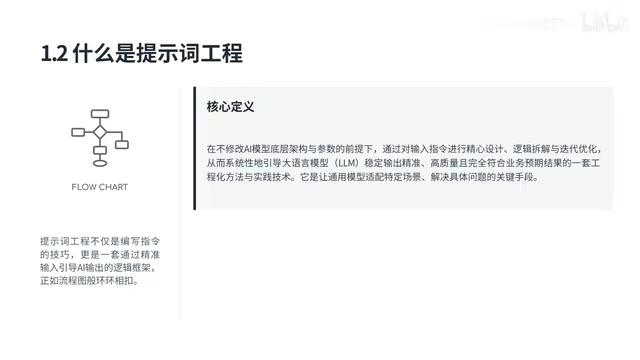
The course offers a plain definition: any text you send to AI, whether a question or a description, is a prompt. But the truly valuable part is the second half—a prompt is the most direct means you have to control AI, bar none.
With the same model, some people can only get it to write elementary-school essays, while others can get professional industry reports. The difference isn't the model—it's the input. The course uses an easy-to-grasp analogy: a prompt is like a neural signal sent to AI—whatever signal you send, it thinks in that direction.
The Four Practical Functions of a Prompt
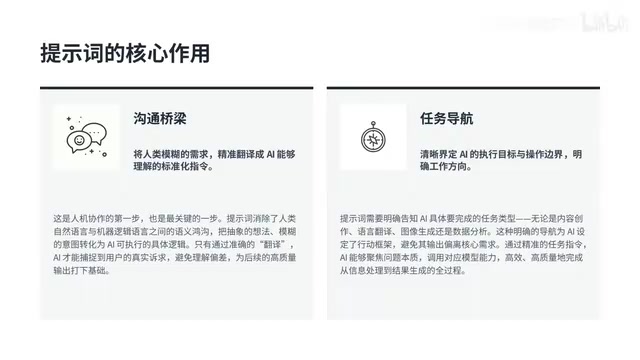
The course breaks down the role of prompts into four layers, which is far clearer than vaguely saying "know how to ask questions":
- Communication bridge: Translating vague needs in your head into clear instructions AI can understand. You can't just say "bring me some food" when ordering takeout—same with AI.
- Task navigation: Telling AI specifically what to do. "Help me process this file" is an invalid instruction—AI can only randomly pick one processing method, most likely not the one you want.
- Style control: Getting the same model to output different tones for business emails, social media posts, or academic papers, reducing rework later.
- Boundary constraints: This is one of the most effective means of suppressing AI's "hallucinations." Limiting the scope of analysis and the data parameters keeps the output focused.
Prompts vs. Prompt Engineering: One-off Tricks vs. Methodology
A judgment the course repeatedly emphasizes: there is no universal prompt—only prompts suited to specific scenarios. This is the most direct dividing line between the two concepts.
A prompt is one-off, like writing a line of code that executes once; change the question and it may stop working. Prompt engineering is a complete process: without modifying model parameters, designing input instructions to enable a general-purpose model to reliably solve specific business problems. It solves not one problem, but a class of problems.
The Six-Step Process
The engineering path the course lays out is: requirement decomposition → solution design → execution and testing → effect evaluation → strategy iteration → consolidation and reuse. The first two steps break big problems into small tasks AI can handle, the middle two verify results, and the last two solidify effective solutions. This process is a lot like software development—except what you're writing is natural language.
The Four Acceptance Criteria
To judge whether a prompt solution is good, the course gives four standards: improve accuracy, reduce hallucinations, enhance stability, and lower cost (get the best results with the fewest tokens). A solution is only successful when all four hold simultaneously.
Token is the basic unit of measurement for how large language models process text—it's neither exactly a "character" nor exactly a "word." In English, one token roughly corresponds to 0.75 words; in Chinese, a single character is typically split into 1 to 2 tokens, depending on the model's tokenizer design. Models don't understand text character by character—they first split the input into a token sequence and then encode it into vectors, so the length of a prompt and the complexity of its structure are directly reflected in token count. This has two practical implications: first, cost—mainstream APIs charge by total input and output tokens, so longer prompts cost more per call; second, the context window—there's a hard limit on the total tokens a model can process at once, and anything beyond is truncated or throws an error. Understanding tokens is the prerequisite for understanding conclusions like "prompts should be concise" and "long prompts lose information."
Why Learn This Now: Low Barrier, but Real Dividends
A statistic cited in the course: over 90% of users only use AI for basic Q&A. That proportion means most people's capabilities are far from being unlocked.

The barrier to prompt engineering is indeed low—no programming required, no need to understand algorithms; if you can explain things clearly, you can get started. The course mentions benefits at three levels: on efficiency, a day's work might be compressed into an hour; on the business side, optimizing prompts for companies and using AI for batch content production are viable side-hustle directions; in startup and self-media scenarios, one person can achieve what used to take a team, dramatically lowering the cost of trial and error. These claims carry the optimistic tone of course promotion, but the direction itself isn't exaggerated.
Limitations We Must Acknowledge: Prompts Are Not a Master Key
This is the most important part of the entire lesson, and also what many tutorials skip over.
Capability Ceilings Cannot Be Broken
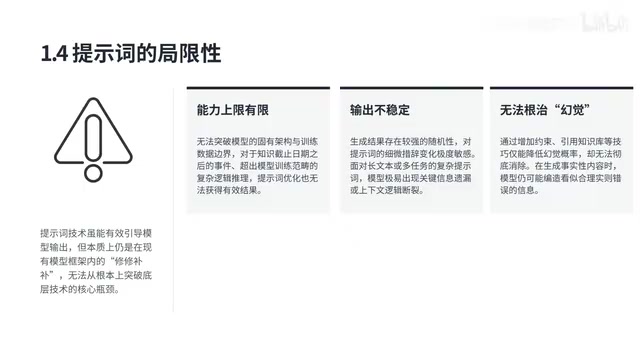
Model training data has a cutoff date—it doesn't know about events beyond that range; it can't perform complex mathematical calculations. No amount of prompt optimization can change the model's inherent capability boundaries.
Output Instability and Residual Hallucinations
Change one word and the result can be completely different; if the prompt is too long, the model "forgets things"—requirements stated earlier are forgotten later. On hallucinations, prompt optimization can only reduce, not completely eliminate—any large model will fabricate, and important matters must be verified by humans.
Hallucination refers to large models generating content that appears plausible but is factually incorrect or fabricated out of thin air—for example, fictitious references, data, legal provisions, or quotes attributed to people. Its root lies in the model's generation mechanism: the model predicts the next word token by token based on context probability, pursuing what "looks most coherent" rather than what is "factually most correct." When training data doesn't cover a particular question, the model doesn't proactively say it doesn't know—it tends to complete a semantically fluent answer. Common mitigation methods include: limiting information sources, requiring the model to explicitly state uncertainty, providing reference materials for it to answer based on (i.e., retrieval-augmented generation, RAG), and reducing sampling randomness. But these methods can only lower the probability of hallucination—they cannot eradicate it mechanistically, so high-risk scenarios involving data, law, and healthcare must retain human verification steps.
Three Technical-Layer Limitations
Context length is limited, similar to a phone's RAM—open too many apps and it clears the background; complex multi-step tasks tend to skip steps and break logic, so they must first be broken into small tasks; there's no true long-term memory—each conversation is brand new, and it can't remember your preferences or background, which can only be supplemented by external databases. These three problems are determined by the underlying technology; prompts can only mitigate them, not cure them.
Context Window refers to the upper limit of total tokens a model can "see" simultaneously in a single conversation, including system prompts, historical dialogue, and current input. You can think of it as the model's working memory capacity: early content beyond the window gets pushed out, and the model then appears to "forget what was said earlier." Window sizes vary greatly across models, from a few thousand to over a million tokens, but a large window doesn't mean uniform attention—information in the middle of long contexts tends to be overlooked, a phenomenon the industry calls "Lost in the Middle." This is why in multi-turn long conversations you should periodically restate key constraints, place important instructions at the beginning or end, and break complex tasks into multiple short sessions. The context window and "long-term memory" are two different things—the latter requires external storage and retrieval mechanisms to supplement.
Three Implementation-Layer Problems
Safety and alignment produce false positives—completely legitimate requests can be blocked; pure prompts cannot be engineered—fine for personal use, but making a product for hundreds or thousands of users lacks version management and issue traceability, and enterprise-grade applications are always prompts plus code; the cost trap—tokens are billed by usage, longer prompts cost more, and hidden costs spiral out of control with high-frequency calls, so prompts should be as concise as possible.
Building Correct Understanding Matters More Than Memorizing Templates
The value of this lesson isn't in teaching you a few templates, but in putting prompt engineering back where it belongs: a core capability for efficient collaboration with AI, with methods, processes, acceptance criteria, and clear boundaries. Acknowledging limitations is what allows you to use humans where humans are needed and code where engineering is needed. For beginners, this cognitive framework is far more useful than saving a hundred "god-tier prompts."
One-line Summary
A prompt is a single input; prompt engineering is a reusable methodology with processes, acceptance criteria, and clear boundaries.
Paragraph Summary
The article breaks down a widely followed prompt engineering course framework. The core judgment: a prompt is just a single input, while prompt engineering is a reusable methodology—the difference being whether you're solving one problem or a class of problems. The article first presents the four functions of prompts—communication bridge, task navigation, style control, and boundary constraints—then introduces the six-step engineering process (requirement decomposition, solution design, execution and testing, effect evaluation, strategy iteration, consolidation and reuse) and four acceptance standards (accuracy, hallucination, stability, cost). It then devotes considerable space to limitations: prompts cannot break through model capability ceilings, hallucinations can only be reduced not eliminated, context length and long-term memory are constrained by underlying technology, pure prompts are hard to engineer, and the token cost trap must be guarded against. The conclusion: building correct understanding is more valuable than collecting templates.
Related articles

Prompt Engineering for Beginners: From Writing Prompts to Engineering Thinking
Starting from the essence and four functions of prompts, this article systematically explains the six-step process, four success criteria, learning value, and practical limitations of prompt engineering to help you build a complete understanding.

Anthropic Launches Nasdaq IPO: AI Giant's Listing and Risk Disclosures
Anthropic officially launches its Nasdaq IPO under ticker ANT, with market valuation expected to potentially exceed SpaceX's record. The prospectus devotes nearly 100 pages to AI risks, while first-half revenue grew over 14x but net losses widened sharply, reigniting the AI bubble debate.

Rust cURL Clone Uses 4,832 unsafe Blocks—Is the Memory Safety Myth Broken?
A Rust cURL clone uses 4,832 unsafe keywords, challenging Rust's memory safety narrative. We analyze what unsafe really means, compare Fil-C, and examine rewrite motives.