Prompt Governance: Achieving Instant Rollbacks with a Version Registry

A version-controlled prompt registry turns chaotic multi-service prompt management into disciplined, instantly rollbackable governance.
As AI Agent systems scale, prompts scattered across microservices become dangerous technical debt. This article explores how one team consolidated fragmented prompts into an immutable-version registry with explicit IDs, environment promotion, and trace metadata — transforming rollbacks from coordinated multi-service deployments into a single config change. It also examines the open challenge of balancing flexible prompt ownership with disciplined version governance.
Scattered Prompts Are Becoming Technical Debt
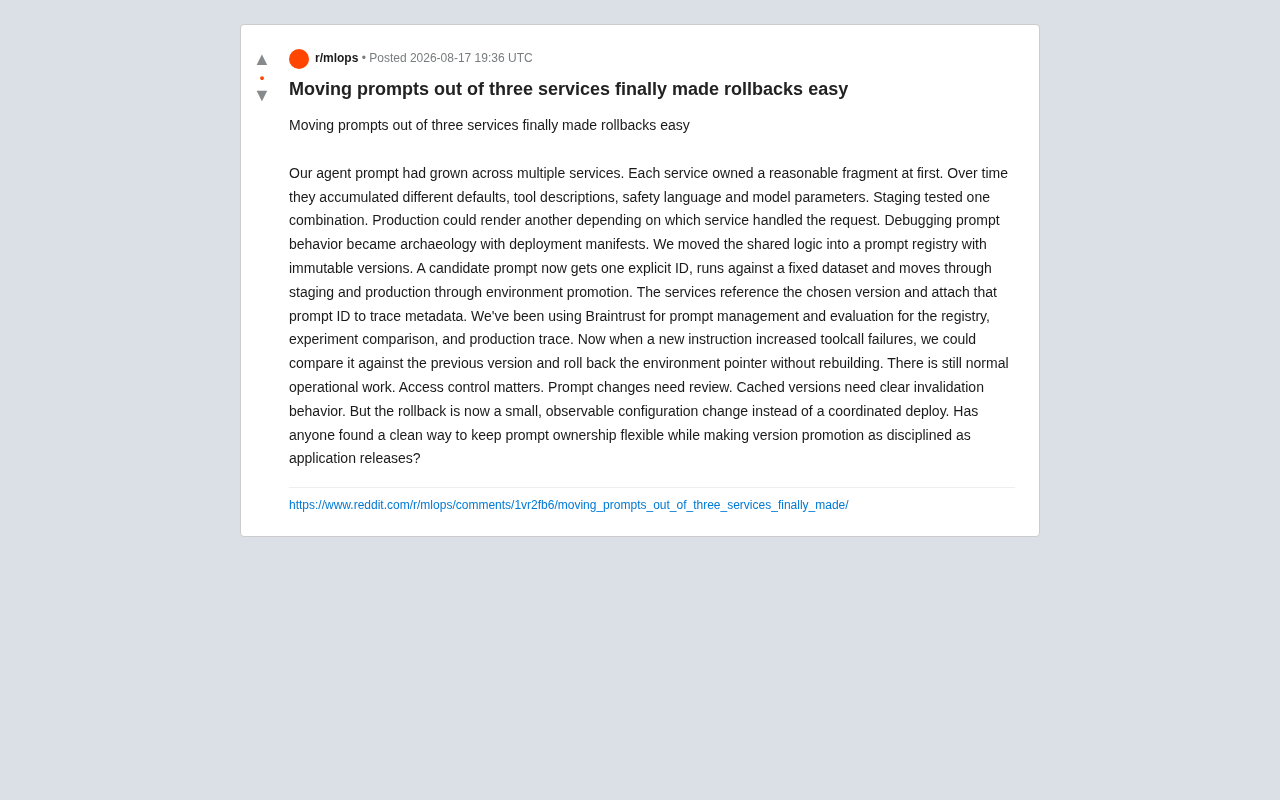
As AI Agent systems grow in complexity, a commonly overlooked problem is emerging: fragmented prompt management. A Reddit developer shared their team's real-world predicament — as the Agent system evolved, its prompts became scattered across multiple microservices, eventually spiraling into an operational nightmare.
Technical Debt is a classic metaphor in software engineering, coined by Ward Cunningham in 1992. It draws an analogy to financial debt — suboptimal technical decisions made for short-term delivery speed continuously accrue "interest" in the form of maintenance costs, system fragility, and declining development efficiency. In AI Agent systems, fragmented prompt management is a new variant of this technical debt: while having each service manage its own prompts seems efficient early on, the hidden costs of debugging and maintenance grow exponentially as the system scales.
Initially, each service held what seemed like a reasonable prompt fragment. But over time, these fragments gradually accumulated divergent default values, tool descriptions, safety disclaimers, and model parameters. This is essentially a reemergence of the "Configuration Drift" problem from microservice architectures in the AI domain — in traditional software engineering, configurations of the same type gradually becoming inconsistent as services evolve independently is a classic challenge, typically addressed through centralized configuration centers (like Consul, etcd, or Apollo). However, prompts are far more complex than ordinary configuration parameters because they contain natural language instructions, tool definitions, safety constraints, and other multidimensional information — subtle wording differences can cause dramatic changes in model behavior.
The problem is this: the test environment validates one combination, while production might render an entirely different combination depending on which service handles the request.
In the original poster's words, debugging prompt behavior became "archaeology with deployment manifests." When the same input behaved differently in staging and production, engineers simply couldn't determine which version of the prompt was actually running in production.
The Core Solution: A Prompt Registry with Immutable Versions
The team's approach was to consolidate the shared logic scattered everywhere into a Prompt Registry with immutable versions.
The concept of immutable versions originates from the practice of Immutable Infrastructure, systematically articulated by Chad Fowler in 2013. Its core philosophy is: once an artifact of a given version is created, it is never modified — any change must create a new version. This concept is already widely applied to container images (Docker Image tags cannot be overwritten), package management (version locking in npm/pip), and database migration scripts, among other areas. Applying it to prompt management means that every modification generates a new, uniquely identified version snapshot. Old versions are never overwritten or tampered with, ensuring that any historical state can be precisely reproduced at any point in time.
The key design elements of this mechanism include:
Explicit Version IDs and Fixed Datasets
Each candidate prompt receives a clear, unique ID. This candidate version is first evaluated against a fixed dataset, then goes through environment promotion, advancing sequentially from staging to production.
Environment promotion is a core concept in Continuous Delivery pipelines. In a typical software release workflow, code changes progress through development, testing, pre-production, and production environments in sequence, with each promotion requiring passage through that environment's corresponding Quality Gates — including automated tests, performance benchmarks, and manual approvals. Applying this mechanism to prompts means new versions cannot be pushed directly to production; they must prove their performance meets expectations in each environment before being "promoted." This effectively prevents insufficiently validated changes from directly affecting end users.
The idea here borrows from mature software release practices — rather than letting prompts "implicitly" scatter across various services alongside code, they are treated as a first-class artifact with independent version numbers and lifecycles.
Services Reference Version Numbers Instead of Hardcoding Content
After the transformation, individual services no longer hold their own prompt fragments. Instead, they reference a selected version number and attach that prompt ID to trace metadata.
This detail is crucial: it means every production call record can be precisely traced back to "exactly which version of the prompt was in use at that time." Observability is no longer a pipe dream.
Observability is a key concept in distributed systems, typically composed of three pillars: Logs, Metrics, and Traces. In traditional software, it helps engineers understand "why" a system exhibits certain behavior. But in AI Agent systems, observability faces unique challenges: LLM output is non-deterministic — the same input can produce different outputs, making issue reproduction and root cause analysis extremely difficult. Embedding the Prompt ID in trace metadata effectively establishes a deterministic anchor point in this uncertainty-laden system — even if model output is unpredictable, at least engineers can confirm which version of instructions was used on the "input side," dramatically narrowing the scope of investigation.
The team used Braintrust to handle the responsibilities of the registry, experiment comparison, and production tracing. Braintrust is an emerging evaluation and observability platform in the AI application development space, focused on providing prompt management, experiment comparison (similar to A/B Testing for prompts), and production tracing capabilities. The emergence of such tools reflects the industry trend toward AI engineering maturity — as LLM applications move from prototype to production, the toolchain requirements around model invocations are rapidly diversifying. Similar products include Humanloop (focused on prompt version management and evaluation), LangSmith (the tracing and evaluation platform in the LangChain ecosystem), Weights & Biases Prompts (focused on experiment tracking), and PromptLayer, among others. Together they form the emerging "LLMOps" ecosystem. It's worth noting that the original author's choice represents a single team's tooling decision, but the architectural philosophy of "registry + evaluation + tracing" as a unified triad has universal reference value.
Rollback: From Coordinated Deployment to a Single Config Change
The most immediate benefit of this mechanism was demonstrated during a real incident.
When a new instruction caused tool-call failure rates to spike, the team was able to immediately compare it against the previous version, then simply roll back the environment pointer — no rebuilds, no redeployments.
Tool Calling (also known as Function Calling) is one of the core capabilities of modern AI Agent systems. Agents use LLM structured output to invoke external tools (such as API queries, database operations, code execution, etc.), connecting natural language reasoning to real-world actions. Common patterns of tool call failures include: LLM-generated parameters not matching the tool schema, calling nonexistent tool names, and parameter values exceeding reasonable ranges. Minor prompt changes — such as wording changes in tool descriptions or priority adjustments in system instructions — can significantly affect how the LLM selects and invokes tools. This is why tool-call failure rate is often one of the most sensitive signals for detecting Prompt Regression.
This is the essence of the entire post:
Rollback is now a small, observable config change — not a coordinated multi-party deployment.
Compared to the previous situation of "doing archaeology through deployment manifests," this represents a qualitative leap. It brings prompt changes under the same rigorous discipline as application releases while preserving the flexibility of configuration-level operations.
Beyond the Benefits: Operational Work That Still Remains
To the original author's credit, they didn't tout this approach as a silver bullet. Instead, they honestly listed the routine operational burdens that still exist:
- Access control: Who has permission to modify prompt versions requires clear authorization boundaries.
- Prompt review: Prompt changes also need a review process, just like code PRs.
- Cache invalidation: Cached versions need clearly defined invalidation behavior, otherwise rollbacks may not take effect.
These are all unavoidable costs of "engineering" prompts. But compared to the controllability and observability they enable, these costs are clearly worthwhile.
An Open Question That Remains Unsolved
The original post concluded with a thought-provoking question that reflects a widespread pain point in the prompt engineering field:
Has anyone found a clean way to keep prompt ownership flexible while making version promotion as disciplined as app releases?
Behind this lies a fundamental tension:
- Flexible ownership means different teams and services can independently iterate on the prompt fragments they care about;
- Rigorous promotion discipline requires unified evaluation, review, and release controls.
These two goals are inherently in conflict. This question actually maps to the long-standing "centralized governance vs. team autonomy" tension in software engineering. In the microservices world, this tension is mitigated through InnerSource models and Platform Engineering — platform teams provide standardized tools and process frameworks, while business teams make autonomous decisions within those frameworks. Similarly, in prompt management, one possible evolutionary direction is introducing Federated Governance: the registry and promotion process are maintained centrally by the platform, but each team owns editing and experimentation rights for prompts within their own namespace — similar to namespace isolation and the RBAC permission model in Kubernetes.
However, the dependency relationships and compositional effects between prompts make this problem more complex than traditional configuration management — a system prompt change in one service could affect the semantic understanding of tool descriptions in another service. The registry + version promotion approach solves the "discipline" half, but how to achieve "flexible ownership" without re-fragmenting remains an open challenge.
Takeaways for Agent Developers
This frontline practical experience offers several direct insights for teams building LLM applications and Agent systems:
- Don't let prompts scatter throughout your codebase. Distributed management is convenient in the short term but inevitably creates technical debt and debugging black holes in the long run.
- Treat prompts as versionable artifacts. Introducing immutable versions, explicit IDs, and fixed evaluation datasets is the first step toward engineering rigor.
- Write the Prompt ID into your traces. Observability is the prerequisite for rapid issue identification — make every call traceable to a specific version.
- Rollback capability takes priority over everything. When a new prompt causes metric degradation, the ability to "roll back the pointer with one click" could be your lifeline.
As AI applications move from demo to production, prompt management is evolving from "writing good copy" into a serious engineering discipline. This post is a vivid footnote to that trend.
Related articles

Python 3.15 New Feature: Is the sentinel Type Better Than None?
Python 3.15 adds the sentinel type, using named unique sentinel objects to replace None and bare object(), resolving confusion among missing values, explicit emptiness, and invalid input while avoiding type hint failures.

Deep Learning's Three Architectures and the Universal Approximation Theorem: A Complete Guide to MLPs, CNNs, and Transformers
Explaining the inductive bias differences among MLP, CNN, and Transformer, the existence meaning of the Universal Approximation Theorem (UAT), and the role of Taylor expansion in approximation analysis, while clearing up common misconceptions.

GitLab Emergency Patch Release: Analysis of Critical Security Fixes
GitLab releases critical patch 19.5.1, sparking 355 points of discussion on Hacker News. This article analyzes the background, upgrade steps for self-hosted instances, and verification points to help DevOps teams respond quickly to security updates.