Prompteina: A Breakthrough in Designing Protein Structures from Natural Language

Prompteina enables all-atom protein structure generation from natural language descriptions, like text-to-image but for proteins.
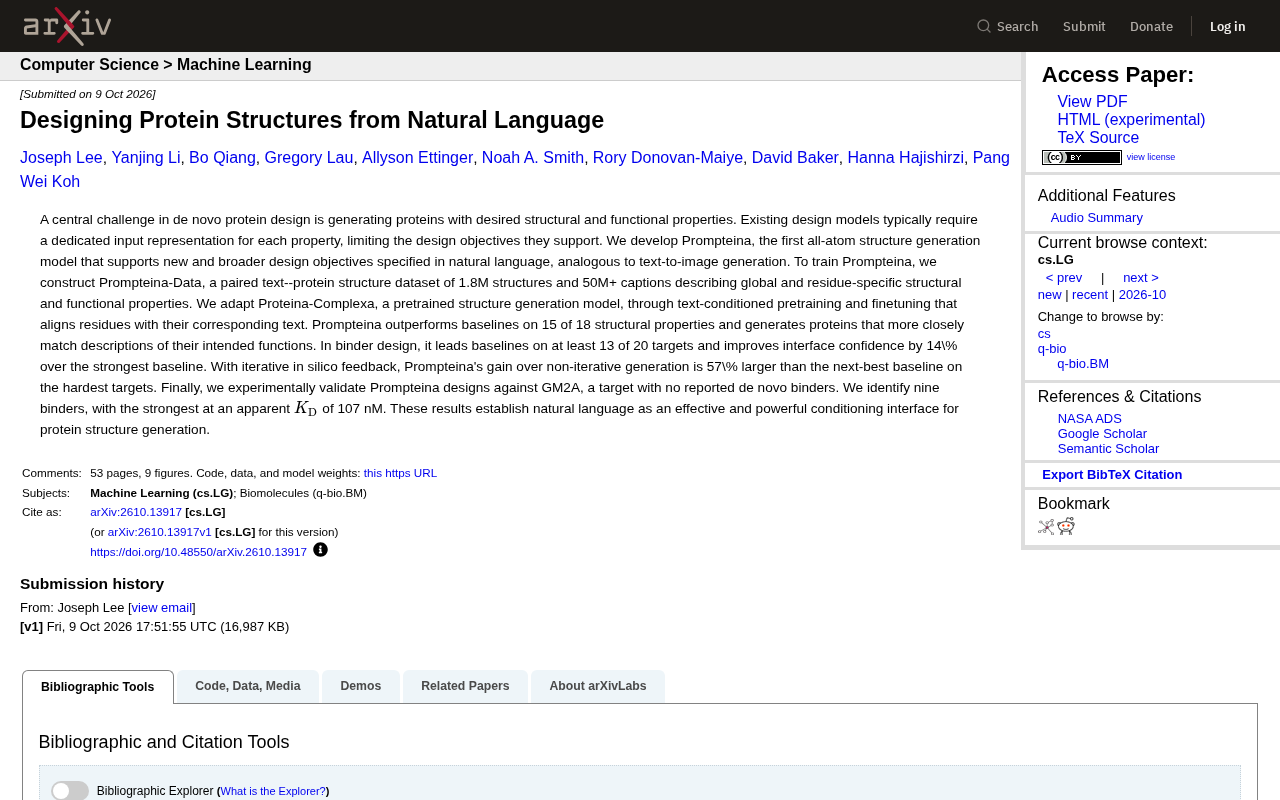
Prompteina is the first all-atom protein structure generation model supporting natural language conditioning, bringing the text-to-image paradigm to de novo protein design. It is built on Proteina-Complexa and adapted via text-conditioned pretraining and residue-level alignment fine-tuning, using the custom Prompteina-Data dataset (1.8M structures, 50M+ captions). It outperforms baselines on 15 of 18 structural properties, improves interface confidence by 14%, and achieves 57% greater gains on hard targets with iterative feedback. Wet-lab validation on GM2A — a target with no prior de novo binders — yielded 9 binders, the best with a 107 nM apparent K_D.
From Text-to-Image to Text-to-Protein
The core challenge in de novo protein design is generating proteins with specific structures and functions on demand. Existing design models share a notable limitation: each category of design goal — such as a particular structural feature or functional constraint — requires its own dedicated input representation, which severely restricts the range of design tasks a model can support. Whenever researchers want to pursue a new objective, they often have to redesign the input interface or even retrain the model from scratch.
Prompteina changes this paradigm. It is the first all-atom protein structure generation model that supports specifying design goals through natural language, analogous to text-to-image generation — you describe the desired protein properties in a sentence, and the model generates the corresponding 3D structure. This means design objectives are no longer constrained by fixed input formats; they can be freely expressed and expanded through flexible language descriptions.
De novo protein design differs from traditional sequence-based protein engineering in that it does not rely on existing natural protein templates. Instead, it builds entirely new amino acid sequences and 3D structures from scratch, guided by physicochemical principles or learned distributions. All-atom design goes a step further, requiring the model to precisely predict the positions of all atoms — including side chains — rather than just the backbone trajectory. This is a prerequisite for designing functional binding interfaces. In recent years, diffusion-based methods such as RFdiffusion and ProteinMPNN have significantly improved the success rate of de novo design, but these approaches typically rely on structured inputs like structural fragments or hotspot residue coordinates to specify design intent, limiting their flexibility. Prompteina's significance lies in decoupling the concept of "conditioning" from fixed structural representations and shifting toward open-ended natural language descriptions, fundamentally changing how the design space can be explored.
Prompteina-Data: A Large-Scale Paired Dataset for Training
For a model to "understand" natural language and map it to protein structures, high-quality paired training data is essential. The research team built Prompteina-Data for this purpose — a text–protein structure paired dataset containing 1.8 million structures and over 50 million descriptive captions.
These captions cover both global-level properties (such as overall structural type and functional category) and residue-specific structural and functional features. This multi-granularity design is critically important — it allows the model to understand not only "what kind of protein this is" but also "which site performs which function," laying the groundwork for fine-grained design control.
Technical Approach: Adapting a Pretrained Model for Text Conditioning
Prompteina is not trained from scratch. It is adapted from an existing structure generation model, Proteina-Complexa, through a two-stage process:
Text-Conditioned Pretraining
The team first performs text-conditioned pretraining on Proteina-Complexa, teaching the model to incorporate textual information into the structure generation process.
Residue-Level Alignment Fine-Tuning
A subsequent fine-tuning stage aligns each residue with its corresponding text description. This step is key to achieving residue-specific control, enabling the model to respond to site-specific requirements in the description rather than simply generating a structure that is only a rough overall match.
This "pretrained model + text-conditioning adaptation" strategy mirrors common paradigms in large language models and multimodal models, demonstrating the effectiveness of transferring mature generative models to scientific design tasks.
The technical challenge of residue-specific alignment lies in the fact that natural language descriptions are global sequence-level signals, while protein function is often concentrated at a few local key sites — such as an enzyme's catalytic triad, an antibody's complementarity-determining regions (CDRs), or the contact residues within a ligand-binding pocket. Getting the model to precisely map descriptions like "site X is responsible for binding" or "the loop region remains flexible" to specific residue coordinates requires residue-level text annotations in the training data, along with appropriate loss functions during fine-tuning to bring the two representation spaces closer together. This is analogous to region-level grounding in vision-language models and represents a core technical challenge for achieving fine-grained controllable generation.
Performance: Leading Baselines Across Multiple Metrics
Prompteina demonstrates advantages over existing methods across several dimensions:
- Structural property generation: Outperforms baseline models on 15 out of 18 structural properties, and generates proteins that more closely match the textual descriptions of their intended functions.
- Binder design: Surpasses baselines on at least 13 out of 20 targets, improving interface confidence by 14% over the strongest baseline.
- Iterative in silico feedback: With iterative computational feedback, Prompteina's gains on the most challenging targets exceed those of the second-best baseline by 57% compared to non-iterative generation.
These results indicate that natural language is not merely a "convenient" interface — it is a conditioning mechanism that is genuinely competitive in terms of real-world design performance.
Experimental Validation: Successful Design of GM2A Binders
No matter how impressive the computational metrics, wet-lab validation is necessary to demonstrate true value. The research team selected GM2A as their validation target — a protein for which no de novo designed binders had previously been reported, making it a non-trivial challenge.
The results were encouraging: the team identified 9 binders, with the strongest exhibiting an apparent dissociation constant ($K_D$) of 107 nM. This nanomolar-level affinity demonstrates that Prompteina's designs are not only credible in silico, but also effective in real biophysical measurements.
GM2A (GM2 Activator Protein) is a small glycolipid transfer protein involved in the lysosomal degradation pathway of gangliosides; functional defects are associated with GM2 gangliosidosis. As a validation target, GM2A is challenging not only because no de novo designed binders have been reported, but also because its surface is relatively flat and lacks deep binding pockets. This type of "difficult-to-drug" target represents a stringent test of a binder design method's generalizability. An apparent $K_D$ of 107 nM represents a moderate-to-strong affinity level — still a gap from the pM to low nM range typically targeted by antibodies, but for a first-generation de novo designed binder, this is already a highly competitive starting point that can be further optimized through approaches such as affinity maturation.
Significance and Outlook
Prompteina's core contribution is establishing natural language as an effective and powerful conditioning interface for protein structure generation. It moves protein design away from the cumbersome paradigm of "customizing inputs for each type of objective" and into a universal paradigm of "describing requirements in a sentence."
The potential impact of this shift is far-reaching: it lowers the barrier to protein design, allowing researchers to explore a wider range of design goals more intuitively. It also opens up exciting possibilities for future design workflows that incorporate richer functional descriptions or integrate with large language models. As paired datasets grow in scale and model capabilities improve, "text-to-protein" generation has the potential to become a mainstream mode of interaction in the field of biological design.
Related articles

Chain of Thought Isn't Just for AI: How Humans Can Use CoT to Improve Thinking Quality
Chain of Thought isn't just a prompt trick for large models. Starting from a Hacker News discussion, this article analyzes why CoT works for human thinking too, breaks down actionable ways to transfer it, and highlights the key differences between human CoT and machine CoT.
Cloudflare Teams Up with OpenAI: Closi…
Cloudflare Teams Up with OpenAI: Closing the Loop from Vulnerability Discovery to Defense with AI
Cloudflare uses OpenAI Daybreak to investigate security vulnerabilities and generate reviewable remediation plans, while developers use Codex to boost coding efficiency and quality.

Orca Multi-Agent Orchestration in Practice: A Guide to Parallel Collaboration with Claude and Codex
Orca is Stable AI's free open-source agent workbench supporting 34 agents like Claude Code and Codex in parallel. Learn its Git worktree isolation, multi-model orchestration, and mobile management.