ProofRun: Local Verification Receipts for AI Coding Agents

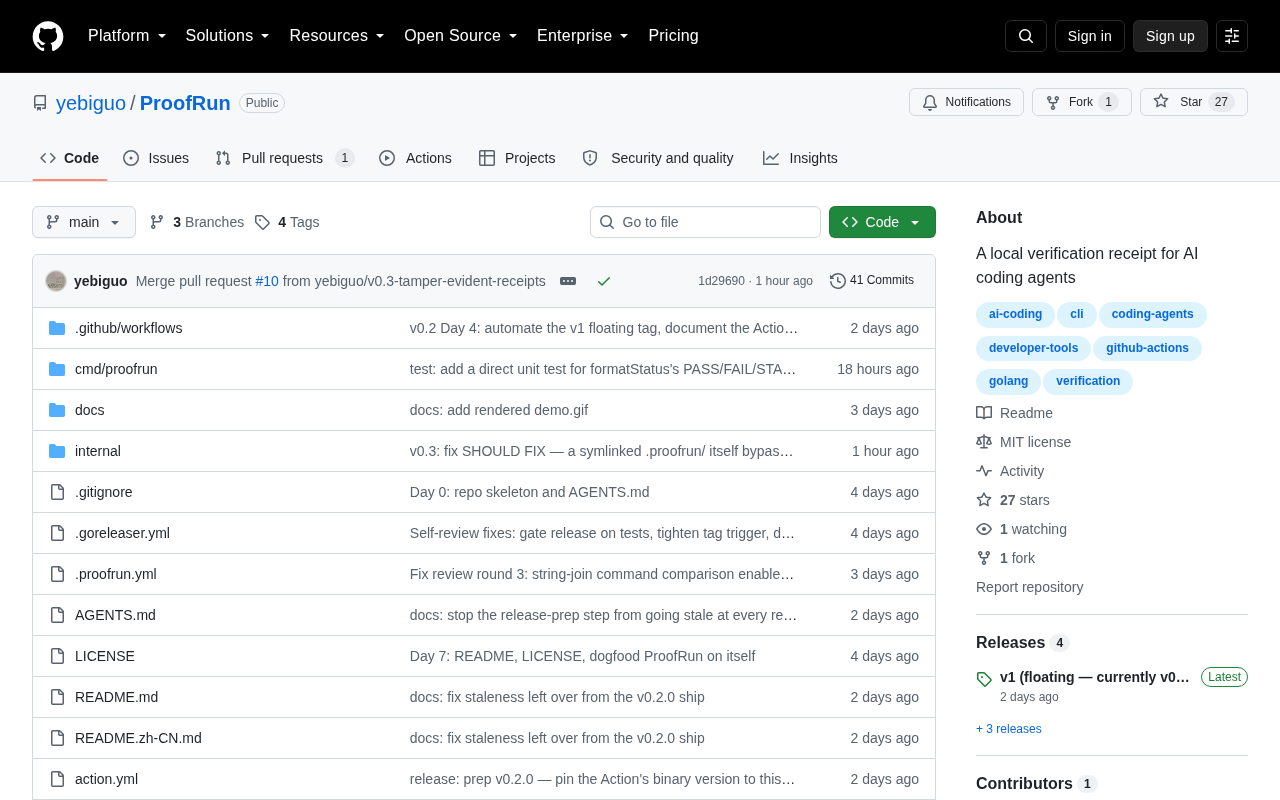
ProofRun provides local verification receipts to make AI coding agents trustworthy and auditable.
ProofRun addresses the trust crisis in AI-assisted programming by providing local verification receipts for AI coding agents. As tools like GitHub Copilot, Cursor, and Claude Code gain autonomy, verifying their claims becomes critical. ProofRun independently validates AI work in real local environments, producing auditable, traceable evidence. This approach benefits team code reviews, CI/CD pipelines, and regulatory compliance scenarios.
When AI Starts Writing Code, Who Verifies What It Did?
With the rise of AI programming tools like GitHub Copilot, Cursor, and Claude Code, more and more developers are getting accustomed to letting AI agents automatically handle code writing, refactoring, and even commits. These tools have evolved from early code completion assistants into intelligent agents with autonomous capabilities — GitHub Copilot, built on OpenAI's Codex model, learns programming patterns by analyzing massive open-source code repositories; Cursor is an IDE with deep LLM integration that supports multi-file context understanding and natural language-driven code modifications; Claude Code is Anthropic's command-line AI programming tool that can directly read/write files and execute commands in the terminal. What they all share is the ability to independently plan task steps, invoke tools, execute commands, and iterate based on feedback — and it's precisely this autonomy that makes the verification problem so urgent.
Yet a critical trust issue has emerged: When an AI agent claims it has completed a task, how do we verify it actually did — rather than producing results that seem plausible but are fundamentally flawed?
ProofRun is a solution designed to address this exact pain point. Its core concept is to provide AI coding agents with a "local verification receipt," making their work auditable, traceable, and trustworthy.
What Problem Does ProofRun Solve?
The "Black Box" Trust Crisis of AI Agents
A fundamental problem with current AI coding agents is the opacity of their execution process. An agent might tell you "tests passed," "feature implemented," or "bug fixed," but these conclusions often lack independent, verifiable evidence.
In practice, developers frequently encounter several typical issues:
- Hallucinated confirmations: The AI claims it ran tests and they passed, but never actually executed them
- Environment inconsistency: The AI's verification results within its own context don't match behavior in the real development environment
- Non-reproducible results: The successes reported by the AI cannot be reproduced locally or in CI environments
AI hallucination is an inherent flaw of large language models, referring to the model generating content that appears fluent and reasonable but is actually incorrect. In natural language conversations, hallucinations might just mean providing wrong information; but in code scenarios, the consequences are far more severe and insidious. Models might fabricate APIs that don't exist, generate code that's syntactically correct but logically wrong, or even report operation results that never actually occurred in "tool calling" mode. Since code correctness demands precision down to every character and logic branch, even a minor hallucination can lead to runtime crashes, security vulnerabilities, or data corruption.
These issues might be tolerable in small personal projects, but in team collaboration and production deployment scenarios, unverified AI output can pose serious risks.
The Value Proposition of "Verification Receipts"
The "local verification receipt" concept proposed by ProofRun is essentially a proof based on real local execution environments, generated after an AI agent completes a task. This receipt records whether the work the AI claims to have completed was actually verified in your local environment.
This is analogous to a receipt in financial transactions — it's not a promise, but evidence of something that has already occurred. Bringing this concept to AI programming means we no longer take the AI's word for it unilaterally, but instead require it to produce verifiable evidence.
The Technical Significance of Local Verification
Why Emphasize "Local" Verification?
The word "local" in ProofRun's name deserves attention. Many current AI programming tools perform computation and verification in the cloud or within the AI service provider's environment, which creates two risks: first, environmental differences from the developer's actual environment; second, the verification process itself depends on the AI, lacking independence.
The significance of local verification lies in:
- Environmental authenticity: Running verification on the developer's own machine ensures results reflect the true project state
- Independent trustworthiness: The verification process is independent of the AI agent, avoiding the "player and referee" problem
- Privacy and security: Sensitive code can be verified without being uploaded to third-party environments
This approach has a deep resonance with the concept of Verifiable Computation in cryptography. In traditional verifiable computation frameworks, the computing party generates a succinct proof after completing the computation, and the verifier can confirm the correctness of results at a cost far lower than recomputing. Zero-Knowledge Proofs go a step further, allowing the prover to demonstrate that a statement is true without revealing the specific computational details. While ProofRun's verification receipts may not necessarily employ these cryptographic primitives, the core logic is consistent: transforming "trust" from trust in the executor to trust in factual evidence, implementing the principle of "Don't trust, verify."
The Paradigm Shift from "Believing" to "Verifying"
The approach ProofRun represents reflects an important evolutionary direction that AI-assisted development tools are undergoing: shifting from blindly trusting AI output to establishing verifiable trust mechanisms for AI output.
This aligns with long-standing best practices in software engineering — whether code is written by humans or AI, it should undergo independent testing, review, and verification. The difference is that the high output volume and automated nature of AI agents make establishing efficient, automated verification mechanisms even more pressing.
From a broader AI trust framework perspective, the trust mechanisms currently being explored by academia and industry can be roughly divided into several layers: the first layer is Output Checking, verifying the final results generated by AI; the second layer is Process Supervision, monitoring whether the AI's intermediate reasoning steps are sound; the third layer is Formal Verification, using mathematical methods to prove that code satisfies specific specifications. ProofRun primarily operates between the first and second layers, verifying AI-claimed outputs through actual execution. In the future, as formal methods and AI further converge, we can expect to see AI not only generating code but simultaneously producing mathematical proofs of that code's correctness — which would be the ultimate solution to the verification problem.
Use Cases and Potential Value
A Trust Foundation for Team Collaboration
In multi-person development teams, if every member is using AI agents, verification receipts can serve as important supplementary material for code review. Reviewers can examine these receipts to quickly understand what work the AI completed, whether that work was locally verified, and thereby make review decisions more efficiently.
A Complement to CI/CD Pipelines
Verification receipts can also be integrated with CI/CD (Continuous Integration/Continuous Deployment) pipelines. CI/CD is a core practice in modern software engineering: continuous integration requires developers to frequently merge code into the main branch, with each merge triggering automated builds and tests; continuous deployment automatically releases code that passes tests to the production environment. Current CI/CD pipelines typically run on remote servers (such as GitHub Actions, GitLab CI, Jenkins), and complete pipelines can take anywhere from minutes to tens of minutes.
If AI agents frequently submit code without local verification, a flood of build failures can cause CI resource contention and lengthen developer feedback loops. Before code enters the automated pipeline, local verification receipts provide a first quality gate, reducing resource waste and feedback delays caused by invalid submissions entering the CI system. This essentially adds a lightweight Quality Gate to the development workflow, consistent with the "Shift-Left Testing" philosophy — moving quality assurance activities as early as possible in the development process.
Audit and Compliance Scenarios
For industries with compliance requirements (such as finance and healthcare), the auditability of AI-generated code is crucial. In the financial industry, regulations like the SOX Act (Sarbanes-Oxley Act) and PCI DSS (Payment Card Industry Data Security Standard) require complete audit trails for all code changes involving critical systems, including who made what modifications, when they were made, and whether they were approved. In healthcare, the FDA has strict design control requirements for medical device software (such as the IEC 62304 standard), requiring documented records for every step of the software development process.
When AI agents participate in code writing, the traditional audit chain breaks — the "author" is no longer an accountable human individual. As a tamper-resistant execution credential, verification receipts provide the technical means to rebuild this audit chain by recording the AI's specific operations and their local verification results, offering reliable evidence for subsequent audit traceability.
A Measured Perspective: An Early-Stage Exploration
It should be objectively noted that ProofRun currently has very limited visibility, indicating it is still in an early exploratory stage. Its actual effectiveness, usability, and ecosystem compatibility all require further validation.
However, the problem it addresses — the credibility and verifiability of AI coding agents — is undoubtedly one of the core challenges the entire AI-assisted development field must face. As AI agents take on increasingly complex and critical programming tasks, "how to verify AI's work" will shift from a fringe topic to a mainstream need.
Conclusion
The "local verification receipt" proposed by ProofRun is a small but important entry point. It reminds us that while embracing the efficiency of AI programming, we cannot abandon independent verification of results. AI can be an extraordinarily powerful assistant, but trust must be built on verifiable evidence, not mere promises.
For developers, it's worth keeping an eye on the evolution of tools like this — they may represent a necessary direction as AI-assisted development matures: trustworthy, auditable, and reproducible.
Related articles

DeepCell: One-Click AI Generation of Documents, Spreadsheets, and Slides
DeepCell tops Product Hunt with one-click generation of documents, spreadsheets, and slides, using the .deepcell format for linked updates, designed for System 2 tasks like modeling and sales reviews.

Doneas: 15-Minute Daily Accountability Calls That Keep Indie Developers From Procrastinating
Doneas is a daily accountability tool for indie developers: plan tasks on Monday, join a 15-minute call with five builders each day, and log deliveries on a public progress page. This article analyzes its core mechanics, effectiveness, and potential issues around retention and matching.

Fastlane 2.0: Fully Automated AI Ad Campaigns, From Creative to Optimization
Fastlane 2.0 is an AI ad automation tool: enter your website and it learns your brand, generates video and image ads, and runs and optimizes them on Meta, TikTok, Instagram, and YouTube.