Pruve.dev: Demanding a Reason for Every Line of Code to End AI Programming's Context Black Hole
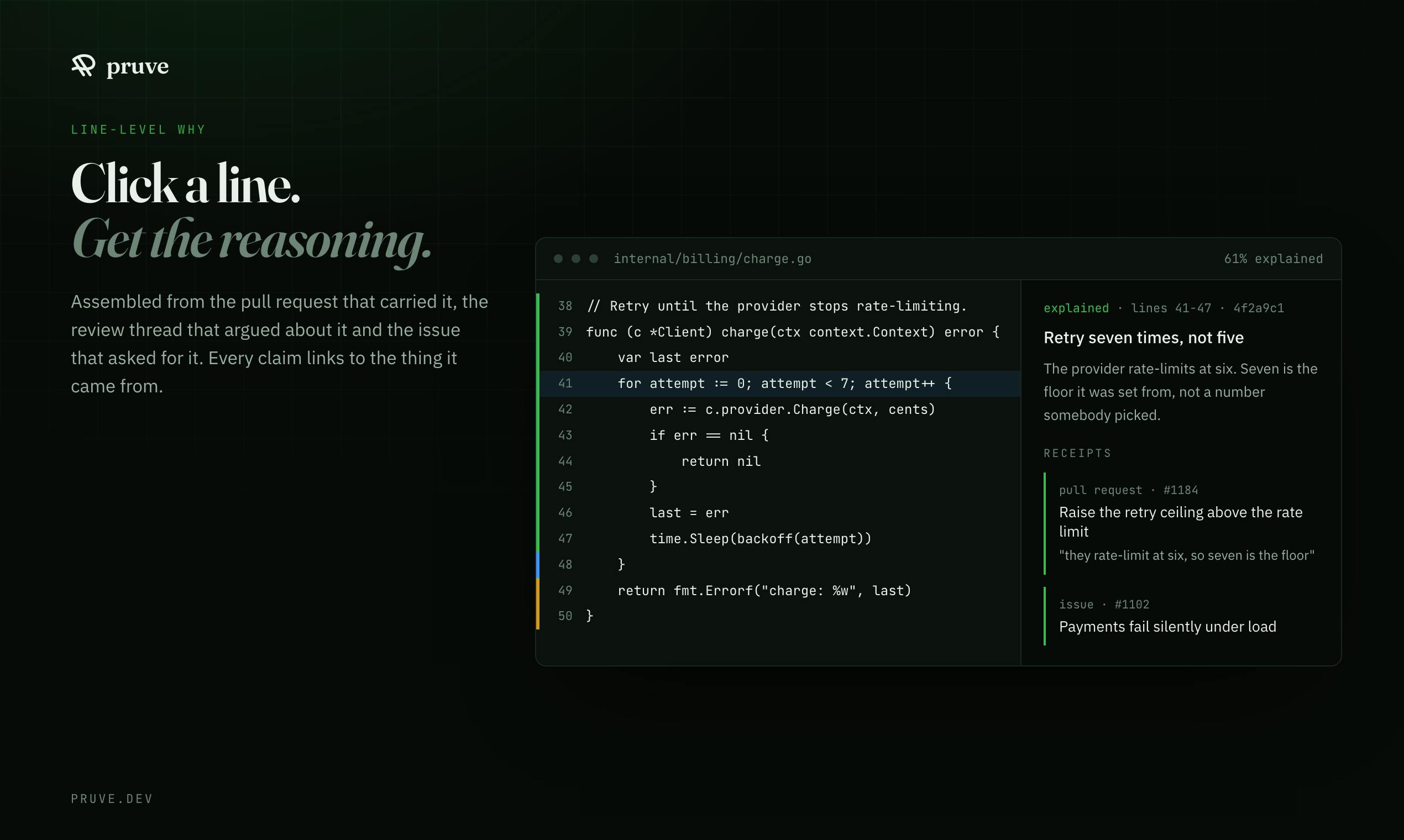
Pruve.dev traces why every line of code exists, tackling the context loss problem in AI programming.
Pruve.dev is a code provenance tool that reads an entire repository's history to explain why any line of code exists — backed by verifiable evidence. By enforcing a strict "No evidence, no answer" principle, it combats AI hallucination and addresses the growing context black hole in AI-assisted programming, where reasoning and decision chains are lost after code merges. Free for open-source repos, it represents a new class of tools focused on code understandability over code generation.
When AI Finishes Writing Code, the Reasoning Disappears
As AI-assisted programming becomes mainstream, a widely overlooked problem is surfacing: the reasoning behind code is being systematically discarded.
Pruve.dev, a code provenance tool that recently debuted on Product Hunt, pinpoints this exact pain point. Its tagline cuts straight to the heart of the matter — "Ask any line of code why it exists, and get receipts."
This problem existed in the era of traditional human programming too, but AI's involvement has made it dramatically worse. After a developer engages in a conversation with an AI Agent, iterating multiple times to finally produce a piece of code, the critical context — discussion threads, linked Issues, Agent session logs — is typically discarded permanently the moment the code is merged.
The "Why" of Code Matters More Than the "What"
Any experienced engineer knows that the hardest question when reading code is never "what does this code do," but rather "why was this code written this way."
The Context Black Hole: A New Dilemma in the AI Era
Imagine this scenario: you inherit a project and encounter what appears to be a redundant conditional check, or a peculiar edge-case handling logic. You don't know whether it was added to fix a production bug or was a temporary solution hastily written by a colleague. Removing it might trigger unknown failures; keeping it makes the code harder to maintain.
This dilemma closely aligns with the famous Chesterton's Fence principle in software engineering: don't tear down a fence until you understand why it was put up in the first place. While Git, the most widely used version control system, provides timeline tracking of code changes through commands like git blame and git log, these mechanisms only capture "who changed what and when" — not "why it was changed." The deeper issue is that decisions in modern development workflows are scattered across information silos — Slack conversations, Jira tickets, PR review comments, design documents — while the code repository itself only retains the final result of those decisions.
This "context black hole" has been drastically amplified in the AI programming era. As more and more code is generated by AI, human developers are losing their grip on the decision chains behind the code. Git commit messages are often just a brief sentence, unable to reconstruct the full decision trail. When AI Agents (such as GitHub Copilot Workspace, Cursor, Devin, etc.) enter the development workflow, the problem worsens further — AI reasoning processes are typically stored in ephemeral sessions that vanish permanently when a browser tab is closed or a session expires, leaving even less of a trace than the human discussions scattered across multiple platforms.
Pruve.dev's Code Provenance Approach
Pruve.dev's approach is to read the entire history of a code repository and then answer why any given line of code looks the way it does. Its core promise is to provide "receipts" — verifiable evidence that you can open directly to validate the reliability of the answer.
More critically, it adheres to one unwavering principle: No evidence, no answer. This design directly targets the most criticized problem of generative AI today — hallucination. AI hallucination is one of the most fundamental technical challenges in the large language model (LLM) field, referring to when a model generates content that seems plausible but is actually fabricated or incorrect. In the context of code understanding, hallucination is especially dangerous: if a tool incorrectly explains why a piece of code exists, developers may make deletion or modification decisions based on flawed understanding, directly causing production incidents.
Pruve's strategy is essentially a strict variant of RAG (Retrieval-Augmented Generation) architecture. The standard RAG pipeline retrieves relevant documents from a knowledge base, then feeds the retrieved results as context to an LLM to generate answers. Pruve's innovation lies in adding a strict evidence threshold gate: when the retrieved evidence is insufficient to support a reliable answer, the system chooses to refuse answering rather than force-generating a response. This design sacrifices recall for extremely high precision — a reasonable trade-off in the developer tools space, where accuracy is paramount. Rather than providing a plausible-sounding but potentially fabricated explanation, Pruve chooses silence when evidence is lacking — a pragmatic and responsible approach in the developer tools domain.
Pruve.dev's Product Positioning and Strategy
From a product perspective, Pruve.dev is categorized under SaaS, Artificial Intelligence, and GitHub, built by Maker Paul Gardiner. It's currently in its early stage on Product Hunt, a niche developer tool that has just gotten started.
Free-for-Open-Source Strategy
Notably, Pruve is completely free for open-source repositories. This is a smart cold-start strategy that follows a proven growth path in the developer tools space. GitHub itself built its developer community in its early days by making public repositories free, eventually being acquired by Microsoft for $7.5 billion. Similarly, developer tools like Sentry (error monitoring) and CircleCI (continuous integration) have adopted the open-source-free, enterprise-paid model.
Open-source projects tend to have the most complex contribution histories, the most diverse participants, and the greatest need for reconstructing the context behind code decisions. For Pruve, open-source repositories offer a unique advantage: these projects typically possess the richest publicly available historical data — detailed PR discussions, Issue tracking, RFC documents — providing the ideal training and validation scenarios for Pruve's code provenance engine. Large open-source projects like the Linux kernel, Kubernetes, and React have hundreds of thousands of commits and tens of thousands of Issue discussions, making them extremely challenging stress-test scenarios. By serving the open-source community, Pruve can accumulate real-world usage data while building developer reputation.
Touching on a Deeper Question in Software Engineering: Knowledge Traceability
Zooming out, what Pruve is really touching on is a deeper question in software engineering — knowledge traceability.
Knowledge traceability has deep academic and industrial roots in software engineering. In safety-critical domains such as aerospace, medical devices, and automotive electronics, the Requirements Traceability Matrix (RTM) is a mandatory compliance audit requirement — every line of code must be traceable to a specific requirement item, and each requirement must be linked to test cases. Standards like DO-178C (aviation software standard) and ISO 26262 (automotive functional safety standard) have explicit provisions for this. However, in the internet and open-source software world, this rigorous traceability practice has almost never been widely adopted, due to its extremely high maintenance cost.
Code is merely the final artifact of decisions; the truly valuable asset is the decision-making process itself. In the era of human-dominated programming, this knowledge existed in engineers' minds, review records, and documentation. In the era of AI-dominated programming, without dedicated tools to capture and reconstruct it, this knowledge evaporates with every merge. Pruve's value lies in its attempt to "reverse-engineer" traceability from existing historical data through automation, rather than requiring developers to actively maintain traceability relationships during the coding process. This post-hoc reconstruction approach dramatically lowers the adoption barrier.
In this sense, Pruve represents the direction of an emerging class of tools: they no longer merely help humans write code, but help humans understand why code became what it is today.
Challenges and Limitations Facing Pruve
Of course, as an early-stage product, Pruve still faces considerable real-world challenges:
- Dependency on data completeness: If a repository's history is sparse — sloppy commit messages, no linked Issue discussions — then the "evidence" Pruve can extract will be correspondingly limited. "No evidence, no answer" means it offers limited help for projects with low-quality histories.
- The challenge of capturing Agent sessions: AI Agent sessions are discarded at merge time, but this session data is typically not stored in the Git repository. How Pruve acquires this context is key to determining its value ceiling.
- Scalability and performance: Reading and indexing the complete history of a large repository presents significant engineering challenges in both computational cost and response speed.
Nevertheless, the problem Pruve raises is immensely valuable in itself. Code Archaeology as a concept existed well before the rise of AI programming, originally referring to the technical practice of understanding legacy systems by analyzing version control history, code comments, and documentation. Notable code archaeology tools include git-archaeology and CodeScene (which analyzes code change patterns to identify technical debt and organizational bottlenecks).
However, with the proliferation of AI programming tools — according to GitHub's 2024 data, code generated by Copilot already accounts for a significant proportion of new code on GitHub — the demand for code archaeology is undergoing a qualitative shift. Traditional code archaeology deals with human-written code, where at least there are implicit clues like coding style and variable naming conventions to follow. AI-generated code, by contrast, tends to be stylistically uniform and lacking in personal characteristics, making it even harder to infer intent from the code alone. This makes external evidence (conversation logs, prompt history, associated documents) more important than ever.
As the proportion of AI-written code continues to rise, the demand for "code archaeology" will only grow stronger. Whoever can effectively preserve and reconstruct the reasoning chains behind code will have seized a critical opportunity in the next generation of developer tools.
Conclusion: Code Understandability Is an Undervalued Asset
Pruve.dev is a small-scale but uniquely insightful tool. Rather than chasing the hot trend of "getting AI to write more code," it goes in the opposite direction, focusing on "making AI-written code explainable and traceable."
At a time when everyone is talking about AI generation efficiency, this focus on code understandability is all the more precious. It reminds us that the value of code lies not only in its ability to run, but in humanity's ability to continuously understand and maintain it.
Related articles

JobRunner MCP Server: AI Agents Can Now Fix Failed Java Jobs
JobRunner launches an open-source MCP server enabling AI agents to view cluster status, diagnose failures, and recover Java jobs—incident response from any cloud coding environment or existing agent.

MLAI Digital Launches 9 Security Agents: MCP Server Safeguards the Full Lifecycle of Agentic AI
MLAI Digital launches Security MCP Server with nine built-in specialized security agents covering vulnerability discovery, attack simulation, prompt injection detection, API and infrastructure assessment, and accelerated remediation—embedding security validation across the full Agentic AI lifecycle from development to production.

Running Isaac Lab on H100 GPUs: Exploring Better Approaches
Exploring optimization methods for running Isaac Lab on NVIDIA H100 GPUs, including MIG configuration, mixed precision, TensorRT acceleration, and community experience to improve robotics simulation and reinforcement learning efficiency.