PS2 Games Statically Recompiled to WebAssembly: Running Console Games Natively in the Browser

PS2 games statically recompiled to WebAssembly now run natively in the browser without an emulator.
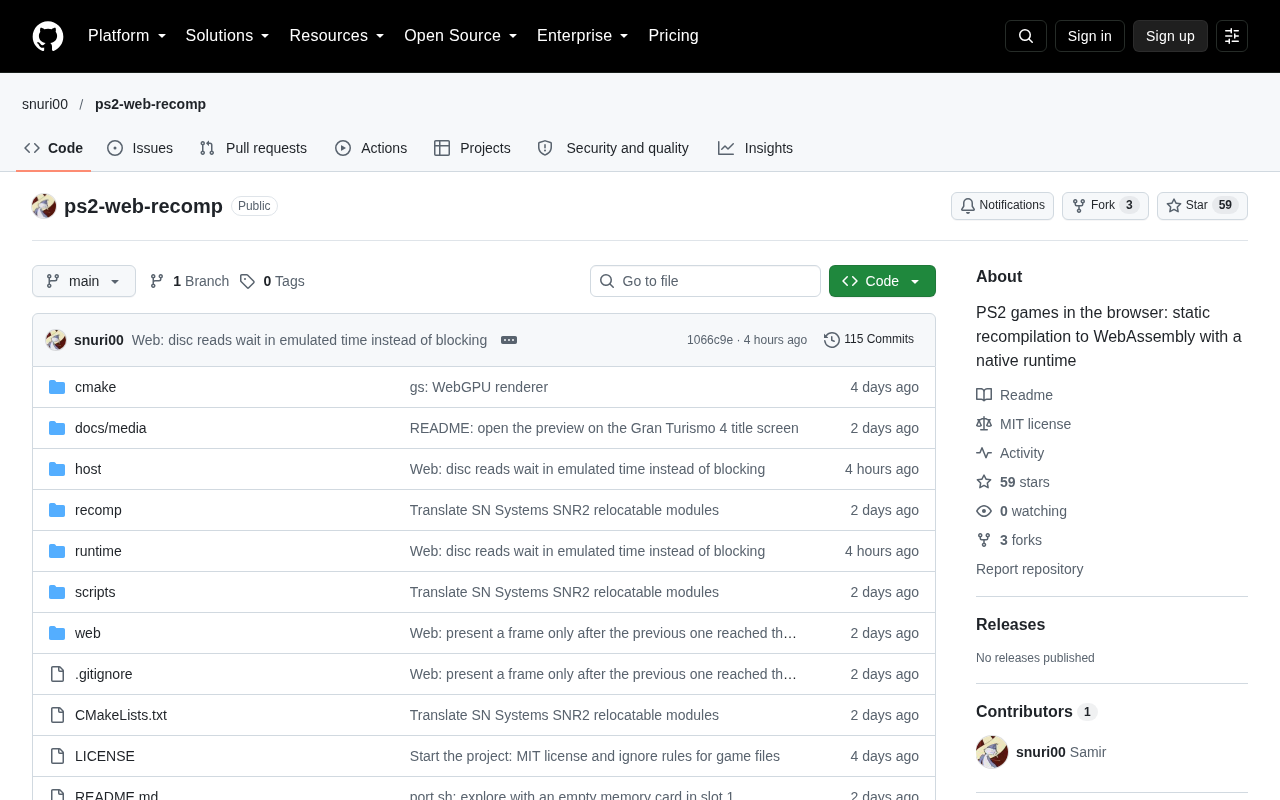
A Show HN project demonstrates converting PlayStation 2 games to WebAssembly via static recompilation. Unlike traditional emulators such as PCSX2 that interpret instructions at runtime, static recompilation translates native machine code once at compile time for near-native execution. The PS2's Emotion Engine, VU0/VU1 vector units, and custom graphics pipeline make this an especially complex engineering challenge. Targeting WebAssembly means recompiled games run in any modern browser with no installation required — offering a compelling new approach to cross-platform distribution and digital game preservation.
When PS2 Games Meet WebAssembly
A Show HN project posted on Hacker News has sparked widespread attention in the tech community: a developer has used static recompilation to convert PlayStation 2 games into WebAssembly, enabling them to run directly in the browser. This isn't traditional emulation — instead of interpreting PS2 machine code at runtime, the approach translates the original binary into executable WebAssembly at compile time.
This represents a new path for game preservation and porting — one that doesn't rely on real-time interpretation by an emulator, but instead lets old console binaries be reborn on modern platforms in a form close to their native state.
Static Recompilation vs. Traditional Emulation
Understanding the value of this project comes down to distinguishing between two very different technical approaches.
Dynamic Emulation vs. Static Recompilation
Traditional PS2 emulators like PCSX2 use a dynamic execution model: the emulator reads game instructions at runtime, translates and executes them one by one, while simultaneously simulating the PS2's CPU (Emotion Engine), GPU (Graphics Synthesizer), and other hardware components. This approach is flexible and compatible, but comes with significant performance overhead — often requiring powerful hardware to run smoothly.
Static recompilation, by contrast, translates the game's native machine code into target platform code all at once, before the program ever runs — in this case, that target is WebAssembly. Once translated, the game logic executes at near-native speed with no need for per-instruction interpretation at runtime. This technique has precedent in N64 and console remaster projects, but applying it to the far more complex PS2 architecture and targeting WebAssembly represents a genuinely challenging engineering feat.
The most well-known early example of static recompilation in the wild comes from the N64 community. Around 2023, developer Mr-Wiseguy released the "N64: Recomp" project, demonstrating a complete toolchain for statically recompiling Nintendo 64 games to native PC code — and using it to produce a PC port of The Legend of Zelda: Ocarina of Time. This precedent significantly eased community doubts about the viability of static recompilation and provided a reference framework for exploring other platforms. The core advantage of static recompilation is that the translated code can be further optimized by modern compilers, sometimes even surpassing the performance of the original hardware. The downside is that it has inherent limitations when handling self-modifying code and indirect branches — games that rely heavily on these techniques may fail to recompile or behave unexpectedly.
Why WebAssembly
Choosing WebAssembly as the compilation target means games can run directly in the browser sandbox, independent of any specific operating system or installation process. This makes it a compelling option for cross-platform distribution and long-term preservation: any device with a modern browser — desktop or mobile — can theoretically access these recompiled titles.
WebAssembly (Wasm) is a binary instruction format standardized by the W3C, becoming an official web standard in 2019. It's designed as a portable compilation target, executing code in a sandboxed environment at near-native speed while sharing a memory model with the JavaScript runtime. Browser Wasm runtimes use JIT or AOT compilation on the bytecode, typically achieving 60–80% of the performance of equivalent native C/C++ code on mainstream platforms. For game porting, another key advantage of Wasm is the maturity of toolchains like WASI (WebAssembly System Interface) and Emscripten — the latter has been used to compile a wide range of C/C++ game engines and emulators to the browser, accumulating deep experience handling system calls for file I/O, audio, OpenGL (via WebGL), and more.
Technical Significance and Challenges
The PS2 is a console with a uniquely complex architecture. Its Emotion Engine co-processors, vector processing units (VU0/VU1), and custom graphics pipeline have long been among the hardest aspects of emulation work. Statically recompiling it requires developers to precisely handle instruction set translation, memory layout, and a large number of edge cases related to the original hardware's behavior.
Mapping all of that complex logic to the relatively constrained WebAssembly runtime environment also means solving additional challenges around graphics rendering, audio synchronization, and browser performance limits. The fact that games actually run at all speaks to the soundness of the underlying engineering.
The PS2's Emotion Engine is a custom processor based on the MIPS R5900 architecture, running at approximately 294 MHz — but its true complexity comes from two co-processors: VU0 and VU1 (Vector Units). These vector processing units have their own instruction sets and 128-bit SIMD registers, purpose-built to accelerate 3D geometric transformations; virtually all vertex processing in PS2 games depends on them. VU1 can operate in "microprogram" mode, where the CPU uploads a custom program that runs asynchronously — meaning rendering behavior can vary dramatically from game to game. Meanwhile, the Graphics Synthesizer (GS) offers no programmable shaders, instead handling rasterization directly through a high-bandwidth memory bus — a significant departure from the abstraction layers of modern GPUs. Accurately mapping this heterogeneous multi-core architecture's behavior onto WebAssembly's single-threaded or limited multi-threaded model is the central technical challenge of statically recompiling PS2 games.
Implications for Game Preservation and the Industry
The deeper significance of projects like this lies in digital cultural heritage preservation. As original console hardware ages and goes out of production, classic games face the risk of becoming unplayable. The combination of static recompilation and WebAssembly offers a preservation strategy that retains the original game logic while adapting it to future computing platforms.
From a broader technology trend perspective, WebAssembly is increasingly becoming a universal carrier for high-performance cross-platform code — not just for web applications, but also for edge computing, plugin systems, and game porting. This PS2 experiment reinforces WebAssembly's potential as a runtime capable of hosting complex native programs.
It's worth noting that since the primary source is a Hacker News Show HN discussion thread, specific details such as the list of supported games, performance benchmarks, and compatibility range still need further verification. Interested readers can follow the project's open-source progress and community feedback.
Summary
Statically recompiling PS2 games to WebAssembly is a prime example of where emulation technology intersects with the modern web platform. It's both a valuable experiment in preserving retro games and a demonstration that WebAssembly's capabilities as a general-purpose runtime continue to expand. For developers interested in game technology, low-level compilation, and digital heritage preservation, this is a direction well worth following.
Related articles

ChatGPT Space Launches: Team Collaboration and New Pages Features Explained
ChatGPT Space is OpenAI's new team collaboration feature with Pages, real-time collaboration, and Slack/Google Drive sync. We break down its privacy design, multi-platform integration, and the full workflow from conversation to document.

Migrating Apache Spark UDFs to GPU Acceleration with AI Agents
NVIDIA developer blog explains how AI Agents rewrite Apache Spark UDFs for GPU acceleration, covering migration criteria, agent rewriting and verification workflows, plus pitfalls like result consistency and CPU-GPU transfer overhead.

Zed Editor v0.40.4-rc2 Released: Usage Credits Now Available Without Upgrading
Zed editor releases v0.40.4-rc2, allowing users to use usage credits for AI features without upgrading to a paid plan, lowering the trial barrier.