Puffies Sticker Puzzle Game: The Design Philosophy of an 8-Person Team Spending Three Months Perfecting a Single Detail

Puffies blends '80s puffy sticker nostalgia with puzzle gameplay, crafting a tactile experience through obsessive detail.
Lykke Studios' 8-person team created Puffies, combining the nostalgic emotion of '80s puffy stickers with puzzle satisfaction. Following a "material-first" design philosophy, the team overcame physics engine performance challenges with 4,000+ 3D stickers and spent three months solving a single sticker-overlap interaction detail, demonstrating near-obsessive dedication to micro-experiences. The game is a finalist for the 2025 Apple Design Awards.
When Puzzles Meet Childhood Stickers: The Origin of Puffies
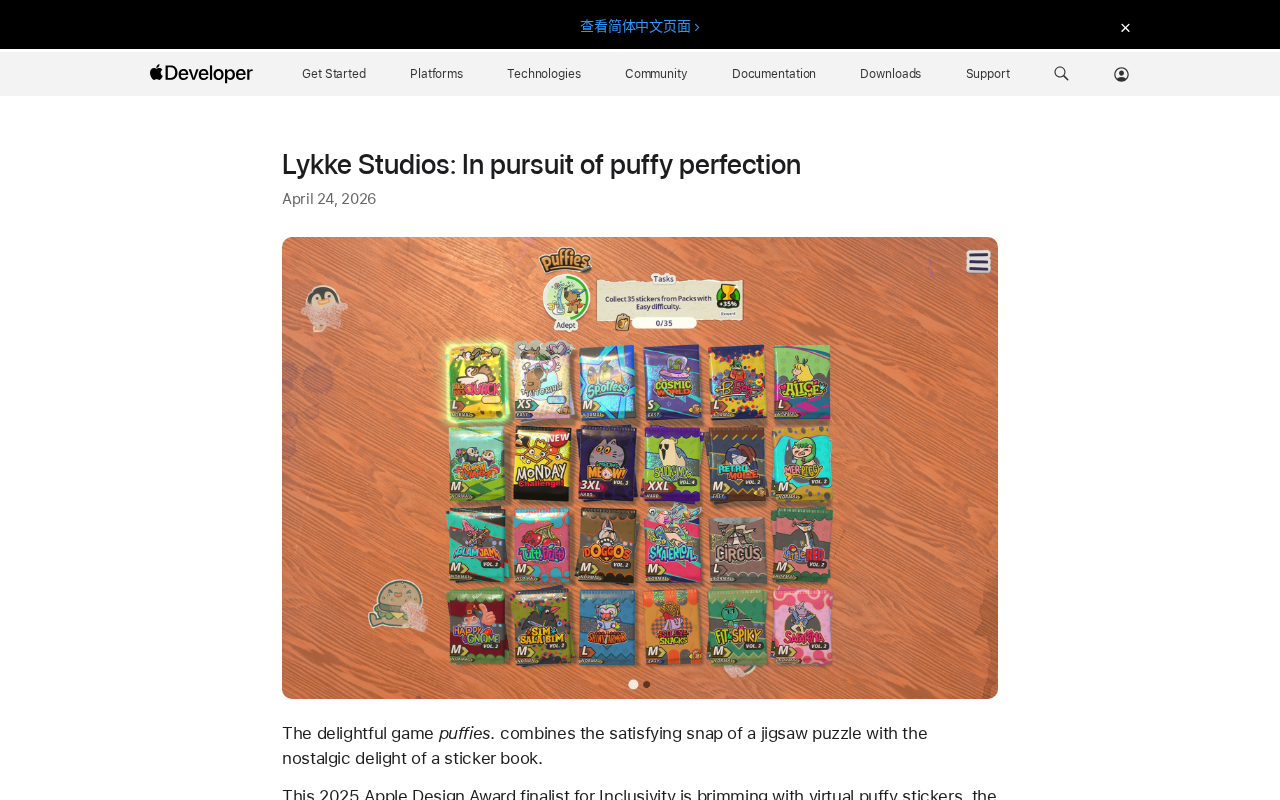
Remember those shiny puffy stickers from the '80s? The ones you stuck on folders and traded with classmates during recess. Puffy Stickers were a collectible cultural phenomenon that swept across North America and Europe in the 1980s—made from PVC or vinyl with foam padding inside, creating a tactile, three-dimensional texture. They circulated as social currency among children, with sticker trading during recess serving as an important peer interaction ritual, fostering an entire generation's psychological satisfaction with "collecting and completing." Lykke Studios' game puffies. perfectly blends this nostalgic emotion with the satisfaction of puzzles, creating an entirely new gaming experience—tearing open themed sticker packs and precisely placing colorful stickers onto blank sticker books, fitting each one perfectly into its designated spot. Choosing this medium isn't just visual nostalgia; it's awakening a deep emotional memory: that sense of ritual and accomplishment when placing a sticker in exactly the "right spot."
This game was a finalist in the Inclusivity category of the 2025 Apple Design Awards, built by a team of just 8 people with studios in Thailand and Cyprus. But what truly sets it apart isn't the team size or geography—it's their near-obsessive pursuit of every tiny detail.
A Material-First Design Philosophy for Indie Games
"We always start with a material that we love," says Lykke Studios founder Jakob Lykkegaard. The team has an impressive track record: they won an Apple Design Award in 2023 for the embroidery puzzle game stitch. and were finalists in 2022 for the watercolor painting game tint. Each product revolves around a unique physical material.
When the team began conceptualizing puffies., they wanted a puzzle experience that felt natural on a touchscreen. The breakthrough came with puffy stickers—they're tactile, nostalgic, and far more interesting than individual puzzle pieces.
Prototypes That Literally Exploded Under the Physics Engine
However, the vision was ambitious but reality proved challenging. "Our first prototypes basically exploded because of the game physics engine," Lykkegaard recalls with a laugh.
A game physics engine is the core system responsible for simulating real-world physical laws, including gravity, collision detection, friction, and rigid body dynamics. Common physics engines in mobile game development include Unity's built-in PhysX, Box2D, and Bullet Physics. When a game has numerous objects requiring real-time physics interaction calculations, performance overhead grows exponentially—this was the root cause of the early prototypes "exploding." The game's 4,000+ stickers are each 3D-modeled objects governed by the physics engine, each requiring real-time collision calculations with other objects—an enormous challenge for mobile device GPUs and CPUs. Early testing proved that these sticker pieces were completely unruly when together, ricocheting all over the virtual desktop. The development team ultimately needed to find an elegant balance between physical realism and performance optimization, which often meant extensive custom trimming and approximation of physics simulations rather than using the engine's default behavior.
Three Months to Solve a Single Interaction Problem
Once the team finally got the stickers to stop flying everywhere, they faced a new problem: what should happen when a player tries to place one sticker on top of another?
Does this scenario occur frequently in actual gameplay? Not really. Did they spend three months perfecting it? Absolutely.
"Does it stay in place? Does it slide off? If it slides, in which direction and at what speed?" Lykkegaard recalls the team's discussions. Ultimately, they decided to have the sticker simply bounce back to its starting position at the puzzle's edge. "It's no exaggeration to say we spent three months on this," Lykkegaard says. "We scrapped the entire codebase and started from scratch until it felt right."
Related articles
 Product Reviews
The Programmer's Desk Setup Guide: Building a Workspace That Feels Like Home
Discover how programmers build productive, comfortable workspaces. From multi-monitor setups to ergonomic design, explore the desk philosophy that drives focus and flow.
 Product Reviews
Qoder vs Cursor Real-World Comparison: Which $20/Month AI IDE Is Better?
Hands-on comparison of Qoder vs Cursor AI IDEs: Agent autonomy, human interaction count, and architecture decisions. Qoder needed only 2 interactions vs Cursor's 8.
 Product Reviews
Cursor Cloud Agent Demo: Eliminating Bottlenecks Across the Entire Software Development Lifecycle
Deep analysis of Cursor's Cloud Agent demo showing how cloud VMs, automated test artifacts, and a full-chain control plane systematically eliminate human bottlenecks across the software development lifecycle.