Putin vs. Zelensky: A Comparative Analysis of Wartime Military Leadership

Differences in command style and the mismatch between goals and means determine the course and endgame conditions of the attrition war.
This article reviews military analysts' comparison of Putin's and Zelensky's wartime command styles: Zelensky delegates tactical command and benefits from higher-quality information, while Putin has strong strategic input but limited operational involvement and faces a long-term mismatch between political goals and military means. The article notes that Ukraine's independence is a foregone conclusion, and what Russia can truly influence is borders and geopolitical alignment; Russia's negotiating demands are not tied to battlefield performance. The attrition war depends on economy, manpower, and external support, with Russia allocating about 44% of its budget to the war and Ukraine relying heavily on Western aid. The conclusion holds that Russia will face strategic failure and a heavy historical verdict, while Ukraine suffers structural damage to its economy and population.
Title
Putin vs. Zelensky: A Comparative Analysis of Wartime Military Leadership
Meta Description
A military leadership comparison of Putin and Zelensky: analyzing their differences in tactical delegation, alignment of strategic goals with military means, and the economic, manpower, and external support dynamics of the war of attrition.
Article Content
As the Russia-Ukraine war enters a protracted phase of attrition, the leadership style differences between the two supreme commanders are becoming a deeper variable shaping the course of the conflict. Experts from a YouTube military analysis channel discussed the strengths and weaknesses of Putin and Zelensky as wartime commanders, offering noteworthy judgments across dimensions such as the match between strategic goals and military means, degree of micromanagement, and structures of external dependence.
Command Style: One Lets Go, the Other Hovers
Analysts generally agree that Zelensky has adopted a clear "delegation" posture on military decisions—he largely refrains from intervening at the tactical or operational level, leaving combat decisions to professional military teams. Commentators say plainly, "Overall, this is a good thing."
Putin's situation is more complex. According to the analysis, Putin undoubtedly has direct input at the strategic level, but his involvement at the tactical and operational levels is limited. When the Russian military performed poorly in the early days of the 2022 campaign, he directly contacted senior commanders at the army group level—a level above combined arms armies, belonging to the operational level. But multiple analysts believe that neither leader actually micromanages combat.
Historical experience is repeatedly invoked: the more directly leaders intervene in military decisions, the more chaotic the situation tends to become. The difference lies in information quality—Zelensky receives a more impartial and honest picture of the battlefield, with a more accurate assessment of Ukraine's situation and resource allocation; Putin's information environment is evidently different.
The distinction between operational and tactical levels is clearly defined in military terminology: the tactical level refers to the deployment of forces and application of firepower in specific engagements, usually the responsibility of division and brigade commanders; the operational level involves the organization and coordination of larger-scale combat operations, such as army group or theater-level offensive planning, requiring the integration of multiple tactical units, logistics, and intelligence support. Analysts emphasize that Putin's direct contact with army group-level commanders demonstrates that his involvement reached the operational level rather than being limited to strategic guidance. The danger of such direct intervention at this level is that the supreme commander lacks real-time frontline information and is prone to making judgments based on a distorted battlefield picture, thereby disrupting the normal functioning of the professional chain of command.
The Fatal Mismatch Between Strategic Goals and Military Means
The sharpest judgment in this discussion points to a fundamental mismatch between Russia's political objectives and the military means available. Analysts explicitly state that responsibility for this mismatch "lies entirely with Putin"—he started the war, and the duty of political leadership is to examine whether goals and means match. "If after four or five years of war you still can't see this, you should ask yourself some tough questions."
The war can be divided into two distinctly different phases. The first 30 days were the phase in which Russia attempted to rewrite Ukraine's regime and prevent it from maintaining an independent state identity and national identity—this attempt "failed decisively" and cannot be repeated under the conditions of this war. Everything thereafter is a protracted conventional war characterized by attrition and exhaustion, which will determine Ukraine's borders, economic sustainability, and whether it must make concessions in its strategic orientation.
The key conclusion is: whether Ukraine will maintain independence and national identity is no longer in question. What Russia can truly influence is the issue of borders and geopolitical alignment.
Asymmetry at the Negotiating Table: Demands Bound to Imagination, Not Reality
The analysis points out that Ukraine's political demands are basically linked to its battlefield performance—ceasefire, a long contact line, return of abducted persons and children. Russia's demands, however, are not bound to actual military performance but rather to "the performance Russia wishes it had."
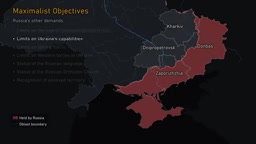
Russia demands that Ukraine cede the remaining Donbas region precisely because the Russian military cannot take it and sees no path to doing so in the short term. Putin recently stated that Zelensky has no right to discuss the future of Zaporizhzhia, Kherson, Donetsk, and Luhansk, calling them "historical Russian lands"—meaning that in the Russian mindset, territories not yet occupied are already established possessions and not open to discussion.
Russia's maximalist goals are not limited to the Donbas. According to the analysis, they include as much of Kharkiv, Zaporizhzhia, and Dnipropetrovsk oblasts as possible. In fact, Russian forces are advancing along a front roughly 1,200 kilometers wide; although the Donbas is the priority direction, last year they advanced more in the Zaporizhzhia and Dnipropetrovsk directions—because the terrain there is less urbanized and Ukraine's elite forces are concentrated in Donbas defense. In addition, Russia seeks a series of national security concessions: limits on the size and capabilities of Ukraine's military, restrictions on NATO membership, limits on Western troop deployments, as well as issues such as the status of the Russian language and the Russian Orthodox Church, and demands recognition of territories it has occupied and annexed.
Analysts provide a clear framework for judging when "negotiation means the end of war": the war will end when both sides believe a negotiated settlement is preferable to continued fighting, and when military capabilities match political concessions. Russia's demands have remained essentially unchanged since the start of the war, which is precisely why many are pessimistic about a short-term ceasefire. To take the city of Kherson and the remaining territories, Russian forces would need to cross the Dnipro River—no observer currently believes Russia is close to achieving this.
The term "historical Russian lands" has specific political connotations in official Russian discourse. It usually refers to territories once controlled during the Russian Empire or Soviet era that the Kremlin regards as having historical and cultural significance, and does not necessarily align with borders recognized by current international law. By calling Zaporizhzhia, Kherson, Donetsk, and Luhansk "historical Russian lands," Putin is in essence pre-defining areas not yet militarily occupied as inherent Russian territory, thereby eliminating room for discussion in negotiations. This rhetorical strategy transforms territorial demands from "bargaining chips based on battlefield reality" into "non-negotiable identity issues," significantly raising the political cost of compromise.
The Three Pillars of Attrition: Economy, Manpower, and External Support
The sustainability of the war depends on three lines: economic endurance, societal will to fight, and external support.
On the economic front, Russia allocates about 44% of its government budget to the war, roughly 9% to 10% of GDP. Analysts note that a large amount of funding flows to military production—products that generate no economic value—and the Russian economy is "slowly consuming itself," with structural risks. Russian economic elites publicly stated in early spring that this level of war spending is unsustainable. On the other hand, the actual effect of sanctions is lower than expected; Russia has found numerous evasion pathways, and the decline in living standards has not triggered discontent as anticipated. Thus the mechanism by which economic pressure translates into motivation to end the war "is like a black box."
On the manpower front, Russia's manpower advantage is "considerable." Ukraine, while mobilizing, tries to minimize personnel in dangerous frontline positions, assigning tasks to robots wherever possible; Russia continues to advance with soldiers rather than drones and robots, at the cost of many lives. Some regions are beginning to struggle to meet recruitment quotas, with signs of hidden mobilization and forced conscription. Analysts mention a case: a soldier attempting to leave the country was stopped at the border and later found value as a drone mechanic in the Ukrainian military—Ukraine has already completed this process, while Russia is just beginning, and how society will react is a huge unknown.
But analysts are not optimistic about Russian societal reaction. About three months into the war, commentators thought casualties would be enough to bring Moscow's residents into the streets; yet now, with monthly casualties exceeding 30,000, they "see no signs."
On external support, Ukraine relies heavily on Western funding, military capabilities, and intelligence support, and this support requires constant renewal and is affected by policy reversals in some countries. Russia benefits significantly from China—obtaining machine tools and components—and receives support from North Korea and Iran. Analysts note that at one stage of the war, North Korea supplied about 40% of Russian artillery ammunition, and North Korean troops also participated in operations in the Kursk direction.
Hidden mobilization refers to the government expanding the pool of recruits without formally declaring a mobilization order—through higher bonuses for contract soldiers, relaxed age and health restrictions, administrative pressure on specific groups, and allowing prison recruitment. This approach avoids the social shock and political risk of formal mobilization, but at the cost of lower troop quality, shortened training cycles, and long-term unsustainability. The cases mentioned by analysts—regions struggling to meet recruitment quotas and soldiers intercepted at borders—are precisely signals that the hidden mobilization mechanism is beginning to strain. In contrast, Ukraine completed its transition from volunteer forces to a mobilization system earlier and systematically replaced personnel in dangerous frontline positions with drones and robots; this difference may gradually amplify over a long attrition war.
Conclusion: Whose Historical Verdict Is Heavier
From a purely military leadership perspective, Zelensky's strengths lie in realistic goals, truthful information, and tactical delegation; Putin's problem lies in the long-term mismatch between political goals and military means, and his unwillingness to lower his goals. Analysts' judgment is quite direct: this war will be seen as a strategic failure for Russia, producing generational ripple effects, and "whatever Russia gains, it is not worth the price paid." Under such a framework, Putin's historical verdict from this war will likely be stained.
For Ukraine, battlefield performance and negotiating position are now quite close, but the ongoing war itself is damaging its economy and driving away its population—this is precisely one of the goals of Russia's strike strategy. No country fighting a conventional war on its own soil becomes better off as a result; this is a structural dilemma Ukraine cannot avoid.
Background Note
The alignment of strategic goals and military means is the core proposition of Clausewitzian strategic analysis: political leadership sets war objectives, and military means must be sufficient to achieve them; otherwise, either the objectives must be adjusted or the means expanded. Analysts attribute Russia's dilemma to "unchanging goals, insufficient means," with responsibility lying with the political leadership rather than the military. This framework also explains why Russia's negotiating demands appear detached from battlefield reality—when political goals are fixed at a maximalist version, the negotiating position no longer reflects military progress but projects an idealized outcome. Understanding this logic helps judge the prospects for a ceasefire: as long as the gap between goals and means is not squarely addressed by political decision-making, the conditions for a negotiated settlement will be difficult to mature.
One-line Summary
Differences in command style and the mismatch between goals and means determine the course and endgame conditions of the attrition war.
Paragraph Summary
This article reviews military analysts' comparison of Putin's and Zelensky's wartime command styles: Zelensky delegates tactical command and benefits from higher-quality information, while Putin has strong strategic input but limited operational involvement and faces a long-term mismatch between political goals and military means. The article notes that Ukraine's independence is a foregone conclusion, and what Russia can truly influence is borders and geopolitical alignment; Russia's negotiating demands are not tied to battlefield performance, demanding unoccupied Donbas and other territories, and seeking security concessions such as limits on Ukraine's military size and NATO membership. The attrition war depends on three pillars: economy, manpower, and external support—Russia allocates about 44% of its budget to the war and its economy slowly consumes itself, has a quantitative manpower advantage but faces recruitment pressure, and benefits externally from China, North Korea, and Iran; Ukraine relies heavily on sustained Western military aid. The conclusion holds that Russia will face strategic failure and a heavy historical verdict, while Ukraine, though its battlefield and negotiating positions are close, suffers structural damage to its economy and population from the war.
Related articles

How the Grok Team Hits 11,000 PRs a Month: Replacing Manual Review with Deterministic Constraints
Inside the Grok team's formula for 11,000 monthly PRs at a 0.5% rollback rate: Lint rules, type systems, and formal verification as deterministic constraints.

Is Spacetime Made of Something? Six Possible Answers from Quantum Gravity
Is spacetime made of something? This article surveys the main candidate answers from quantum gravity: spacetime may be fundamental, geometry quantized, causal relations prior to distance, spacetime an emergent state of matter, geometry derived from string theory, or no spacetime atoms needed at all.

After GTA 6, Where Does the Game Industry Go?
The Vergecast talks with Game File's Stephen Totilo about GTA 6's impact on gaming: billion-dollar budgets, console market struggles, cloud gaming tests, and the future of microtransactions—and whether it marks the end of an era.