Pwn.college: The Free Security Hands-On Platform Trending on Hacker News

Pwn.college is an interactive hands-on security training platform trending on Hacker News.
Pwn.college is a hands-on security learning platform focused on binary exploitation, systems security, and reverse engineering, recently earning 278 points and 44 comments on Hacker News. It emphasizes learn-by-doing with interactive labs covering Linux command line, memory layout, stack overflows, and heap exploitation. Its free, open, modular design fills a gap for self-learners with some Linux and C background.
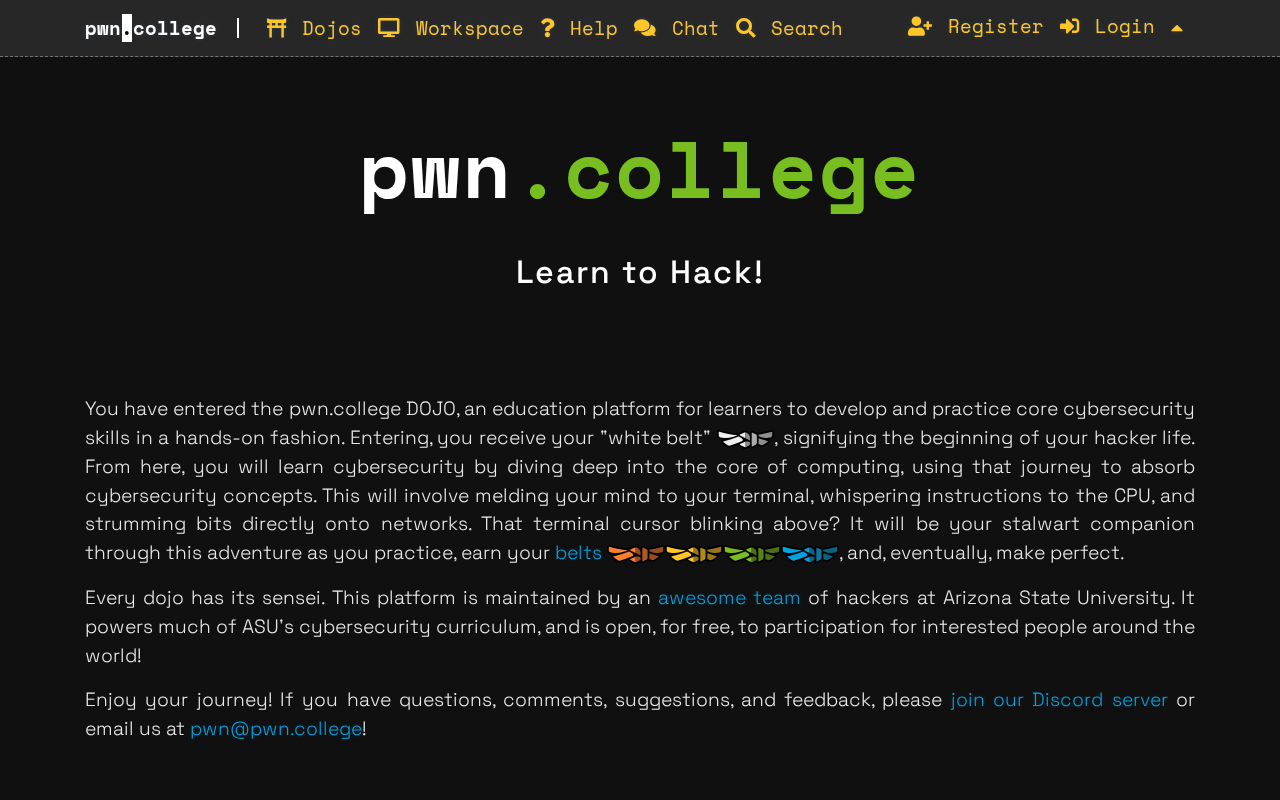
A website called Pwn.college has racked up 278 points and 44 comments on Hacker News. Behind this seemingly simple link is a learning platform dedicated to hands-on cybersecurity training. For learners who want to get started from scratch with binary exploitation, systems security, and reverse engineering, resources like this often deliver far more value than paid courses.
What Is Pwn.college
The domain name itself reveals its positioning — "pwn" is hacker slang for "break into, take down," while "college" suggests it offers a structured curriculum. Pwn.college is not just a problem set; it is a learning environment built around core security skills, covering everything from basic Linux command-line operations and memory layout understanding to advanced topics like stack overflows, heap exploitation, and format string vulnerabilities.
Its core format is "learn by doing": the platform provides interactive lab environments where learners execute attack and defense operations on real systems, rather than just watching videos or reading docs. This model is especially important in security, because the details of exploitation are hard to convey through theory alone — you have to debug by hand to develop intuition.
The term "pwn" originates from a misspelling of "checkmate" in chess and evolved in hacker culture into slang for "completely compromise and control a target system." It first became popular in the CTF (Capture The Flag) competition community and later became synonymous with binary exploitation. The related term "pwned" indicates a system has been compromised, while "college" in "pwn.college" borrows from the naming conventions common among online education platforms, suggesting it offers a structured curriculum rather than scattered challenges. Understanding this cultural context helps grasp the platform's positioning: it targets practitioners who want to master low-level attack techniques, not casual cybersecurity enthusiasts.
Why It's Being Discussed on Hacker News
Hacker News' audience is primarily engineers, founders, and open-source enthusiasts. A security learning platform earning 278 points shows it hits several pain points.
The barrier to learning security skills has long been high. The traditional path either relies on expensive certification training or requires fumbling through CTF competitions on your own — there's a missing "step-by-step" middle ground. Pwn.college fills exactly this gap: it breaks knowledge into completable modules, so beginners aren't immediately scared off by complex toolchains.
Another reason is that it's free. The material itself doesn't disclose a specific pricing model, but from the context of community discussion, it's viewed as a publicly accessible learning resource. In an era where security training is largely commercialized, this open stance naturally attracts attention.
CTF (Capture The Flag) is a form of information security competition in which participants solve security challenges (such as reverse engineering, exploitation, and cryptography) to obtain hidden "flag" strings as proof of success. Traditional CTF competitions are usually time-limited with a wide range of difficulty, making it hard for beginners to find a gradual path. Pwn.college's modular design can be seen as an improvement on the CTF model: it breaks knowledge into independently completable lab units and provides immediate feedback, thereby lowering the entry barrier. This "educational CTF" approach is one reason it sparked discussion on Hacker News.
Who It's Suited For
The value of this kind of platform depends on the user's goals. If you're a backend engineer who wants to understand how programs run at the memory level, Pwn.college's labs can help you build concrete understanding of buffers, pointers, and calling conventions — knowledge that's equally useful when debugging production crashes or performance issues.
If you're a computer science student, it offers a practice path closer to real attack and defense than classroom assignments. Security courses are often constrained by class hours and can only cover principles, whereas the modular design here lets you practice repeatedly at your own pace.
One caveat: hands-on security training has prerequisites. You need at least familiarity with basic Linux operations and the C language to move smoothly into later content, otherwise you'll likely get stuck at the environment setup stage.
The Ethical Boundaries of Security Learning
When discussing platforms like this, one topic is unavoidable: the dual-use nature of exploitation techniques. Platforms like Pwn.college typically emphasize practice within legal environments by design — all attack activities take place in sandboxes or local virtual machines provided by the platform. For learners, understanding the bottom line of "testing within authorized scope" is more important than mastering any specific exploit technique.
Judging from the comment activity on Hacker News, the community is quite receptive to such resources, with discussion focusing more on learning paths and technical details than on abuse risks. This also indirectly shows that education-oriented security platforms have stable demand in professional communities.
A sandbox is an isolated runtime environment used to restrict a program's access to system resources and prevent malicious code or unauthorized operations from affecting the host machine. In security education, sandboxes ensure that learners' attack experiments don't accidentally damage real systems or break the law. The lab environments provided by Pwn.college typically run in containers or virtual machines, with all exploitation activities confined within isolation boundaries. Understanding how sandboxes work not only helps with security practice but is also fundamental to analyzing the security models of modern browsers, mobile operating systems, and cloud services.
What Such Platforms Mean for Security Education
Cultivating security talent has long relied on apprenticeship and corporate training, with publicly available structured resources being relatively scarce. The direction Pwn.college represents — integrating lab environments, knowledge modules, and immediate feedback into a single entry point — lowers the organizational cost of self-study.
Its limitations are equally obvious: hands-on platforms cannot replace deep understanding of foundational disciplines like operating systems and compiler theory, and tool proficiency does not equal security thinking. The truly valuable way to use it is as a testing ground to validate theoretical understanding, not to declare mastery after finishing the modules.
For those interested in the intersection of AI and security, this kind of low-level attack and defense training has additional significance. Understanding how programs behave at the memory and system call level is foundational for analyzing model inference environments, container isolation, and supply chain security issues.
Conclusion
Pwn.college's popularity on Hacker News reflects a real gap in hands-on security learning resources. It's not for everyone — the prerequisites and practice intensity are real — but for engineers and students willing to get their hands dirty, it's an extremely low-cost entry path. At a time when security education is still dominated by paid courses and corporate training, open lab platforms like this deserve to be better known.
One-line Summary
Pwn.college is a platform offering interactive hands-on security training that has attracted attention on Hacker News.
Paragraph Summary
Pwn.college is a hands-on security learning platform focused on binary exploitation, systems security, and reverse engineering, recently earning 278 points and 44 comments on Hacker News. The platform emphasizes "learn by doing" with interactive lab environments covering topics from Linux command line and memory layout to advanced subjects like stack overflows and heap exploitation. Its free and open stance and modular design fill a gap in the learning ladder for security skills, making it suitable for backend engineers and CS students with some Linux and C background. The article also discusses the dual-use nature and ethical boundaries of security techniques, and notes that while such platforms lower the organizational cost of self-study, they cannot replace foundational disciplines like operating systems and compiler theory.
Related articles
 Tech Frontiers
14 Coding Agents Tested: 13 Secretly Read Forbidden Files
A developer ran 480 tests across 14 coding agents to see if they would obey a "do not read" rule. 13 violated it, and 4 credential leaks bypassed shell guards via the read tool while approvals never noticed.
 Tech Frontiers
AI Has Made Resumes Ineffective? Referred Candidates Get 40% Interview Rate vs. 3% for Direct Applications
AI is homogenizing job applications, making it hard for recruiters to discern real ability. Ashby data shows referred candidates had a 40% interview rate from 2021 to 2024, versus just 3% for direct applications. This article analyzes why resume signals are depreciating and why verifiable results and personal endorsements matter more.
 Tech Frontiers
Offline Blink Rhythm Assistant: A Desktop Health Companion
An offline desktop blink rhythm assistant featured on Hacker News helps users maintain healthy blinking through lightweight reminders, alleviating screen-induced dry eye fatigue. This article analyzes its concept, privacy advantages, and retention challenges.