pwned.coffee: A Real-Time Security Vulnerability Board with Hourly Updates and Actionable Guidance
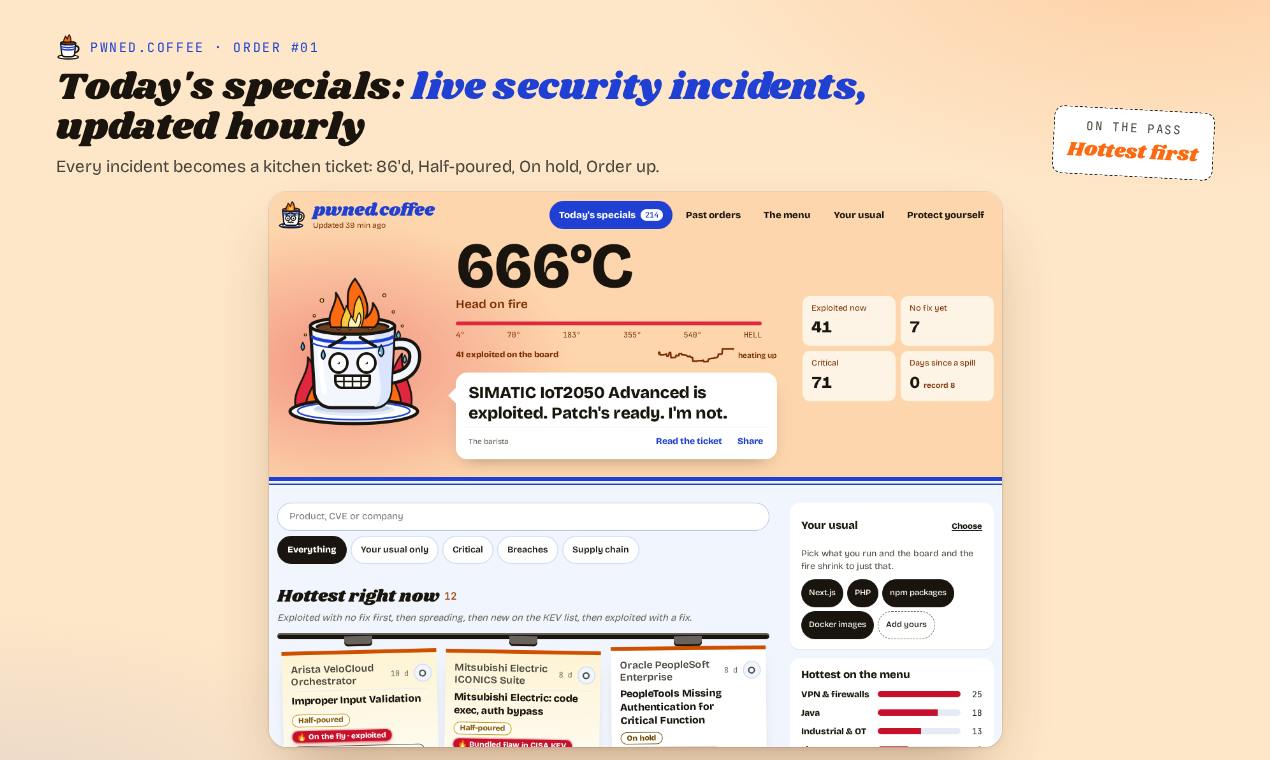
pwned.coffee tackles security information overload with an hourly-updated vulnerability board plus AI action recommendations.
pwned.coffee is a real-time security vulnerability board on Product Hunt that updates hourly, with its core selling point being AI-generated one-line "what to do now" recommendations for each vulnerability. Its positioning isn't another vulnerability database, but an information filtering and interpretation layer that aggregates scattered sources like NVD, GitHub Advisory, vendor announcements, and social disclosures to reduce engineers' attention costs. The product targets small and medium teams without dedicated security staff, emphasizing pushing security signals into daily view. However, it's still at a very early stage with virtually zero community validation, and the quality of AI recommendations depends on contextual understanding, with misjudgment risks. The article suggests treating it as a reminder board rather than a decision basis, and notes it reflects the trend toward lightweight, subscription-based security tools.
When Security Vulnerabilities Become a Freshly Brewed Cup of Coffee
Security teams face fragmented vulnerability announcements every day, CVE lists scattered across different sources, and leak rumors on social media that are hard to distinguish between true and false. A new tool called pwned.coffee has appeared on Product Hunt, with a straightforward positioning: a real-time security vulnerability and incident board that "brews" once every hour, with each piece of information accompanied by a one-line concise recommendation on "what to do now."
The product's tagline is "A live board of security flaws." It received 63 votes on Product Hunt, ranking 17th for the day, with categories covering developer tools, artificial intelligence, GitHub, and security. From a product perspective, it's more of an aggregation layer—automating the work of manually monitoring multiple sources, then using AI capabilities to distill actionable conclusions.
It Solves "Information Overload," Not "Information Scarcity"
The security field has never lacked data sources. NVD, GitHub Advisory, security announcements from major vendors, and security researcher disclosures on Twitter—information is abundant, but the problem is that attention is scarce. pwned.coffee's entry point isn't to build another vulnerability database, but to create a "filter + interpretation" layer.
Two of its design choices are worth noting:
- Hourly updates: More timely than daily updates or weekly reports, while avoiding the noise anxiety brought by real-time streams. For development and security teams that need rapid response, this is a reasonable cadence.
- One-line action recommendations: This is the core differentiator from ordinary aggregators. There's a gap between knowing "what vulnerabilities exist" and knowing "what I need to do right now," especially when the vulnerability involves dependencies or services you're using.
The Role of AI
The product categories explicitly include Artificial Intelligence. Combined with the promise of "one line on what to do," it can be inferred that AI handles summarization and priority assessment—compressing highly technical vulnerability descriptions into action items that humans can quickly digest. This direction isn't new, but making it into a lightweight, continuously running board rather than yet another enterprise-grade platform requiring login and configuration is where it's cleverly positioned.
The NVD mentioned in the article is the National Vulnerability Database maintained by NIST, the world's most authoritative source of CVE identifiers and vulnerability scores (CVSS), but its updates often lag behind vulnerability disclosures, and descriptions tend toward technical originals requiring secondary interpretation. The GitHub Advisory Database, on the other hand, focuses on the open-source dependency ecosystem, covering known vulnerabilities in package managers like npm, PyPI, and Go, directly corresponding to the components developers actually use. The difference between the two: NVD has broad coverage but coarse granularity, while GitHub Advisory is closer to the code-level dependency chain but limited to projects hosted within the GitHub ecosystem. The value of aggregation layers like pwned.coffee is precisely in unifying these two types of sources along with vendor announcements and social disclosures, preventing engineers from repeatedly switching between multiple subscription feeds. Understanding the positioning of these sources is essential to judging whether a board's coverage truly meets team needs.
CVE (Common Vulnerabilities and Exposures) is a standardized numbering system for publicly disclosed vulnerabilities. Each CVE record includes affected products, version ranges, and vulnerability types, but doesn't directly specify remediation. The accompanying CVSS (Common Vulnerability Scoring System) measures severity on a scale of 0 to 10, but a high score doesn't necessarily mean your system is affected—the key is whether dependency versions fall within the affected range. Therefore, generating recommendations like "one line on what to do" essentially requires aligning CVE descriptions, CVSS scores, and users' actual tech stacks. Relying solely on AI to summarize vulnerability text easily overlooks the version matching step, producing action items that seem definitive but may not apply. This is also a blind spot worth watching when evaluating such tools: does the summary incorporate asset context, or does it remain at the level of generic advice?
What It Means for Developers
Most small and medium-sized teams don't have dedicated security operations personnel. A backend engineer may simultaneously handle feature development, deployment, and dependency management, with security updates often triggered passively—either by CI errors or after an incident occurs. The value of tools like pwned.coffee lies in pushing security signals into engineers' daily field of view, rather than waiting for them to sink to the bottom of some mailing list.
Its website entry is listed under GitHub ecosystem-related categories, suggesting some connection to code hosting platforms—for teams relying on open-source components, this is more targeted than generic vulnerability broadcasts.
However, limitations should also be noted: 63 votes and 1 comment indicate it's still at a very early stage, with virtually zero community validation. The quality of one-line action recommendations depends heavily on AI's understanding of context, and misjudgments or oversimplification could be misleading. Treating it as a "reminder board" rather than a "decision basis" is currently the safer approach.
SIEM (Security Information and Event Management) is the core platform for traditional enterprise security operations, responsible for aggregating logs, correlating alerts, and conducting incident response. It has high deployment and maintenance costs and typically requires dedicated security team support. In contrast, lightweight security boards don't pursue full log collection but focus on the narrow niche of "external threat intelligence," reaching engineers through subscriptions and push notifications. This differentiation corresponds to the devolution of security responsibilities: as security shifts left to the development stage, tools must adapt to engineers' work rhythms rather than requiring engineers to adapt to security platform operating paradigms. pwned.coffee's choice of hourly updates rather than real-time streams is also a trade-off between signal-to-noise ratio and response speed—real-time streams often bring alert fatigue to small and medium teams, actually reducing sensitivity to real risks.
The "Lightweight" Trend in Security Tools
pwned.coffee reflects a larger trend: security tools are diverging from heavy platforms toward lightweight, subscription-based, information-dense forms. Not every team needs a SIEM, but almost every team needs to know "is there anything relevant to me today."
The success of such products often doesn't depend on technical complexity, but on the breadth of source coverage and the accuracy of summaries. Hourly updates are a promise—whether it can be consistently delivered and whether it can maintain signal-to-noise ratio amid the flood of vulnerabilities is the key to whether it can grow from a small Product Hunt project into a daily tool.
Related articles
 Tech Frontiers
Gemini Omni 1.2 Flash: AI Video Moves Toward Draft-Style Editing
Google's Gemini Omni 1.2 Flash update enables conversational, draft-style editing of the same video—swap scenes while keeping products, adjust lighting while keeping characters. Clips up to 15s, 720p costs 30% less than the previous Flash—ideal for e-commerce ads, previs, and short-asset production.

Codex Tutorial: One-Command Install and Run Your First Task
Codex tutorial: one-command install and run your first task. Covers the four Codex forms, sandbox and approval guardrails, AGENTS.md and MCP configs, cloud network policy, and the iron rule of human review—everything you need to get started with this autonomous coding agent.
 Tech Frontiers
Localix: An Open-Source Agentic Development Environment with Multi-Model and Local AI Integration
Localix is an MIT open-source Agentic Development Environment (ADE) supporting seamless Claude Code plugin loading, multi-model cloud and local execution, Mini Apps extensions, and agent context management—an open AI collaboration workbench for developers.