Pylon Sync: An In-Depth Look at the Full-Stack Realtime Framework Built for AI Agents
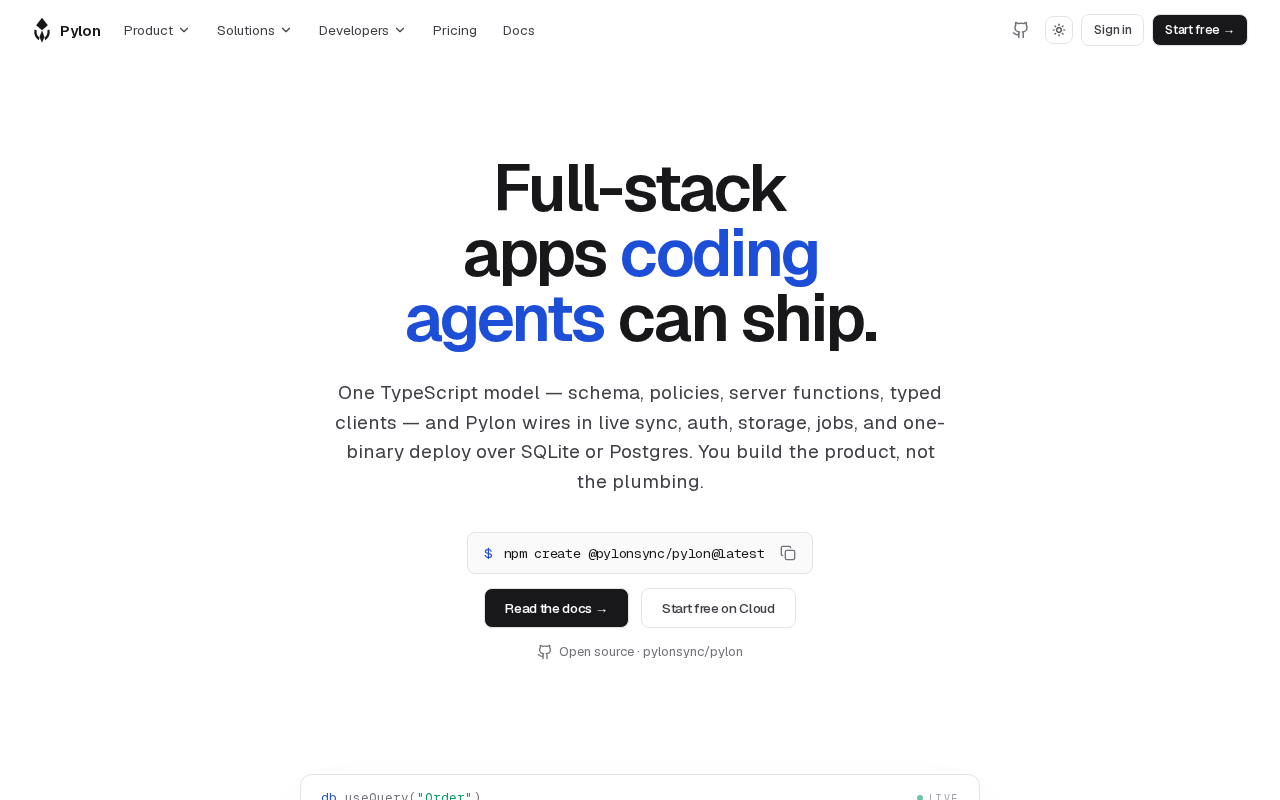
Pylon Sync: an Agent-First full-stack realtime framework built for AI Agents.
Pylon Sync is an "Agent-First" full-stack realtime framework that treats AI Agents as first-class design citizens. By converging coding patterns and reinforcing conventions, it aims to reduce AI hallucination and improve generated code reliability. This article explores its design philosophy and industry significance.
When Frameworks Are Born for AI
The history of software development frameworks is essentially a history of continuous optimization of the developer experience (DX). From hand-writing HTTP handling logic, to the rise of MVC frameworks, and then to modern full-stack solutions like React and Next.js, every iteration has lowered the barrier to building complex applications. There is a clear technical logic behind this journey: Ruby on Rails swept through the web development world in 2004 with its principle of "Convention over Configuration," compressing CRUD applications that once required hundreds of lines of configuration into just a few commands; Next.js in 2016 fused server-side rendering with file-system routing, dramatically reducing the cognitive burden of full-stack development. Every generational breakthrough in frameworks stems from a precise judgment about "what developers repeat most often."
It's worth noting that the "Convention over Configuration" principle championed by Rails did not emerge out of nowhere. Its intellectual roots trace back to the long-standing research on "Cognitive Load" in the field of software engineering. Psychologist John Sweller proposed Cognitive Load Theory in 1988, pointing out that the limited capacity of working memory is the core reason complex tasks fail. Rails creator David Heinemeier Hansson translated this insight into a framework design philosophy: by presetting reasonable directory structures, naming conventions, and database mapping relationships, developers are freed from a great deal of "decision fatigue." This logic is essentially a strategy of "cognitive outsourcing"—solidifying recurring decisions into framework conventions so that developers' limited attention can focus on the business logic itself. Django, Laravel, and Spring Boot have all borrowed from this spirit to varying degrees. As AI Agents gradually replace humans as the primary executors of coding, this logic does not disappear but continues in a new form—only the object of outsourcing shifts from human working memory to the context window of a language model.
However, as AI coding assistants and autonomous Agents gradually become core participants in the development workflow, a new question surfaces: Are existing frameworks really suitable for AI to write and maintain?
Pylon Sync, which recently appeared on Hacker News, is a direct response to this question. It positions itself as an "Agent-First" full-stack realtime framework, attempting to treat AI Agents as first-class citizens at the framework's foundational design level, rather than as an afterthought patch.
What Is an "Agent-First" Framework
From Developer-First to Agent-First
Over the past two decades, nearly all mainstream frameworks have adhered to a "Developer-First" philosophy—optimizing for the mental models of human engineers: clear directory structures, intuitive API naming, rich documentation, and error messages. The core assumption of this design logic is that there's a human programmer sitting at the keyboard.
"Agent-First" proposes a fundamentally different premise: If the primary author and maintainer of the code is an AI Agent, how should the framework be designed? To understand the depth of this question, one must first understand how current AI coding Agents work. Take coding Agents powered by large language models such as Claude and GPT-4: they understand a project through a "Context Window"—the total amount of text they can process in a single inference. Currently, mainstream models have context windows between 100,000 and 200,000 tokens.
From a technical implementation standpoint, the computational complexity of the self-attention mechanism in the Transformer architecture is quadratic to the sequence length—this means that the longer the context, the exponentially greater the computational resources required for inference, with latency and cost rising accordingly. More critically, there is a significant gap between "effective context" and "nominal context": research shows that models exhibit clear attention decay for information located in the middle of the context, the so-called "Lost in the Middle" phenomenon—a 2023 study from Stanford University showed that when key information is located in the middle of a long document, the model's task completion rate can drop by more than 20%. This means an Agent cannot form long-term memory of an entire codebase like a human engineer can; each task requires rebuilding an understanding of the project within a limited context. When a framework allows the same feature to be written in ten different ways, and directory structures vary from person to person, the Agent must consume a large amount of context to "guess" the current project's conventions. This not only reduces the accuracy of generated code but also increases the probability of hallucinated erroneous invocations. The core idea of an Agent-First framework is precisely to converge coding patterns and reinforce conventions to reduce the AI's decision entropy, allowing the model to infer the correct implementation with minimal context overhead.
It's worth mentioning that context window limitations have also given rise to another category of engineering practice—RAG (Retrieval-Augmented Generation). By indexing the codebase, the Agent can dynamically retrieve relevant code snippets during inference rather than stuffing the entire project into the context. However, the recall quality of RAG is highly dependent on the structural consistency of the codebase: the more unified the conventions, the clearer the semantic boundaries of vector embeddings, and the higher the retrieval precision. This confirms from another dimension the systemic value of strong-convention frameworks for AI toolchains—they not only optimize the context efficiency of a single inference but also improve the reliability of the entire retrieval-generation pipeline.
Realtime Sync as a Core Framework Capability
Another keyword for Pylon Sync is "Realtime." Collaborative editing, real-time dashboards, multi-client state consistency... modern applications increasingly depend on real-time data synchronization. In traditional solutions, developers must manually handle complex logic such as WebSocket connections, state subscriptions, and conflict resolution.
Realtime synchronization has always been a high-complexity domain at the technical implementation level. The WebSocket protocol solves the problem of persistent bidirectional communication, but the challenge of state consistency at the application layer remains—when multiple clients modify the same piece of data simultaneously, how are conflicts merged? Academia has developed two major theoretical systems for this: CRDT (Conflict-free Replicated Data Type) and OT (Operational Transformation). OT was proposed by Ellis and Gibbs in 1989, guaranteeing eventual consistency by mathematically transforming operation sequences—this is exactly the approach Google Docs uses to this day, but its correctness proofs are extremely complex, and handling edge cases in engineering implementation has long been a technical challenge. CRDT was formalized by Shapiro et al. in 2011; its core idea is to design data structures that satisfy commutativity, associativity, and idempotency, so that the merged result of operations in any order is the same, fundamentally avoiding the complexity of OT—at the cost of constraints on data structure design and metadata bloat issues in certain scenarios. New-generation collaboration tools such as Figma and Linear have turned to the more concisely engineered CRDT route; Figma's engineering blog once documented this decision-making process in detail.
Beyond CRDT and OT, the "Local-First" software movement that has emerged in recent years also provides a new architectural perspective for realtime synchronization. Proposed by the Ink & Switch research team in 2019, the local-first concept advocates storing the primary copy of data on the user's device, with network sync as an aid rather than a prerequisite—this has significant advantages in offline scenarios and unstable network environments. Automerge and Yjs are two representative local-first CRDT libraries, the latter having been widely adopted by mainstream rich-text editors such as Tiptap and BlockSuite. For AI Agents, understanding which consistency model a framework adopts at its foundation directly determines whether the generated data operation code conforms to the framework's concurrency semantics—this is the fundamental reason why "Agent-First" design needs to expose the consistency model as an explicit convention rather than an implicit implementation detail.
Encapsulating these underlying mechanisms into developer-friendly high-level abstractions is precisely the core problem that new-generation Backend-as-a-Service (BaaS) products like Convex, InstantDB, and Liveblocks are tackling. Pylon Sync builds in realtime synchronization as a first-class feature, aligning with this product trend. For AI Agents, a framework that natively supports realtime sync semantics means there's no need to assemble underlying communication logic from scratch—following the framework's conventions grants full realtime capabilities. For frameworks like Pylon Sync, the choice of underlying consistency model will directly determine the reliability boundaries in complex collaboration scenarios, and this is also one of the important technical indicators for evaluating the maturity of such frameworks.
Why This Direction Is Worth Watching
The Practical Dilemma of AI Coding Tools
AI coding tools such as GitHub Copilot, Cursor, and Claude Code have deeply penetrated daily development. Any developer who has used such tools shares a similar experience: When faced with loosely structured, inconsistently conventioned codebases, AI is highly prone to making incorrect assumptions and writing code that looks reasonable but doesn't run.
The root of the problem is that the flexibility of existing frameworks, an advantage for humans, is a burden for AI. The same feature can be written in ten different ways, and AI struggles to determine which is the "correct" way for the current project. This phenomenon is known in the industry as "Hallucination"—the code generated by the model is syntactically fully legal, and the API names it calls seem reasonable, but it actually references nonexistent methods or incorrect parameter signatures. Research shows that the hallucination rate is positively correlated with the degree of ambiguity in the context: the vaguer the project conventions, the more the model tends to "invent" seemingly reasonable implementation details. The idea of an Agent-First framework is to fundamentally reduce the space for ambiguity through converging coding patterns and reinforcing conventions, thereby improving the reliability of generated code.
From a more macro perspective, this dilemma reflects a structural paradox in current AI coding tools: the richer the training data of mainstream frameworks (such as React, Express), the stronger the model's generation capability, but at the same time, the ecosystem diversity of these frameworks also brings more convention fragmentation. There may be dozens of community paradigms for organizing middleware in an Express project, and when lacking sufficient context, the model can only statistically choose one of them. This means there is an inherent tension between "popularity" and "AI-friendliness"—if an emerging framework can make convention consistency a core metric at the design stage, it can theoretically achieve higher AI generation quality with a smaller training data scale. This is an underestimated potential advantage of Agent-First frameworks in the competitive landscape.
The Value of Full-Stack Integration for AI Agents
Pylon Sync emphasizes "Full-Stack" capability, attempting to unify frontend, backend, and data layer development paradigms within a single framework. This value is especially prominent for AI Agents: the Agent doesn't need to switch context between multiple tech stacks, nor understand the glue code between layers, thereby being able to complete a full feature requirement end-to-end.
This integrated design has similarities with early full-stack frameworks such as Meteor (2011) and Blitz.js—Meteor's trajectory is a classic case for understanding the lifecycle of full-stack integrated frameworks. In 2012, Meteor burst onto the scene with its "seven core principles," among which the combination of the "Data on the Wire" and "One Language" principles was highly revolutionary at the time, with realtime data synchronization working out of the box. Meteor's valuation once exceeded $1 billion during its 2015 funding round, but several structural problems ultimately constrained its development: its tight coupling with MongoDB limited enterprise users' freedom in technology selection; the framework's magical automation made performance tuning and debugging difficult; and the rise of emerging technologies such as React and GraphQL broke the value proposition of its integrated solution. This history reveals the core contradiction of full-stack frameworks: the stronger the convention, the faster the onboarding, but the higher the escape cost when hitting the boundaries of those conventions. To avoid repeating this mistake, Pylon Sync needs to find a precise balance between strong conventions and Escape Hatch design—which happens to be the most difficult to quantify and the dimension that most tests long-term engineering judgment in framework design.
The importance of escape hatch design is especially prominent in enterprise adoption. Next.js's success is largely attributable to its "progressive adoption" strategy—developers can migrate a single page rather than rewriting the entire application; its API Routes provide an exit for bypassing framework conventions and directly handling HTTP logic. For Agent-First frameworks, escape hatch design also needs to consider an additional dimension: when an AI Agent encounters the boundary of framework conventions, should it stop and request human intervention, or autonomously decide to use the escape hatch? The answer to this question will profoundly influence the design of human-machine collaboration workflows, and is also one of the frontier topics in current "Agentic IDE" (such as Devin, SWE-agent) research. Pylon Sync's difference lies in its explicit AI orientation—this may be reflected in deeper design decisions such as type inference, code generation templates, and structural constraints. Whether these features can truly change the quality of AI code generation remains to be tested in practice.
A Sober View: The Practical Limitations of an Early-Stage Project
Worth mentioning: Pylon Sync's visibility on Hacker News remains limited—at the time of release, it had only 6 upvotes and 0 comments, and neither community validation nor production practice has been sufficiently developed.
For the concept of "Agent-First," the industry currently lacks a unified definition and evaluation criteria. What qualities does a framework need to possess to be truly AI-friendly? A stricter type system? More standardized file organization? Or metadata and context hints designed specifically for AI?
Some framework authors have already begun attempting to provide machine-readable project description files such as "AGENTS.md" or "llms.txt" as supplementary means to guide AI in understanding project conventions. llms.txt was proposed by Answer.AI co-founder Jeremy Howard in 2024. Referencing the design philosophy of robots.txt, it aims to provide AI assistants with a structured entry point for project understanding—including project purpose, core concepts, an index of important files, and usage conventions. AGENTS.md focuses more on providing operational guidance for autonomous coding Agents: which files are forbidden to modify, how tests should be run, and what the commit conventions are. However, such solutions face two inherent dilemmas: first, keeping documentation and code in sync is itself an old problem that human developers have long failed to solve; second, the llms.txt formats of different projects vary significantly, and AI tools need to "learn" each project's conventions individually, so the marginal cost is not truly reduced. From this perspective, the value proposition of Agent-First frameworks is more fundamental—it attempts to embed AI-friendliness into the framework itself, rather than relying on developers' additional documentation efforts. But these explorations are still in an early, fragmented stage, far from forming an industry consensus.
The standardization process in this field is worth continuously watching. Model vendors such as OpenAI and Anthropic have already begun recommending specific project structure conventions in their respective developer documentation, implicitly playing the role of "convention setters." If leading model vendors ultimately form a unified "AI-friendly project structure" standard, the first-mover advantage of Agent-First frameworks may be rapidly diluted—conversely, if standard fragmentation persists, frameworks that establish clear convention systems first will gain lasting ecosystem dividends. The trajectory of this dynamic game may be more worth watching than the technical details of any single framework.
Therefore, the greater significance of Pylon Sync may lie not in its own maturity, but in the directional thinking it represents: In an era where AI is deeply involved in software development, should the design philosophy of frameworks undergo a fundamental shift?
A Paradigm Shift in Framework Design
From "optimizing for humans" to "optimizing for AI Agents," this may be an important paradigm shift brewing in the field of software engineering. The emergence of Agent-First frameworks like Pylon Sync is an industry signal worth recording.
Future frameworks may need to serve two types of users simultaneously: human engineers responsible for requirement definition and architectural decisions, and AI Agents responsible for concrete code implementation and iterative maintenance. This collaboration model requires frameworks to balance both human comprehensibility and AI operability. In a sense, this is exactly like the long-standing tension in programming language design between the two needs of "machine-executable" and "human-readable"—only now, the object of "human-readable" has shifted from the compiler to the language model. This evolution reflects a recurring theme in the history of software engineering: whenever the "reader" of executed code undergoes a fundamental change, the design logic of the entire toolchain must be restructured accordingly.
This paradigm shift also brings far-reaching implications at the testing and validation level. The testing systems of traditional frameworks are designed with human developers at the center—unit tests verify logical correctness, integration tests verify component collaboration, and code reviews ensure stylistic consistency. When AI Agents take on a large amount of implementation work, "the verifiability of AI-generated code" becomes a new dimension of framework design: Can the framework provide sufficient type constraints so that the compiler automatically catches the AI's hallucination errors? Can it clarify the boundaries of human-machine collaboration through formalized interface definitions? These questions foreshadow that the next generation of frameworks may need to incorporate "Verifiability as a Feature" into their core design goals, rather than leaving it to downstream toolchains to solve.
Regardless of whether Pylon Sync ultimately becomes mainstream, the question it raises deserves serious consideration from every practitioner concerned with the intersection of AI and software engineering: As code is increasingly written by AI, are our tools truly ready?
Related articles
Understanding GitHub's Availability Report: Platform Stability and Developer Response Strategies
Deep dive into GitHub's monthly availability report: analyzing service degradation impacts, CI/CD fault tolerance, and platform dependency risk strategies for resilient development.
OpenAI's Claim of Solving a Millennium Prize Problem Sparks Academic Controversy
OpenAI claims its AI solved a Millennium Prize Problem, sparking debates over attribution, verification, and AI's role in reshaping mathematical research.
Ledoit-Wolf Covariance Shrinkage in Practice: 57% Lower Turnover + 10x GPU Acceleration
Learn how Ledoit-Wolf covariance shrinkage reduces portfolio turnover by up to 57% and how cuML GPU acceleration cuts backtest time from 1.5 hours to 9 minutes.