Pyrite Benchmark: How LLM Agents Break Through the Protein-Ligand Conformation Ranking Challenge

Pyrite benchmark has 1,500 conformation pairs; LLM agents outperform human experts in ranking.
Pyrite proposes a pairwise ranking benchmark of 1,500 conformation pairs to evaluate selecting the best candidate binding pose. Expert chemists using 3D visualization and physics-based scoring perform near random, highlighting difficulty. The team developed a structured representation, PyriteRep, and two LLM agents: PyriteReasoner with direct text reasoning (67% accuracy) and PyriteFeaturizer generating code-built features for logistic regression (74%), both surpassing experts. Key findings: LLM-guided feature discovery outperforms direct reasoning, and GRPO enables open-weight models to match or surpass closed-source frontier models. The work positions LLMs as coordinators of computational chemistry tools, offering new ideas and a standardized testbed for conformation ranking in drug discovery.
Introduction: Conformation Ranking — The Hidden Bottleneck in Drug Discovery
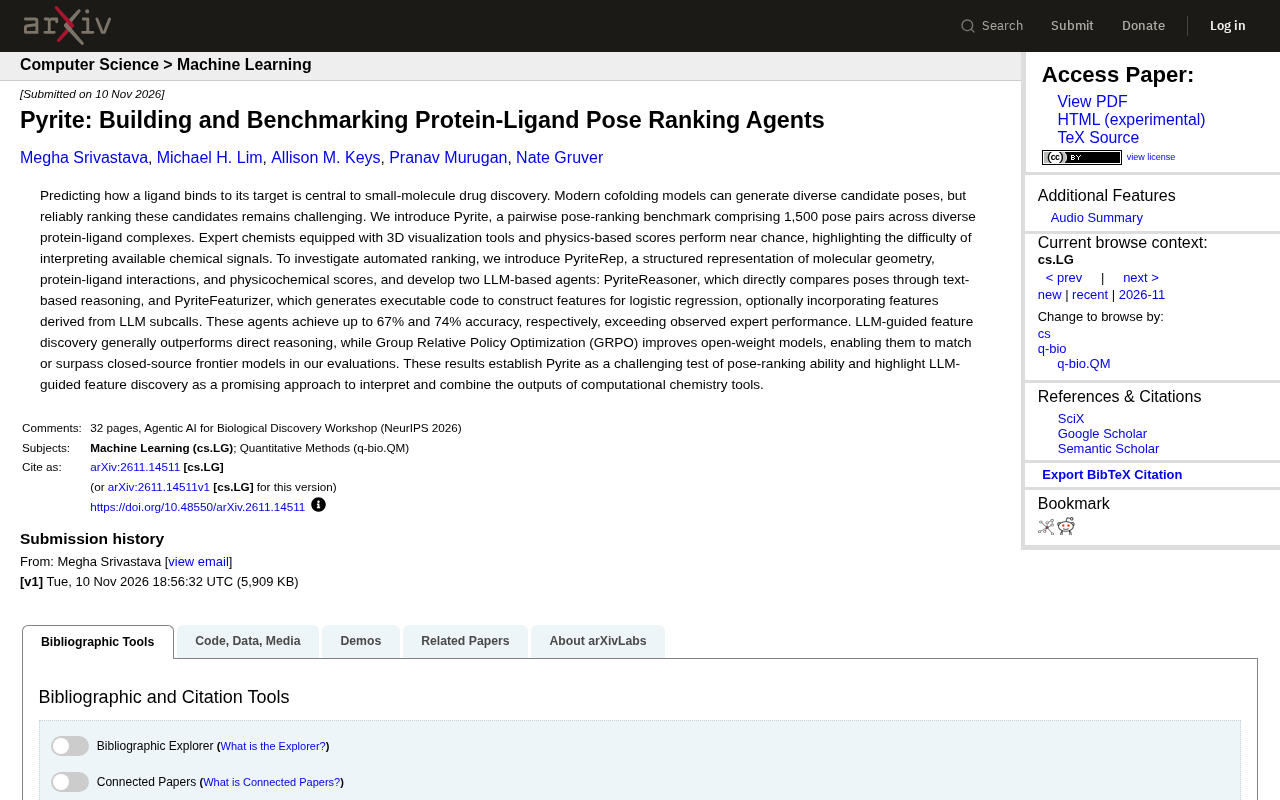
In small-molecule drug discovery, predicting how a ligand binds to its target is a core problem. Modern cofolding models can generate diverse candidate conformations, but reliably ranking the optimal binding pose from among these candidates remains a thorny challenge. Recently, a study called Pyrite proposed a pairwise conformation ranking benchmark and developed agents based on large language models (LLMs) that surpass human expert-level ranking accuracy.
Cofolding models are an emerging class of protein-ligand complex structure prediction methods. Their core idea is to jointly feed protein sequences and ligand molecular graphs into a deep learning model to directly generate the 3D structure of the complex. Representative works include AlphaFold3 and RoseTTAFold All-Atom. Unlike traditional molecular docking, cofolding models do not rely on rigid-body assumptions or predefined scoring functions; instead, they capture the flexibility of the binding interface through end-to-end learning. However, these models typically generate multiple candidate poses and lack a reliable confidence ranking mechanism, so selecting the pose closest to the true binding mode from among the candidates becomes a key bottleneck for downstream applications. The Pyrite benchmark is designed precisely as an evaluation tool targeting this ranking step.
The Pyrite Benchmark: A Rigorous Test of 1,500 Conformation Pairs
The Pyrite benchmark contains 1,500 conformation pairs, covering diverse protein-ligand complexes. Each pair requires judging which of two candidate poses is closer to the true binding mode. This design directly simulates the real-world need in drug discovery pipelines to screen high-quality candidates from a large number of generated conformations.
What makes the benchmark unique is its difficulty setting. The research team invited expert chemists, equipped with 3D visualization tools and physics-based scoring, to rank the conformation pairs. The results showed that these experts performed close to random guessing. This finding highlights the inherent difficulty of interpreting binding quality from existing chemical signals — even for trained chemists, visual and energetic metrics are often insufficient to reveal subtle binding differences.
PyriteRep: Structured Representations and LLM Agents
To explore automated ranking, the research team introduced PyriteRep — a structured representation of molecular geometry, protein-ligand interactions, and physicochemical scores. Building on this, they developed two LLM agents:
- PyriteReasoner: directly compares conformation pairs through text-based reasoning.
- PyriteFeaturizer: generates executable code to build features for logistic regression, and can optionally incorporate features derived from LLM sub-calls.
In evaluation, these two agents achieved accuracies of 67% and 74%, respectively, both exceeding the observed expert performance. This result not only demonstrates the potential of LLMs on the conformation ranking task but also reveals efficiency differences between the methods.
Group Relative Policy Optimization (GRPO) is a reinforcement learning algorithm proposed by the DeepSeekAd team for fine-tuning large language models. Its core idea is to sample a group of outputs for the same input and use the relative magnitude of rewards within the group as the advantage estimate, thereby avoiding training an independent value network (critic) and significantly reducing memory and computational overhead. GRPO is particularly suited to tasks where reward signals are sparse or difficult to define in absolute terms. In the Pyrite study, GRPO was used to improve the performance of open-weight models on conformation ranking, enabling them to match or even surpass closed-source frontier models — offering a feasible path for academic teams to reproduce and surpass commercial models with limited compute.
Key Finding: Feature Discovery Outperforms Direct Reasoning
One of the most striking conclusions of the study is that LLM-guided feature discovery generally outperforms direct reasoning. PyriteFeaturizer generates code to extract and combine features, which are then passed to a logistic regression classifier for ranking; this hybrid strategy of "LLM-generated features + traditional model" performed best. By contrast, although PyriteReasoner relies entirely on the LLM's text reasoning capabilities, it also achieved considerable accuracy — just slightly lower.
Another important finding concerns training strategy. Group Relative Policy Optimization (GRPO) can significantly improve the performance of open-weight models, enabling them to match or even surpass closed-source frontier models in evaluation. This means that, with appropriate reinforcement learning fine-tuning, open-source models are fully capable of reaching top-tier performance on specialized scientific tasks — a point that cannot be ignored for reducing computational costs and promoting reproducible research.
Logistic regression is a classic linear classification model that maps a linear combination of input features to a probability via the sigmoid function, and is commonly used for binary classification tasks. In Pyrite's ranking task, logistic regression serves as the top-level classifier, with inputs being the structured features generated by PyriteFeaturizer (such as molecular geometry descriptors, interaction type counts, and physicochemical scores). The advantages of logistic regression are strong interpretability, efficient training, and resistance to overfitting, making it suitable for a small-scale benchmark (1,500 samples). LLMs generate code to build features, which are then ranked by logistic regression; this hybrid strategy combines the semantic understanding of LLMs with the robustness of classic models, becoming the best-performing method.
Industry Implications: LLMs as Coordinators of Computational Chemistry Tools
The Pyrite results establish conformation ranking as a challenging test task while pointing to a promising technical route: LLM-guided feature discovery. This approach does not ask the LLM to give the answer directly; instead, it lets the LLM generate code to build features, thereby interpreting and combining the outputs of computational chemistry tools. This offers a new perspective on the role of AI in scientific discovery — LLMs serve as "coordinators" and "translators" of computational tools rather than replacements for traditional physics-based models.
For drug discovery, this means we can use LLMs to automatically discover and combine chemical signals from different sources to build more robust ranking models. At the same time, the improvement of open-weight models through methods such as GRPO offers resource-constrained research teams a way to catch up with the frontier. The Pyrite benchmark itself provides a standardized testing platform that can be used in the future to evaluate more conformation ranking methods and drive continued progress in the field.
Conclusion
Pyrite is not just a benchmark but also a test of LLM capabilities in complex scientific reasoning. It shows that on a conformation ranking task where even experts struggle to judge, LLM agents can achieve substantive breakthroughs through feature discovery and code generation. As open-weight models continue to advance, we have reason to expect more similar methods to emerge, accelerating the intelligentization of small-molecule drug discovery.
One-line Summary
Pyrite benchmark contains 1,500 conformation pairs; LLM agents surpass human experts in ranking accuracy.
Paragraph Summary
Pyrite proposes a pairwise ranking benchmark with 1,500 conformation pairs to evaluate the ability to select the best from candidate binding poses. Expert chemists using 3D visualization and physics-based scoring achieve near-random accuracy, highlighting the task's difficulty. The team developed a structured representation, PyriteRep, and two LLM agents: PyriteReasoner, which performs direct text reasoning with 67% accuracy, and PyriteFeaturizer, which generates code to build features for logistic regression, achieving 74%; both surpass experts. Key findings are that LLM-guided feature discovery outperforms direct reasoning, and that Group Relative Policy Optimization (GRPO) can enable open-weight models to match or surpass closed-source frontier models. The work positions LLMs as coordinators of computational chemistry tools, offering new ideas and a standardized testing platform for conformation ranking in drug discovery.
Related articles

Abnormal Error Rate Spike in Claude Mythos 5.2 and Fable 5.2
Claude Mythos 5.2 and Claude Fable 5.2 show an abnormal spike in request error rates, marked as investigating on the official status page. This article covers the incident overview, practical impact on developers, and recommended responses.

ReAct Runtime Context Trimming: Why Claude Code Acts at 70%
A deep dive into ReAct runtime context trimming: why Claude Code compresses at ~70% usage, why tool calls dominate, why messages must be dropped in pairs, and why codebases don't need RAG.

AI Agent vs LLM: How Cursor and Claude Code Actually Work
An in-depth analysis of the essential difference between AI Agents and LLMs: LLMs generate code suggestions, while Agents modify files and run tests via tool calls. Using a Spring Boot bug fix as an example, it breaks down the workflows, permission control, and verification mechanisms of Cursor and Claude Code.