Python Core Developer Tim Peters Passes Away, Community Remembers a Legend

Tim Peters, Python core developer, author of The Zen of Python, and designer of Timsort, has died; the community mourns widely.
The news of the passing of Python core developer Tim Peters has sparked widespread attention and mourning on Hacker News and Reddit's r/Python subreddit. Tim Peters was a highly respected figure in the Python community, best known for writing "The Zen of Python" (PEP 20), whose principles such as "Beautiful is better than ugly" and "Explicit is better than implicit" have profoundly influenced countless developers' coding style and mindset. He also designed and implemented the Timsort sorting algorithm, which has been the core of Python's built-in sorting since Python 2.3 and has been adopted by platforms such as Java. His contributions span language design, algorithm implementation, and community culture. His passing is a loss to the Python community, but the code and ideas he left behind will continue to influence future developers.
A Somber Message from the Community
According to Hacker News and the Reddit community, Python core developer Tim Peters has passed away. The related discussion received 301 points and 29 comments on Hacker News, and a related link also appeared on Reddit's r/Python subreddit. Although the original information only provided a link to Reddit and a Hacker News comment address, the news has already sparked widespread attention within the Python developer community.
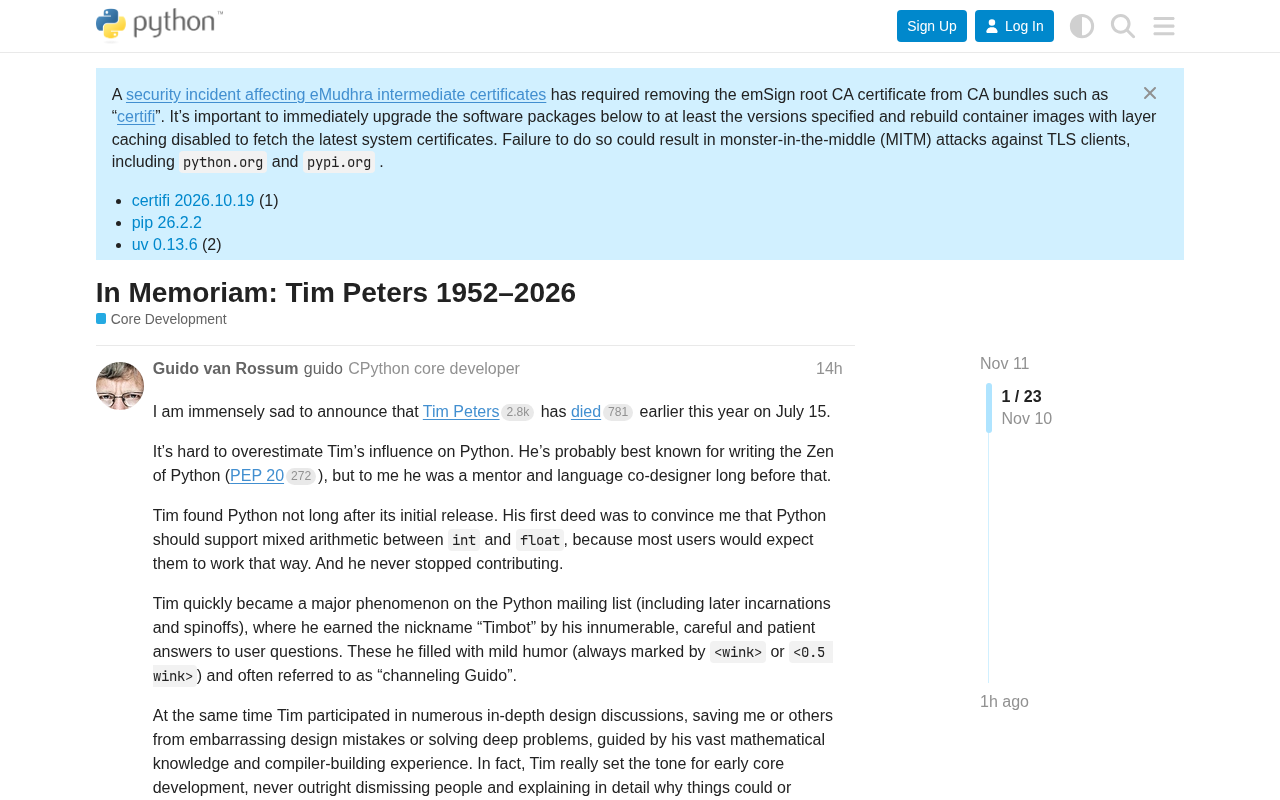
Tim Peters and His Deep Connection to Python
Tim Peters is a highly respected figure in the Python community. His name is closely tied to several core mechanisms of Python, the most widely known of which is "The Zen of Python." This concise and philosophical set of programming principles, opening with "Beautiful is better than ugly" and "Explicit is better than implicit," has influenced the coding style and mindset of countless Python developers.
In addition to "The Zen of Python," Tim Peters also participated in the design and implementation of Python's sorting algorithm, Timsort. Timsort is a hybrid sorting algorithm that combines characteristics of merge sort and insertion sort, performing excellently on real-world data, and was later adopted by other languages and platforms as well. His contributions are reflected not only at the code level but also in shaping Python community culture and engineering practices.
"The Zen of Python" (PEP 20) originally began as a long letter Tim Peters wrote to the Python mailing list in 1999 to summarize the core design philosophy of the Python language. It was later incorporated into the Python Enhancement Proposal (PEP) system and hidden as an easter egg in the Python interpreter—running import this in an interactive environment prints all 19 aphorisms. These principles, such as "Explicit is better than implicit," "Simple is better than complex," and "Readability counts," have profoundly shaped Python's syntax trade-offs and standard library style.
Timsort was designed by Tim Peters in 2002 for Python and is a stable, adaptive hybrid sorting algorithm: it first scans the data for naturally ordered segments (runs), then merges these runs according to rules, and uses insertion sort for short arrays. Its worst-case time complexity is O(n log n), and on partially ordered real-world data it can approach O(n). The algorithm has been the default implementation for list.sort() and sorted() since Python 2.3, and was subsequently widely adopted by Java (used for object array sorting since Java 7), the Android platform, and the V8 engine, among others.
Community Reaction and Mourning
The discussion thread on Hacker News brought together tributes and memories from developers around the world. Although the original material did not provide specific comment content, judging from the 301 points and 29 comments, Tim Peters' passing resonated within the technical community. Many developers may have first encountered Python's design philosophy through "The Zen of Python," while Timsort became the infrastructure they unknowingly rely on in their daily programming.
As an important gathering place for Python developers, the appearance of related links on Reddit's r/Python subreddit also means the community is spontaneously sharing information and expressing grief. This cross-platform attention reflects Tim Peters' profound influence in the open-source world.
Far-Reaching Impact on the Python Ecosystem
Tim Peters' work spans multiple dimensions: language design, algorithm implementation, and community culture. As an implicit design guide, "The Zen of Python" is still widely cited and discussed today; it is not only a philosophical summary of Python but also a classic piece of material in programming education. Timsort, as the core of Python's built-in sorting algorithm, underpins countless data processing tasks.
His passing is a loss to the Python community, but the code and ideas he left behind will continue to influence future developers. In the open-source world, contributors' work often endures in the form of code and documentation, and Tim Peters' legacy is a manifestation of that lasting influence.
Conclusion
Currently, specific information about Tim Peters' passing is limited, and the original material only provides an entry point to community discussions. For Python developers, the best tribute may be to revisit "The Zen of Python," understand the design wisdom behind it, and practice those principles in their own code. The community's memory and inheritance are the most sincere homage to a contributor.
One-line Summary
Tim Peters, Python core developer, author of "The Zen of Python," and designer of Timsort, has passed away, and the community is mourning widely.
Paragraph Summary
The news of the passing of Python core developer Tim Peters has sparked widespread attention and mourning on Hacker News and Reddit's r/Python subreddit. Tim Peters was a highly respected figure in the Python community, best known for writing "The Zen of Python" (PEP 20), whose principles such as "Beautiful is better than ugly" and "Explicit is better than implicit" have profoundly influenced countless developers' coding style and mindset. He also designed and implemented the Timsort sorting algorithm, which has been the core of Python's built-in sorting since Python 2.3 and has been adopted by platforms such as Java. His contributions span language design, algorithm implementation, and community culture. His passing is a loss to the Python community, but the code and ideas he left behind will continue to influence future developers.
Related articles

Prompt Engineering for Beginners: From Writing Prompts to Engineering Thinking
Starting from the essence and four functions of prompts, this article systematically explains the six-step process, four success criteria, learning value, and practical limitations of prompt engineering to help you build a complete understanding.

Anthropic Launches Nasdaq IPO: AI Giant's Listing and Risk Disclosures
Anthropic officially launches its Nasdaq IPO under ticker ANT, with market valuation expected to potentially exceed SpaceX's record. The prospectus devotes nearly 100 pages to AI risks, while first-half revenue grew over 14x but net losses widened sharply, reigniting the AI bubble debate.

Rust cURL Clone Uses 4,832 unsafe Blocks—Is the Memory Safety Myth Broken?
A Rust cURL clone uses 4,832 unsafe keywords, challenging Rust's memory safety narrative. We analyze what unsafe really means, compare Fil-C, and examine rewrite motives.