Python for Absolute Beginners: A Must-Learn in the AI Era of 2026

A Bilibili creator launches a systematic Python course, explaining why Python rose, its job-market position, and a hands-on learning path.
The article introduces a systematic Python course created over three months by a Bilibili creator, divided into core fundamentals, advanced topics, and project practice, with mind maps and free materials. It analyzes why Python has become popular: early hardware limits favored Java's cross-platform nature, while today Python's concise syntax and low learning curve stand out. In the job market, Python ranks high, but Java still dominates web servers. The course combines engaging presentation with hands-on projects to help beginners get started with AI development.
Why Has Python Become a Must-Learn in the AI Era?
As AI technology sweeps across industries, Python, one of the most popular programming languages, is becoming the top choice for absolute beginners entering the tech field. In a newly released Python systematic course, a Bilibili creator points out that over 85% of Python tutorials currently on the market vary in quality, making it hard to find content that walks you through operations step by step and explains syntax in detail. To address this, the creator combined teaching resources from Bilibili and YouTube and spent three months building a complete course that goes from core fundamentals to hands-on projects.
The course is divided into three major sections: core fundamentals, advanced topics, and project practice. The fundamentals section covers installation and activation of Python and PyCharm, environment setup, and basic concepts such as variables, tuples, operators, strings, and functions. The advanced section dives into object-oriented programming, multithreading, and modular programming. The project section helps learners turn knowledge into practical ability through projects like scraping images and videos, office automation, and data storage and analysis. The creator also provides accompanying mind maps to help students organize their notes.
The Rise of Python: Driven by Both Hardware Advances and Language Simplicity
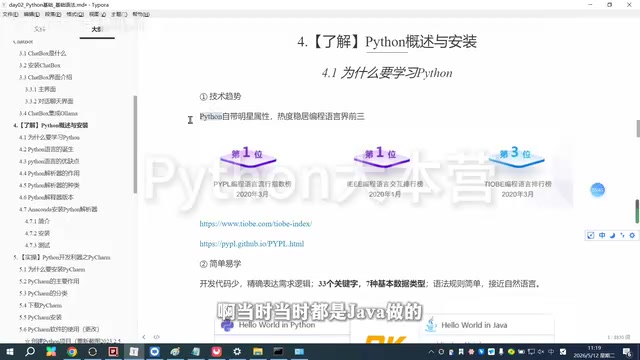
Many people wonder: Python was born earlier than Java, so why did it only become popular in recent years? The creator offers his analysis in the course. Early hardware had limited performance, making Python difficult to run, while Java thrived in the feature phone era thanks to its cross-platform nature ("write once, run anywhere"). He recalls that small games like Snake on Motorola and Samsung phones back then were mostly developed in Java, because Java's cross-platform capability had lower hardware requirements.
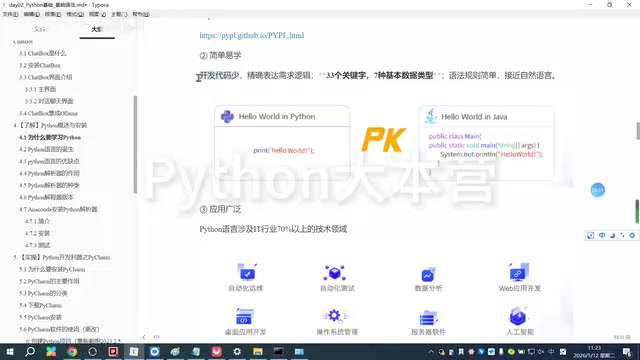
As hardware performance became more than sufficient, Python's concise syntax and near-natural-language expression allow developers to focus more on logic itself. The creator notes that Python has only 33 keywords and 7 basic data types, giving it a relatively gentle learning curve. Based on his observation, for people with a programming background, Python's difficulty is about 30 to 40 percent of Java's; but for absolute beginners, getting started with any language is not easy—the key is hands-on practice.
Cross-platform capability means that the same source code can be compiled and run on different operating systems or hardware architectures without modification. The core reason Java can achieve "write once, run anywhere" is the Java Virtual Machine (JVM): Java code is first compiled into platform-independent bytecode, which is then interpreted and executed by the JVM on each platform. This design had obvious advantages in the early mobile era when hardware performance was limited and device fragmentation was severe, because developers did not have to adapt separately for each phone model. By contrast, although Python is also a cross-platform language, its interpreter needs to interact directly with the operating system, and early on it ran inefficiently on low-end devices. As hardware performance improved, the performance cost of cross-platform support became less significant, and the language's own development efficiency became a more important consideration.
Job Market and Language Choice: Taking a Rational View of Python's Position
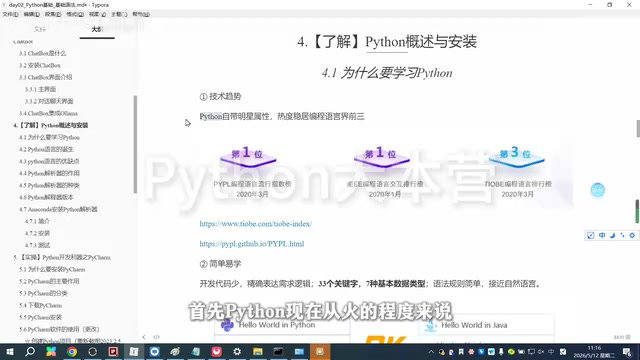
Regarding the job market, the creator cites data showing that Python remains near the top of major programming language rankings, while demand for Java positions has declined in recent years but is still within the top ten. He specifically points out that Java still dominates the web server field, with a high market share and huge enterprise replacement costs, so Python will not completely replace Java in the short term.
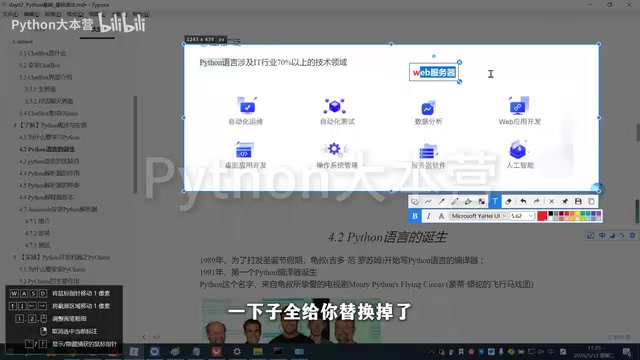
The creator also uses HarmonyOS as an example to remind learners to pay attention to technology trends: when HarmonyOS was first launched, third-party companies came directly to classrooms to sign contracts with graduates, but as the hype faded, the window of opportunity also changed. He suggests that entering while a language is hot can bring dividends, but learners should also rationally assess long-term trends. For beginners, Python, with its ease of learning and wide applications (covering automated operations, testing, data analysis, web development, artificial intelligence, and more), is a friendly entry choice.
The web server field refers to the software runtime environment used to handle HTTP requests and host website backend logic. Java's dominance in this field stems from its mature ecosystem: frameworks such as Spring and Spring Boot provide complete enterprise-grade solutions, the JVM has been optimized over the long term and performs reliably in concurrency handling and stability, and a large number of finance, telecom, and e-commerce systems are deeply tied to the Java technology stack. Changing a backend language means refactoring code, retraining teams, and bearing migration risks—costs that are extremely high—so technology selection often has path dependence. Although Python can also develop web services through frameworks such as Django and Flask, its accumulation in high-concurrency, large-scale enterprise scenarios still falls short of Java. This is the fundamental reason the two coexist long term rather than simply replacing each other.
Course Features: Engaging Presentation Combined with Practice
Unlike common tutorials, this course emphasizes that "every second is outputting knowledge points," using engaging presentation and a knowledge-plus-hands-on model. The creator not only explains syntax but also provides a full set of materials, including a development environment setup package, study schedules, e-books, and courseware, which learners can get for free by leaving a comment.
Another highlight of the course is the mind maps, which help learners grasp key points amid fast-paced learning. The creator says the goal of this course is to let beginners "painlessly get started with AI development," applying what they learn to real scenarios through projects such as web scraping, office automation, and data analysis.
Web scraping (web crawlers) refers to programs that automatically extract data from web pages. The basic principle is to simulate a browser sending HTTP requests, parse the returned HTML content, and extract the needed information. Python has mature libraries such as requests, BeautifulSoup, and Scrapy, which greatly lower the threshold for crawler development, so it is often used as an introductory hands-on project. It is important to note that web scraping involves legal and ethical boundaries: you should comply with a website's robots protocol, control request frequency to avoid putting pressure on the target server, and must not scrape personal privacy or copyrighted content. Office automation refers to using scripts to replace repetitive manual operations, such as batch processing Excel spreadsheets, automatically sending emails, and organizing files. Such projects intuitively demonstrate how programming improves work efficiency and are also the hands-on direction in which absolute beginners most easily gain a sense of achievement.
Learning Advice: Hands-On Practice Beats Passive Watching
The creator repeatedly emphasizes in the course that Python's "simplicity" is relative—it looks easy when you watch, but mistakes are easy to make when you try it yourself. He advises learners not to stop at watching videos but to type along with the code and understand every detail. For absolute beginners, the path design from basic syntax to project practice is intended precisely to consolidate memory through repeated practice.
In addition, the creator mentions that learning a programming language requires attention to market dynamics. Although no one can guarantee how long a language will remain popular, entering while Python is still on the rise at least allows you to capture the current dividends. For those hesitating about which language to start with, Python's friendliness and broad application scenarios make it an investment worth making in the AI era.
One-line Summary
A Bilibili creator launches a systematic Python course, explaining why Python rose, its job-market position, and a hands-on learning path.
Paragraph Summary
The article introduces a systematic Python course created over three months by a Bilibili creator, divided into three major sections—core fundamentals, advanced topics, and project practice—with accompanying mind maps and free materials. The author analyzes why Python has become popular in recent years: early hardware performance was limited, and Java had the advantage thanks to its cross-platform nature; as hardware performance became more than sufficient, Python's concise syntax and low learning curve made it more favored. In the job market, Python ranks high, but Java still dominates the web server field and will not be replaced in the short term. The course emphasizes engaging presentation combined with hands-on practice, helping absolute beginners painlessly get started with AI development through projects such as web scraping, office automation, and data analysis. The creator advises learners to type code themselves rather than watch passively, and to enter while the language is on the rise to enjoy the dividends.
Related articles

The Private PT Site Revival: As Streaming Prices Rise, Pirates Build Cultural Archives
Rising streaming prices and fragmented content fuel a private PT site revival. The Vergecast reveals these invite-only tracker communities: ratio rules, gamified tiers, a Salinger manuscript bounty, and pirates' contradictory self-image as cultural archivists.

The Other Half of AI Agent Observability: Execution-Level Verification
AI Agent observability isn't just about execution traces—execution-level verification is key to confirming whether business actions truly took effect. This article analyzes the monitoring and verification layer proposed by a Reddit founder, covering silent failures, result reconciliation, and prioritization of human intervention.

Anthropic Buys $3.4B in Natural Gas Turbines as AI Energy Anxiety Spreads
Anthropic buys $3.4B in natural gas turbines, joining AI's energy procurement race. Analysis of power demand, heavy-asset risks, and the new challenges from AI companies' shifting role.