The Other Half of AI Agent Observability: Execution-Level Verification

AI Agent observability needs to extend from execution traces to execution-level result verification in external systems.
The article points out that getting AI Agents to run through workflows is only half the task; the other half is confirming whether they actually completed the intended actions in business systems. Existing observability tools mostly focus on execution traces, recording tool calls and errors, but they can't answer business-result questions like whether CRM contacts were updated, meetings were created, or actions failed silently. In response, a founder on Reddit proposed building a monitoring and verification layer that connects Agent execution data with external business system records, delivering three layers of value: result confirmation, anomaly attribution, and prioritization of human intervention. This need first emerges among teams that have already put Agents into production with concrete action consequences. The source material does not disclose specific implementation approaches, supported system types, or verification latency details.
An AI Agent successfully running through a workflow doesn't mean it did the right thing. What really keeps teams up at night are those business actions after the Agent executes—the ones nobody knows actually succeeded or not.
The Problem: Execution Is Done, Now What?
When building enterprise-facing AI Agents, many teams pour most of their effort into "enabling the Agent to execute workflows." That's important, of course, but it's only half the task. The other half is: confirming whether it actually completed the intended action.
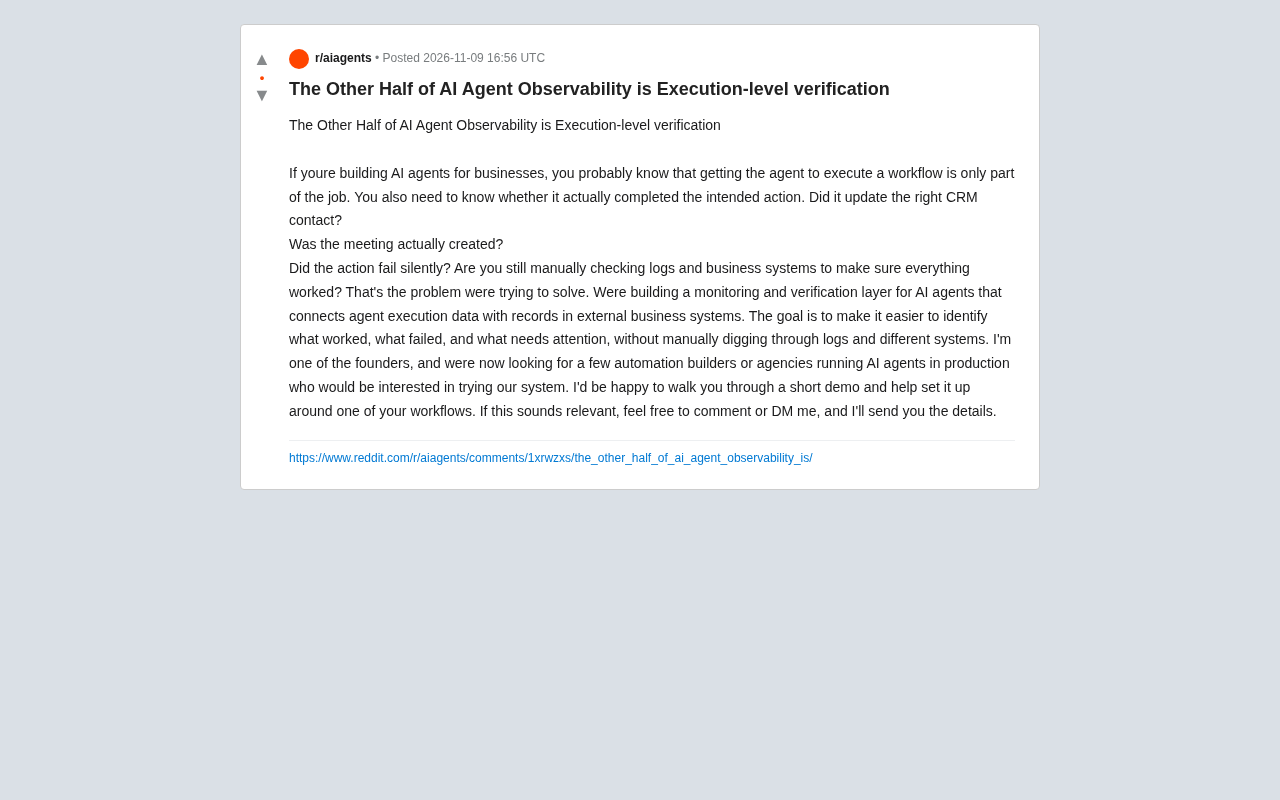
According to a founder on Reddit who is building such a system, common pain points include:
- Did the Agent update the correct CRM contact?
- Was the meeting actually created?
- Did some action fail silently?
Answering these questions by manually digging through logs and checking business systems one by one is not only inefficient but also prone to misses. What's worse, silent failures often don't throw obvious errors—by the time you discover them, they may have already impacted customer experience or business data.
The Blind Spot of Traditional Observability
Most existing AI Agent observability tools focus on the "execution trace" level: recording which tools the Agent called, what the inputs and outputs were, how long it took, and whether there were errors. This information is valuable for debugging, but it can't answer the question business owners care about most—whether the execution results took effect in external systems.
In other words, execution traces tell you "the Agent says it did it," while execution-level verification tells you "it actually happened in the business system." The gap between the two is the breeding ground for many production incidents.
The founder's proposed approach is to build a monitoring and verification layer that connects Agent execution data with records in external business systems. The goal is not to replace logs but to add a layer of "result reconciliation" on top of them, making it easier for teams to identify which actions succeeded, which failed, and which need human intervention.
Execution trace is the foundational data form in AI Agent observability, typically recorded automatically by the Agent framework at each step: including the model's generated chain of thought or tool selection, tool call inputs and return values, latency, token consumption, and error codes. This data essentially describes "the execution process from the Agent's internal perspective," and its completeness depends on the quality of the Agent's own instrumentation.
The contrasting concept is execution-level verification, which doesn't trust the Agent's self-report but instead relies on actual records in external business systems (CRM, calendar, ticketing, etc.), performing state read-back through query interfaces and comparing against the Agent's declared results. The key difference lies in the independence of the data source: execution traces come from the Agent itself, while execution-level verification comes from the target system being operated on. This is precisely why the latter can expose discrepancies like "API returned 200 but nothing was actually written"—deviations only visible in external systems.
What Execution-Level Verification Solves
From a product perspective, the core value of execution-level verification can be broken into three layers:
The first layer is result confirmation. For each critical business action, the system needs to query the actual state in external systems (such as CRM, calendar, ticketing systems) and compare it against the Agent's declared results. This way, silent failures are no longer silent.
The second layer is anomaly attribution. When comparisons don't match, teams need to know where the problem lies: did the Agent select the wrong object, did the external API return success but not actually write, or was it a hidden failure caused by permissions or data format issues? Correlating execution data with business records provides clues for attribution.
The third layer is prioritization of human intervention. Not all failures need immediate attention, but the system should help teams distinguish between "must fix now" and "can look at later," reducing indiscriminate manual inspection.
Silent failure refers to the phenomenon where an action doesn't achieve the expected result but no error is thrown. In Agent scenarios, it's often caused by several mechanisms: external APIs return success status codes but business-layer validation fails, asynchronous writes are ultimately discarded, the Agent fills parameters into wrong but valid fields, or insufficient OAuth permission scopes cause writes to be silently ignored by the system. These situations don't appear in error logs, so traditional exception-capture-based monitoring can't catch them.
The typical approach for the verification layer to handle silent failures is idempotent read-back and eventual consistency reconciliation: after an action completes, wait a period (covering the asynchronous write window) before re-querying the target system, then compare the read-back results against the Agent's declared entity identifiers and key fields one by one. This also explains why "verification delay" is a critical design parameter—too short an interval causes false positives on asynchronous operations, while too long weakens alert timeliness.
Who Needs This Kind of Tool
The founder explicitly stated they are looking for automation builders or agencies running AI Agents in production environments who are willing to try this system. This signals that the demand for execution-level verification first emerges in scenarios where Agents have already been put into actual business operations and the consequences of actions are relatively concrete.
For teams still in the experimental phase, execution traces may already be sufficient; but for teams processing large volumes of business actions daily, lacking result verification means either increasing manual review costs or bearing the risk of silent failures.
Cross-referencing multiple sources, the original Reddit post provides product positioning and problem description, while the screenshot serves only as source evidence with no additional technical details. Therefore, key information about this system's specific implementation, supported system types, and verification latency cannot currently be confirmed from the available material.
A Gap Worth Noticing
AI Agent observability is extending from "being able to see the execution process" to "being able to confirm execution results." This direction isn't novel—result verification has long been practiced in traditional automation—but systematically applying it to AI Agent scenarios and connecting it with external business systems remains a gap with real pain points.
For teams currently running Agents in production, it's worth asking yourself: how much time do you spend today manually confirming whether your Agent actually did things right? If that number isn't small, execution-level verification may be exactly the missing half.
Related articles

The Private PT Site Revival: As Streaming Prices Rise, Pirates Build Cultural Archives
Rising streaming prices and fragmented content fuel a private PT site revival. The Vergecast reveals these invite-only tracker communities: ratio rules, gamified tiers, a Salinger manuscript bounty, and pirates' contradictory self-image as cultural archivists.

Anthropic Buys $3.4B in Natural Gas Turbines as AI Energy Anxiety Spreads
Anthropic buys $3.4B in natural gas turbines, joining AI's energy procurement race. Analysis of power demand, heavy-asset risks, and the new challenges from AI companies' shifting role.

Medium Launches TK Writing App: Deeply Integrating AI Assistance into the Creative Process
Medium launches the TK writing app, deeply embedding AI assistance into the writing process. Amid growing AI controversy in publishing, what does Medium's contrarian embrace of technology mean for creators and the platform competition landscape?