Python to AI Engineer: A Complete Learning Path from Zero

A complete learning roadmap from Python beginner to AI engineer across four key stages.
This article outlines a structured learning path from absolute zero to AI engineer, covering four stages: Python fundamentals, data science tools (NumPy, Pandas, SQL), math and statistics foundations, and machine learning with scikit-learn. It also addresses common concerns like how much DSA matters, how deep to go in math, and how to avoid tutorial hell.
Introduction: Why You Need a Clear Learning Path
Recently on Reddit, a complete beginner posted asking for help. They had decided to start learning Python with the ultimate goal of breaking into data science, machine learning, and AI, but felt overwhelmed by the complex tech stack: What should I learn first? How much Python do I need before moving on? Does DSA (Data Structures and Algorithms) really matter? How deep should I go into math and statistics?
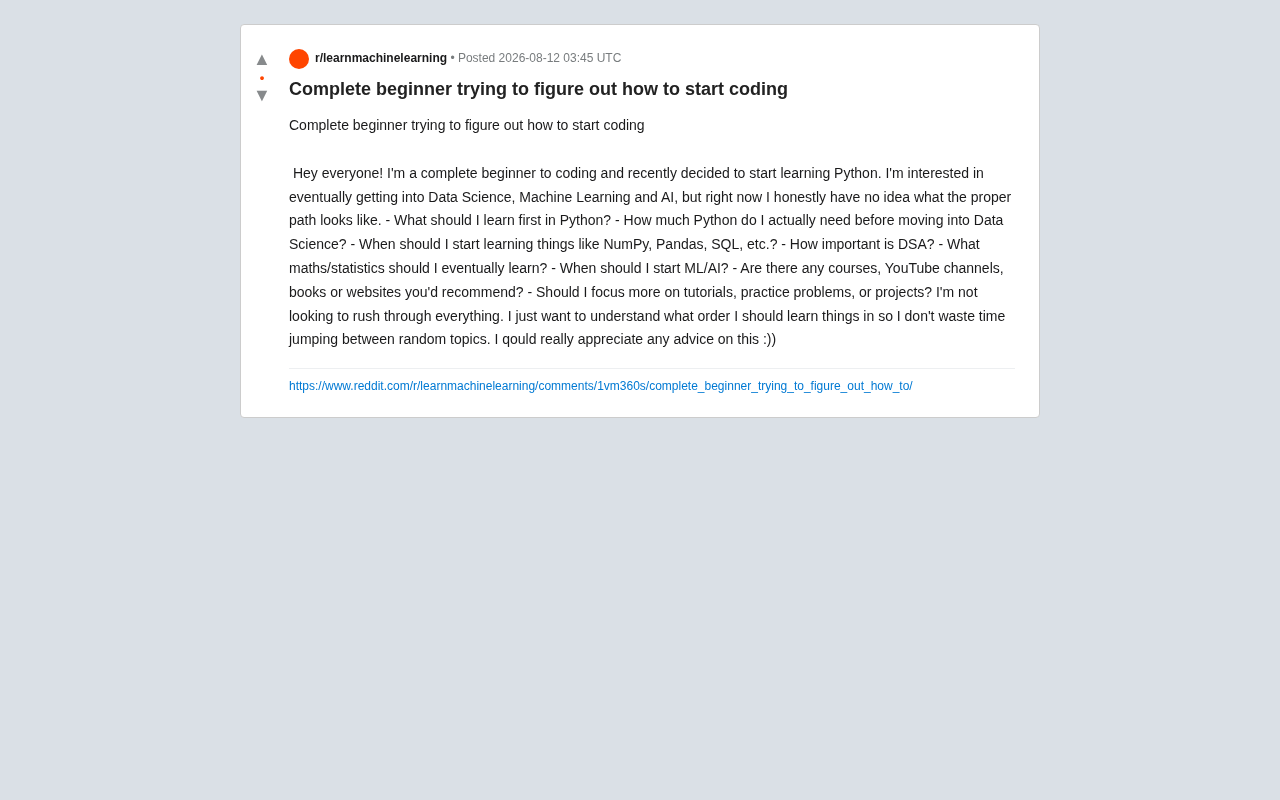
These questions are shared by nearly every aspiring AI learner. A chaotic learning path—randomly jumping between topics—is the core reason so many beginners give up halfway. This article systematically outlines a complete progression from Python fundamentals to machine learning, helping you avoid detours and grow efficiently.
Python Fundamentals: The First Step in AI Learning
Why Python
Python became the language of choice for AI due to its clean syntax design and massive ecosystem. When Guido van Rossum released Python in 1991, he emphasized a "readability first" design philosophy, allowing beginners to focus on problem-solving rather than syntax details. Today, Python has over 400,000 third-party packages on PyPI, covering virtually everything from data processing to deep learning. In comparison, R has deep roots in statistical analysis but falls short of Python in engineering deployment and deep learning framework support, while C++ offers superior performance but presents an unfriendly learning curve for beginners.
What Should a Complete Beginner Learn First
For absolute beginners, don't rush into data science libraries like NumPy and Pandas. First, build a solid foundation in Python's core syntax:
- Basic syntax: Variables, data types (int, float, str, bool), operators
- Data structures: Lists (list), dictionaries (dict), tuples (tuple), sets (set)
- Control flow: if/else conditionals, for/while loops
- Functions: Defining functions, parameter passing, return values, scope
- Object-oriented programming: Classes and objects, inheritance, encapsulation (can be explored in depth later)
- File operations and exception handling
How Much Python Do You Need Before Moving On
A common misconception is that you must "master" Python before starting data science. In reality, once you can independently write small-to-medium scripts involving functions, loops, and data structure operations, and can read other people's code, you already have the foundation to advance. Roughly 4-8 weeks of consistent study (1-2 hours per day) is enough to reach this level.
The key is to learn by doing, rather than passively watching all the tutorials. Once you've grasped 80% of commonly used syntax, start building things—filling in the remaining 20% through practice is far more efficient.
Core Data Science Toolkit: NumPy, Pandas, and SQL
Learning Order for the Data Processing Trio
Once your Python fundamentals are solid, introduce data science tools in this order:
- NumPy: The cornerstone of numerical computing—understand array (ndarray) operations and broadcasting
- Pandas: The core of data manipulation—master DataFrame CRUD operations, cleaning, and aggregation
- Matplotlib / Seaborn: Data visualization—learn to explore data through charts
- SQL: The universal language of data querying—required for virtually all data roles
NumPy: Why It's the Foundation of Everything
NumPy (Numerical Python) was created by Travis Oliphant in 2005 by consolidating two earlier projects, Numeric and Numarray. Its core data structure, ndarray, uses contiguous memory storage and C-level implementation, making vectorized operations 10-100x faster than pure Python loops. "Broadcasting" refers to NumPy's rules for automatically expanding dimensions when operating on arrays of different shapes—a mechanism that greatly simplifies matrix operation code. Nearly all major ML frameworks (scikit-learn, TensorFlow, PyTorch) use NumPy arrays or compatible formats as their underlying data flow.
Pandas: The Data Scientist's Swiss Army Knife
Pandas was developed by Wes McKinney in 2008 while working at AQR Capital Management, originally to solve pain points in financial data analysis. A DataFrame is essentially a two-dimensional labeled data structure, analogous to an Excel spreadsheet or SQL table—each column can have a different data type, with row and column indexing. Pandas' method chaining style makes data cleaning workflows extremely intuitive: reading data, handling missing values, type conversion, and group aggregation can be accomplished in just a few lines of code, whereas the same tasks in pure Python might require dozens of lines.
Why SQL Is Indispensable
Many learners overlook SQL, thinking Pandas is sufficient. But in real work scenarios, data is mostly stored in databases, and SQL is the first step in extracting data from the source.
SQL (Structured Query Language) was born from IBM's relational database research project in the 1970s. Over 50 years later, it remains one of the most universal skills in the data field. According to Stack Overflow's 2023 Developer Survey, SQL is among the most-used languages, with over 50% of developers using it daily. In enterprise data architectures—whether traditional PostgreSQL and MySQL, or cloud-based BigQuery, Snowflake, and Redshift—SQL is the standard query interface. Even in the "big data" ecosystem, tools like Spark SQL and Hive use SQL syntax, meaning the return on investment for learning SQL is extremely high.
I recommend learning basic SQL queries (SELECT, JOIN, GROUP BY, subqueries, etc.) alongside or shortly after learning Pandas.
Math and Statistics Foundations: The Theoretical Backbone of Machine Learning
How Deep Does Your Math Need to Go
Math is the theoretical foundation of machine learning, but beginners often fall into two extremes: either skipping it entirely or getting lost in pure mathematical proofs. A pragmatic approach is to master these core areas:
- Linear algebra: Vectors, matrix operations, eigenvalues (the basis for understanding neural networks and dimensionality reduction)
- Calculus: Derivatives, partial derivatives, gradients (understanding model optimization and backpropagation)
- Probability and statistics: Probability distributions, Bayes' theorem, hypothesis testing, expectation and variance
Linear Algebra: Data as Matrices, Models as Transformations
Linear algebra is the mathematical cornerstone of ML because machine learning is fundamentally about transforming and optimizing data in high-dimensional spaces. A 28×28 pixel grayscale image can be represented as a 784-dimensional vector; a neural network layer's forward pass is essentially matrix multiplication plus an activation function. Principal Component Analysis (PCA) uses eigenvalue decomposition to find the directions of maximum variance for dimensionality reduction; recommendation systems use matrix factorization to decompose user-item interaction matrices into low-rank approximations. Understanding these concepts doesn't require proving theorems, but does require building the intuition that "data is matrices, models are transformations."
Gradients and Backpropagation: How Models Learn
Gradient descent is the optimization core of virtually all modern machine learning models. Intuitively, a gradient is the direction of "steepest ascent" for a multivariable function at a given point, and model training involves continuously moving in the opposite direction of the gradient to progressively minimize the loss function. Backpropagation in deep learning was popularized by Rumelhart, Hinton, and Williams in 1986, and is essentially the application of the chain rule to compute gradients for each parameter layer by layer from the output. Modern frameworks like PyTorch's autograd and TensorFlow's GradientTape have fully automated this process, but understanding the principles remains crucial for debugging models, choosing learning rates, and diagnosing training issues.
You don't need to master all this math before starting ML. Instead, adopt a "learn as needed" strategy—when you encounter a specific algorithm, go back and fill in the corresponding mathematical concepts. This often leads to deeper understanding.
DSA and Machine Learning: How to Set Priorities
How Important Is DSA for AI Roles
The importance of Data Structures and Algorithms (DSA) for data science and ML roles depends on your specific goals.
The relevance of DSA varies by role type, closely tied to the tech industry's hiring culture. The interview traditions at companies like Google and Meta originate from software engineering roles' demands for algorithmic efficiency—when systems process billions of user data points, the difference between O(n²) and O(n log n) can mean hours versus seconds. However, for data scientist and ML researcher positions, interviews typically shift toward statistical inference, experimental design, and model understanding. That said, understanding basic concepts like hash tables, tree structures, and graph algorithms still has practical value for understanding database indexing, encoding strategies in feature engineering, and cutting-edge directions like graph neural networks.
If you want to join a major tech company, or if the role leans toward engineering implementation, DSA is almost unavoidable in interviews. But if you're focused on data analysis and modeling, DSA can be deprioritized—grasping basic time complexity concepts and common data structures is sufficient; you don't need to grind LeetCode like a competitive programmer.
Recommended Entry Sequence for Machine Learning
Once you have Python programming ability, familiarity with Pandas/NumPy, and foundational math and statistics concepts, you're ready to enter machine learning. Recommended learning order:
- Traditional machine learning: Start with scikit-learn—learn linear regression, logistic regression, decision trees, random forests, SVM, and other classic algorithms
- Model evaluation: Cross-validation, overfitting vs. underfitting, evaluation metrics
- Deep learning: After mastering traditional ML, move into TensorFlow or PyTorch to learn neural networks, CNNs, RNNs, etc.
scikit-learn: The Standard Starting Point for Traditional ML
scikit-learn was initiated by David Cournapeau during a 2007 Google Summer of Code project and has since become the de facto standard library for traditional machine learning. Its design philosophy emphasizes a consistent API—all models follow the unified pattern of fit(), predict(), and transform(), making algorithm switching a one-line change. From linear regression to random forests, from K-Means clustering to support vector machines, scikit-learn provides a complete algorithmic toolkit. More importantly, it includes comprehensive model evaluation tools (cross-validation, grid search, learning curves), which are essential for understanding model generalization. I recommend building a complete understanding of the ML workflow on scikit-learn before venturing into deep learning.
Learning Methods: Balancing Tutorials, Exercises, and Projects
Regarding whether to focus on tutorials, practice problems, or projects, the answer is combine all three, with projects as the ultimate goal:
- Tutorials are for quickly building a knowledge framework, but don't fall into "tutorial hell"—watching tutorials repeatedly without ever getting hands-on
- Practice problems are for reinforcing syntax and algorithmic thinking, suitable for bite-sized training
- Projects are the best way to test and integrate what you've learned, and form the core of your resume and portfolio
Beware of "Tutorial Hell"
"Tutorial Hell" is a widely discussed phenomenon in programming learning communities: learners continuously consume tutorial content and feel like they're making progress, but are helpless when trying to solve problems independently without a tutorial. The psychological root lies in the "illusion of fluency" created by passive learning—cognitive load is very low when following an instructor step by step, easily producing the false sense of "I already know this." Cognitive science research shows that active recall and spaced repetition are the keys to long-term memory formation. Therefore, closing the tutorial and attempting independent reproduction immediately after learning each concept is more effective than watching an entire series straight through.
I recommend completing a small project after each learning phase (such as a data analysis report or a simple prediction model), using real data to test your abilities.
Recommended Resource Directions
While specific resources vary by individual, the following types are worth your attention: Python's official documentation, Kaggle (offering datasets and competitions), free online courses, and quality tech blogs and YouTube channels. Committing to 1-2 systematic resources and completing them is better than bookmarking a pile you never open.
Conclusion
Going from zero to AI engineer is a journey that requires patience. As the Reddit user said, they "don't want to rush, just want to know the right order to learn"—this mindset itself is exactly right. By following the progression of Python fundamentals → Data toolkit → Math and statistics → Machine learning, combined with continuous project practice, you can avoid wasting time jumping between random topics and steadily advance toward your goal.
Key Takeaways
Related articles

Felix Rieseberg Personal Homepage
Felix Rieseberg's personal homepage sparks attention on Hacker News. This article covers the Slack engineer's technical background, the rise and fall of nativefier, and the value of a developer homepage as a tech calling card.

@ai-sdk/vue 3.0.306 Patch Release Syncs with [email protected] Update
@ai-sdk/vue 3.0.306 released, synced with [email protected]. A routine patch release for the Vercel AI SDK ecosystem with no public API changes; the Vue adapter layer stays version-aligned with the core package.

Gemini 4 Argon API Launches: The Era of Million-Token Output Begins
Google launches Gemini 4 Argon with sparse MoE architecture, up to 1M output tokens, and a 68.90% Vals Index score, available across API, AI Studio, and the Gemini app.