Python Web Scraping for Beginners: How It Works, Core Workflow, and Legal Red Lines Explained

A beginner's guide to how Python web scrapers work, the core three-step workflow, and the legal red lines.
This article explains in plain language how Python web scrapers work: from HTTP requests and responses, HTML/DOM parsing, to the complete three-step workflow of sending requests, parsing data, and storing results. It focuses on the three legal red lines and compliance best practices, making it ideal for beginners.
Web scraping is a foundational skill in data collection, research analysis, and engineering practice, and it's often the first practical tool many graduate students and tech newcomers want to master. This article is based on a three-hour Python web scraping crash course that took three months to produce, explaining in plain language how web scrapers work, their core workflow, and the legal red lines that are most easily overlooked yet critically important.
What Is a Web Scraper: Using Programs to Simulate Human Browsing
Many people find web scrapers mysterious, but their essence is actually quite straightforward—a web scraper is a program that simulates the human behavior of opening web pages, browsing content, finding target data, and saving it.
Here's an intuitive example: when we open Huawei's official website and are only interested in a certain product's name and price, our brain automatically filters out irrelevant content and remembers only the key information. A Python web scraper does exactly the same thing—except it uses code to accomplish it all.
Understanding this is crucial. A web scraper is not a hacking tool, nor is it some profound, unfathomable technology. It simply automates and scales the everyday human action of browsing web pages. Once you view a web scraper as a "tireless browser," the rest of your learning will go much more smoothly.
The Value of Automation and Scaling Automation and scaling are the core values that distinguish web scrapers from manual browsing. An optimized scraper program can send dozens or even hundreds of requests per second, completing in a few hours data collection tasks that would take months to do manually. This characteristic makes web scrapers a foundational tool in scenarios like academic research, price monitoring, public sentiment analysis, and building machine learning training datasets. It is precisely because of this "scaling" capability that the boundaries of scraper usage must be carefully defined—it amplifies the efficiency of human information gathering, but likewise amplifies potential risks and responsibilities.
How Web Scrapers Work: HTTP Requests and Responses
To understand Python web scrapers, you first need to understand how humans obtain web page content.
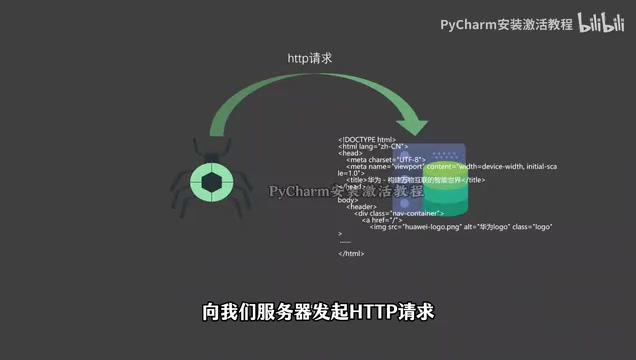
When we visit a website through a browser, the browser sends an HTTP request to the target server. Upon receiving the request, the server responds by returning the website's raw content to the browser, which then renders this raw content into the page we see.
Background: The Evolution of the HTTP Protocol and Scraping Practice
HTTP (Hypertext Transfer Protocol) is the foundational protocol for World Wide Web data communication, born in 1991 and designed under the leadership of Tim Berners-Lee. Modern web communication commonly uses its upgraded version, HTTPS, for encrypted transmission. HTTPS adds a TLS/SSL encryption layer on top of HTTP, ensuring that data cannot be eavesdropped upon or tampered with during transmission. A complete HTTP interaction includes key elements such as the request method (GET for retrieving resources, POST for submitting data, etc.), request headers (Headers, used to carry identity information like browser identifiers and cookies), and response status codes (such as 200 for success, 404 for resource not found, and 403 for server access denied). Web scrapers work by constructing legitimate HTTP request messages in code, making the server "think" it is interacting with an ordinary browser, thereby obtaining the desired content.
The commonly used
requestslibrary in Python was released by Kenneth Reitz in 2011. Its design philosophy is "HTTP for Humans"—it encapsulates the tedious details of the underlying urllib3 (connection pooling, redirects, encoding, etc.), making it possible to send an HTTP request with just a single line,requests.get(url). It also supports Session management (maintaining login state), custom request headers (simulating browser identity), and proxy settings, making it the HTTP client library of choice for both beginners and professional scraping engineers.It's worth mentioning that in the HTTP/1.1 era, each request required establishing a separate TCP connection, whereas HTTP/2 uses Multiplexing technology to allow multiple requests to be transmitted concurrently over a single TCP connection, significantly reducing latency. HTTP/3 further switches the transport layer from TCP to the QUIC protocol to address packet loss issues in weak network environments. The significance of these protocol evolutions for scraping is that modern high-performance servers increasingly deploy HTTP/2, and scraping engineers need to adjust connection pool parameters accordingly when designing concurrency strategies.
Supplementary Note on Asynchronous Scraping: In addition to synchronous HTTP clients like
requests, the Python ecosystem also provides asynchronous HTTP libraries such asaiohttp, which, combined with theasyncioevent loop, can achieve high-concurrency requests within a single thread. Traditional synchronous scrapers block the entire program while waiting for a server response, whereas asynchronous scrapers use the event loop mechanism to switch to other tasks during the gaps of waiting for IO responses, achieving far greater efficiency than synchronous methods when handling hundreds or even thousands of concurrent URLs. Usingasyncio.Semaphoreallows precise limiting of the maximum number of concurrent connections, improving efficiency while avoiding overwhelming the target server—this is also a recommended practice for balancing performance and compliance during large-scale collection.
Web scraper programs follow almost the same path: they send HTTP requests to the server via code, and the server likewise returns the raw content. The key difference is that a web scraper lacks the browser's rendering capability—what it obtains is the web page's raw HTML source code.
Here's a practical tip: right-click in your browser and select "Inspect," and the pop-up window displays the entire web page's raw content. Click the "element selector" icon in the window, move your mouse over any element on the page, and the source code will simultaneously highlight the corresponding position. Through this method, you can intuitively see the correspondence between page elements and HTML code.
Note: The Special Case of Dynamically Rendered Pages
The methods described above apply to server-side rendered static pages, but modern web applications extensively use JavaScript to dynamically render content (i.e., SPAs, or Single-Page Applications). The HTML obtained directly by sending an HTTP request often lacks the actual data. To handle such scenarios, scraping engineers typically adopt two strategies: the first is to reverse-engineer the page's XHR/Fetch interfaces and directly request the underlying data API (more efficient); the second is to use browser automation tools like Selenium or Playwright to drive a real browser to complete JavaScript rendering before extracting data. Playwright is a next-generation framework launched by Microsoft in 2020, supporting asynchronous concurrency, and is gradually becoming the mainstream alternative to Selenium. Beginners can focus on static pages during the introductory phase, as dynamic rendering is more advanced material.
A quick way to distinguish between "static pages" and "dynamic pages" is: press
Ctrl+Uin the browser to view the page source code (rather than the Elements panel in developer tools). If the source code already contains the target data, it indicates server-side rendering; if the source code contains only a small amount of skeleton HTML and a large number of JavaScript tags, it indicates that the data is dynamically loaded by front-end JS, requiring further analysis of the XHR/Fetch requests in the Network panel to locate the data interface.
Parsing Web Page Tags: Where Is the Data Hidden?
If you look closely at the web page source code, you'll find that every element is wrapped in a pair of angle brackets (< >)—this is a pair of HTML tags.
There are many types of tags, and different tags produce different display effects. For beginners, there's no need to memorize all tag types for now—you just need to grasp one core concept: the content wrapped by a tag is a page element.
Background: The Structural Principles of HTML and the DOM Tree
HTML (Hypertext Markup Language), released in 1993, has undergone multiple iterations, with HTML5 being the current mainstream standard. All the tags on a web page are not randomly piled together—they are nested within one another, collectively forming a tree structure called the DOM (Document Object Model). You can imagine it as a family tree:
<html>is the root node,<head>and<body>are child nodes, and beneath<body>hang various element nodes like<div>,<p>, and<a>. The essence of parsing data with a scraper is traversing this DOM tree, using CSS selectors (like.product-price) or XPath syntax (like//div[@class='price']) to precisely locate target nodes and extract the text or attribute values within them.The widely used
BeautifulSoupandlxmllibraries in Python are tools designed specifically for efficiently parsing the DOM tree—BeautifulSoup is known for its ease of use, providing an intuitive Python object interface suitable for rapid development and handling malformed HTML; lxml is based on the C-language libxml2 library, parsing 5 to 10 times faster than BeautifulSoup, and natively supports XPath syntax, making it suitable for large-scale scraping scenarios. The two are not mutually exclusive—BeautifulSoup supports using lxml as its underlying parsing engine, combining ease of use with performance.Besides CSS selectors and XPath, regular expressions (Regex) remain a powerful tool for processing unstructured text, but due to their poor readability and tendency to fail when the HTML structure changes slightly, they are usually used only as a supplementary means rather than the primary parsing solution. Notably, with the development of AI technology, some scraping frameworks have begun integrating large language models (LLMs) to assist in parsing non-standard pages—by describing "extract product price" in natural language, the model can automatically generate the corresponding selector rules, greatly reducing the labor cost of maintaining scrapers.
Data Quality and Cleaning: A Step That Cannot Be Ignored After Parsing
Raw scraped data typically contains a lot of noise, and using it directly often affects analysis results. Common issues include: excess whitespace characters and newlines (
\n,\t), un-restored HTML entity encodings (e.g.,&should be decoded to&, should be decoded to a space), inconsistent page encodings (mixing GBK and UTF-8 causing garbled text), and numeric fields mixed with currency symbols or thousands separators (e.g., "¥1,299" needs to be converted to the float 1299.0). It is recommended to uniformly execute cleaning logic during the scraper's Pipeline data processing stage—use Python'sstr.strip()andre.sub()to handle text noise, usehtml.unescape()to restore HTML entities, and use pandas'dtypeparameter to force field types during reading. Separating cleaning logic from parsing logic not only keeps the Spider code concise but also facilitates separate debugging and maintenance of data quality issues later.
Take scraping product information as an example: the product name and price are usually wrapped in <div> tags, and <div> tags generally use the class attribute to label their own name. As long as you precisely locate the tag with a specific class, you can extract the target data.

This step—filtering out truly valuable information from a massive amount of raw content—is precisely the core logic of web scraping. When humans browse web pages, they automatically filter out irrelevant content, whereas a scraper needs us to "teach" it to do the same through locating rules like tags and classes.
The Complete Three-Step Workflow of a Python Web Scraper
Stringing the above content together, a complete web scraping workflow can be summarized into the following three steps:
- Send the Request: Send an HTTP request to the target server to obtain the web page's raw HTML content.
- Parse and Filter: Extract valuable data from the source code based on locating rules like tags and classes.
- Store the Data: Save the scraped content to a database or local file.
Once you understand these three steps, you've mastered the core skeleton common to all scraper programs. No matter how tools and frameworks change, the essence never goes beyond this scope.
Common tools used in the storage phase include CSV/Excel files (suitable for small-scale structured data), SQLite or MySQL databases (suitable for medium-to-large-scale data and subsequent query needs), and JSON files (suitable for nested-structure data). Choosing the appropriate storage method can often make subsequent data analysis significantly more efficient.
Advanced Storage: From Files to Data Pipelines
When scraping scales from tens of thousands to millions of records, directly writing to local files or relational databases often becomes a performance bottleneck. Engineered scrapers typically introduce a message queue (such as Redis's List structure, or Apache Kafka) as a buffer layer between URL scheduling and data storage: the scraper process is only responsible for pushing scraped results into the queue, while an independent consumer process handles batch writing to the database. After decoupling, the two can scale horizontally independently. For unstructured or semi-structured data (such as news article bodies or comment text), document-oriented databases like MongoDB are more suitable for storage than relational databases, because their Schema-free nature allows fields to change flexibly without needing to define table structures in advance. Elasticsearch is suitable for scenarios requiring full-text search. Beginners don't need to consider these complex architectures initially, but understanding their existence helps make the right technical choices when a project's scale grows.
The Legal Red Lines of Web Scraping: Three Boundaries That Cannot Be Crossed
"Web scraping is dangerous"—this is why many people shy away from it. But in reality, as long as you hold firm to a few bottom lines, there's absolutely no need to fear web scraping. The following three red lines are content that every scraping learner must keep firmly in mind.

First, you must not scrape information from government agencies, national defense, and other related entities. Such information involves national security, and any behavior that touches this line will face severe legal consequences.
Second, you must not involve citizens' personal information or trade secrets. Many websites require real-name registration, and users' personal information is stored in each platform's membership system. Scraping and using others' private information is illegal—do not attempt it lightly.
Third, you must not cause damage to the target website. Sending a large number of requests to a server in a short period may cause the server to crash and prevent normal users from accessing it. The losses caused by such behavior will ultimately be pursued against the scraper.

Background: Web Scraping-Related Legal Provisions and Judicial Practice
In addition to Article 286 of the Criminal Law (the crime of destroying computer information systems) mentioned in the text, China's Cybersecurity Law (Article 27), Data Security Law (Article 32), and the Personal Information Protection Law that officially took effect in 2021 (Article 13) all clearly regulate data collection behavior. From the perspective of judicial practice, the first batch of scraping-related criminal cases in China in 2019, as well as multiple platform data dispute cases, show that the core dimensions courts use to judge the legality of scraping behavior typically include four points: whether the website's technical protection measures were bypassed (such as CAPTCHAs, login walls), whether non-public data was obtained, whether substantial harm was caused to the platform, and whether the data was used for commercial profit. It's worth noting that international judicial attitudes are also evolving—in 2019, the U.S. Ninth Circuit Court of Appeals ruled in hiQ Labs v. LinkedIn that scraping publicly visible web content does not violate the Computer Fraud and Abuse Act, but this ruling does not apply to the Chinese legal context. Even when collecting data from public pages, using it at scale for commercial purposes may face unfair competition litigation. Understanding these boundaries can help you make more accurate risk judgments when learning and using web scrapers.
Additionally, the Personal Information Protection Law specifically emphasizes the "principle of minimum necessity"—even if the data collection behavior itself is legal, the processing of personal information must be limited to the minimum scope necessary to achieve the purpose. This means that even if a platform's user information is technically publicly accessible, batch collecting and persistently storing fields such as user names, phone numbers, and geographic locations may still violate this principle. When academic researchers use scrapers to collect data, they usually also need approval from their institution's Institutional Review Board (IRB) to ensure that the research complies with data protection standards.
Supplement: Compliance Requirements for Cross-Border Data Transfers
As domestic enterprises and researchers increasingly scrape data from overseas websites, or store scraped domestic data on overseas servers, compliance issues regarding cross-border data transfers are becoming increasingly prominent. The Measures for Security Assessment of Cross-Border Data Transfers, which took effect in 2022, stipulate that data processors handling important data or personal information exceeding a certain scale must pass a security assessment by the Cyberspace Administration of China before providing data overseas. Even for academic purposes, if you scrape domestic platform data containing personal information and store it in overseas cloud services (such as AWS overseas regions), you may trigger the above compliance requirements. For multinational research projects, it is recommended to consult legal professionals during the data collection design phase to confirm that data storage locations and transmission paths meet the relevant provisions of the Data Security Law and the Personal Information Protection Law.
How to Conduct Data Collection Compliantly
To use web scrapers safely and legally, the following recommendations must be taken seriously:
-
Check the robots.txt file: By entering
/robots.txtafter the website URL, you can view the website's scraping rules and understand which paths are allowed to be accessed and which are explicitly prohibited. robots.txt is an industry-convention protocol established in 1994 by the Robots Exclusion Protocol (REP). It is not a mandatory legal regulation, but mainstream search engines like Google and Baidu strictly comply with it. It's worth noting that while it is technically possible to ignore this file, in judicial practice, behavior that violates robots.txt and causes losses may be deemed "unauthorized access" and bear legal liability. Chinese courts have precedents of classifying scraping behavior that clearly violates the robots.txt protocol as "interfering with the normal operation of networks" as referred to in Article 27 of the Cybersecurity Law. Therefore, although this protocol is not a legal provision, it already carries a certain judicial reference value and should not be taken lightly. -
Control request frequency: Reasonably set the time interval and concurrency of requests to avoid placing excessive pressure on the server. Generally, it is recommended to have an interval of at least 1 to 3 seconds between each request, simulating the normal pace of human browsing. For scenarios requiring large-scale collection, you can combine asynchronous IO frameworks (such as Python's
asyncio) with rate-limiting middleware to achieve efficient and friendly concurrency control. -
Only collect publicly visible content: Generally speaking, scraping only the public information normally displayed on a page carries relatively controllable legal risk.
Understand Anti-Scraping Mechanisms and Be a Scraping Engineer with a Sense of Boundaries
Modern websites deploy multiple layers of anti-scraping mechanisms, and understanding their principles helps you design more robust scrapers within legal limits, while also making it clearer to you which behaviors fall into the dangerous territory of "bypassing security measures." Common anti-scraping techniques include: User-Agent detection (the server identifies non-browser request headers and refuses to respond; the countermeasure is to set a legitimate browser UA string); IP frequency limiting (high-frequency requests from the same IP trigger a ban; the countermeasure is to control request intervals or use compliant proxy IP pools); CAPTCHAs (including image CAPTCHAs, slider verification, behavioral analysis, etc.—these are technical protection measures actively set by the website, and attempting to bypass CAPTCHAs via OCR or third-party CAPTCHA-solving platforms constitutes high-risk behavior legally); and dynamic tokens and signature verification (the server requires requests to carry dynamic signature parameters generated by JS; reverse-engineering their generation logic falls into a gray area). For beginners, the safest strategy when encountering anti-scraping is to lower the request frequency and adjust request headers, rather than attempting to "break through"—the latter not only carries high legal risk but also runs counter to the original intent of using web scrapers compliantly.
As for the question many people are curious about—"Can I scrape a platform's paid content?"—there may be a technical way around it, but legally it's absolutely off-limits. It is recommended to understand Article 286 of the Criminal Law of the People's Republic of China, the crime of destroying computer information systems, as well as relevant provisions on copyright infringement. Technology itself is not guilty; only its abuse warrants liability.
Conclusion: Understand the Principles First, Then Get Hands-On
A good introductory tutorial does not pile up code right from the start, but rather first explains thoroughly "what a web scraper is, how it works, and where its boundaries lie." For beginners with no foundation, the path of understanding the principles first, then getting hands-on with programming is especially important—it lets you know not only the how but also the why when writing code, and it helps you proactively avoid legal risks.
After mastering the basic principles of Python web scraping and compliance awareness, the next step is to actually implement a complete scraper program. The recommended learning path is: start with requests + BeautifulSoup for static pages, advance to lxml + XPath for complex structures, then learn Playwright to handle dynamically rendered pages, and finally explore scraping frameworks like Scrapy to achieve engineered large-scale collection.
The Scrapy Framework: The Leap from Script to Engineering
Scrapy is the most mature scraping framework in the Python ecosystem, open-sourced by the Scrapinghub team in 2008, and has now become the de facto standard for industrial-grade data collection. Compared to a single-file
requestsscript, Scrapy provides a complete engineered architecture: the built-in Scheduler manages URL queues and deduplication, the Downloader handles concurrent HTTP requests, the Spider defines parsing logic, the Item Pipeline handles data cleaning and storage, and the Middleware layer allows global injection of request headers, proxies, retry logic, etc. Scrapy is based on the Twisted asynchronous networking framework, naturally supporting high concurrency without relying on multithreading, with lower memory usage. There's a simple rule of thumb for when to migrate from a script to Scrapy: when your scraper needs to maintain dozens of URLs simultaneously, handle resumable crawling, interface with multiple databases, or requires team collaboration for maintenance, the engineering standardization value that Scrapy brings will far exceed its learning cost. For graduate students and data practitioners, mastering Scrapy means being able to independently build production-grade data collection systems, rather than just writing one-off data acquisition scripts.Supplement: The Maintainability and Long-Term Operation of Scrapers
Scraper programs have a characteristic often overlooked by beginners—they will break as the target website is revised. Website front-end redesigns, CSS class name changes, and interface parameter adjustments can all cause carefully written selector rules to fail overnight. Engineered scrapers typically improve maintainability through the following strategies: separating selector rules from business logic (storing them as configuration files rather than hard-coding); establishing data monitoring alerts (automatically notifying when scraped fields are empty or the format is abnormal); and regularly regression-testing the parsing results of key pages. For production-grade scrapers that need to run stably over the long term, operational costs are often no less than initial development costs—a point that should be factored in during the project planning phase.
For graduate students and data practitioners, this is a fundamental skill that can significantly improve work efficiency, well worth investing time to study seriously.
Key Takeaways
- The essence of a web scraper is to automate and scale the human behavior of browsing web pages. The three core steps are: send an HTTP request → parse the HTML/DOM tree → store the data
- The HTTP protocol is the communication foundation of web scrapers; the
requestslibrary makes sending requests extremely simple;BeautifulSoupandlxmlare mainstream tools for parsing HTML; theaiohttp+asynciocombination is suitable for high-concurrency asynchronous scenarios - Modern dynamic pages require reverse-engineering API interfaces or browser automation tools like Playwright to handle JavaScript rendering; pressing
Ctrl+Uto view page source code is a practical trick for quickly distinguishing static from dynamic pages - Data cleaning is an indispensable step after parsing; it is recommended to uniformly handle noise issues such as encoding, whitespace characters, and HTML entities during the Pipeline stage
- Keep three legal red lines firmly in mind: don't touch national security information, don't collect personal privacy or trade secrets (mind the "principle of minimum necessity"), and don't cause damage to the target server; cross-border data transfers require additional attention to the Measures for Security Assessment of Cross-Border Data Transfers
- Key points for compliant practice: comply with the robots.txt protocol (which already has judicial reference value), control request frequency (an interval of 1-3 seconds is recommended), only collect publicly visible content, and don't attempt to bypass technical protection measures like CAPTCHAs
- Understanding anti-scraping mechanisms: User-Agent detection, IP frequency limiting, CAPTCHAs, and dynamic token signatures are the main techniques; when encountering anti-scraping, beginners should lower the frequency and adjust request headers rather than attempting to "break through"
- Learning path:
requests+BeautifulSoup(static pages) →lxml+ XPath (complex structures) → Playwright (dynamic rendering) → Scrapy (engineered large-scale collection); long-term operation also requires attention to scraper maintainability, monitoring alerts, and regression testing mechanisms - Advanced scaling storage: Redis/Kafka message queues are suitable for decoupling the scraping and storage processes; MongoDB is suitable for semi-structured data; Elasticsearch is suitable for full-text search needs
Related articles

Greek Fire: The Ultimate Military Secret Guarded by the Byzantine Empire for a Millennium
Greek Fire was the Byzantine Empire's most closely guarded state secret — an ancient flamethrower that burned on water. Learn how it helped repel Arabs and Vikings and ensured the empire's survival.

7 Vibe Coding Agents Tested & Ranked: Which AI Coding Tool Should Beginners Choose?
Hands-on comparison of 7 Vibe Coding agents including Trae, Cursor, Claude Code, Codex, WorkBuddy & CoderWork, ranked by beginner-friendliness and performance.

AI-Generated Series 'Nido de Villanas': How AI Tells a Soap Opera Story
Deep analysis of AI-generated telenovela Nido de Villanas Episode 2: examining dialogue design, narrative tension, and AI's potential in dramatic storytelling.