PyTorch Certified Associate (PTCA) Learning Path Launches: A One-Stop Journey from Learning to Certification

PyTorch launches the PTCA official certification path, unifying structured learning modules and exam into one cohesive experience.
PyTorch has officially released the PyTorch Certified Associate (PTCA) certification learning path, integrating focused learning modules with the certification exam into a cohesive experience — addressing the long-standing pain points of scattered resources and a disconnected study-to-exam journey. For AI practitioners, PTCA provides a standardized credential that transforms a self-declared résumé line into a verifiable official qualification, with real value for hiring and career advancement. The path offers three key advantages: clear scope, manageable pace, and a closed feedback loop. Note that official details on module content, exam format, and fees remain limited — check PyTorch's official channels for the latest information.
PyTorch has officially launched the PyTorch Certified Associate (PTCA) certification learning path, integrating focused learning modules with the PTCA certification exam into a single, structured experience. For developers and AI practitioners who want to systematically master PyTorch and earn an official credential, this means no more gap between learning and getting certified.
What Problem Does the PTCA Path Solve?
In the past, learners pursuing PyTorch-related certification faced a real challenge: learning resources were scattered across documentation, tutorials, and community forums, while the exam itself was an entirely separate system. Learners had to piece together their own knowledge map, figuring out what was in scope for the exam and what was merely supplementary.
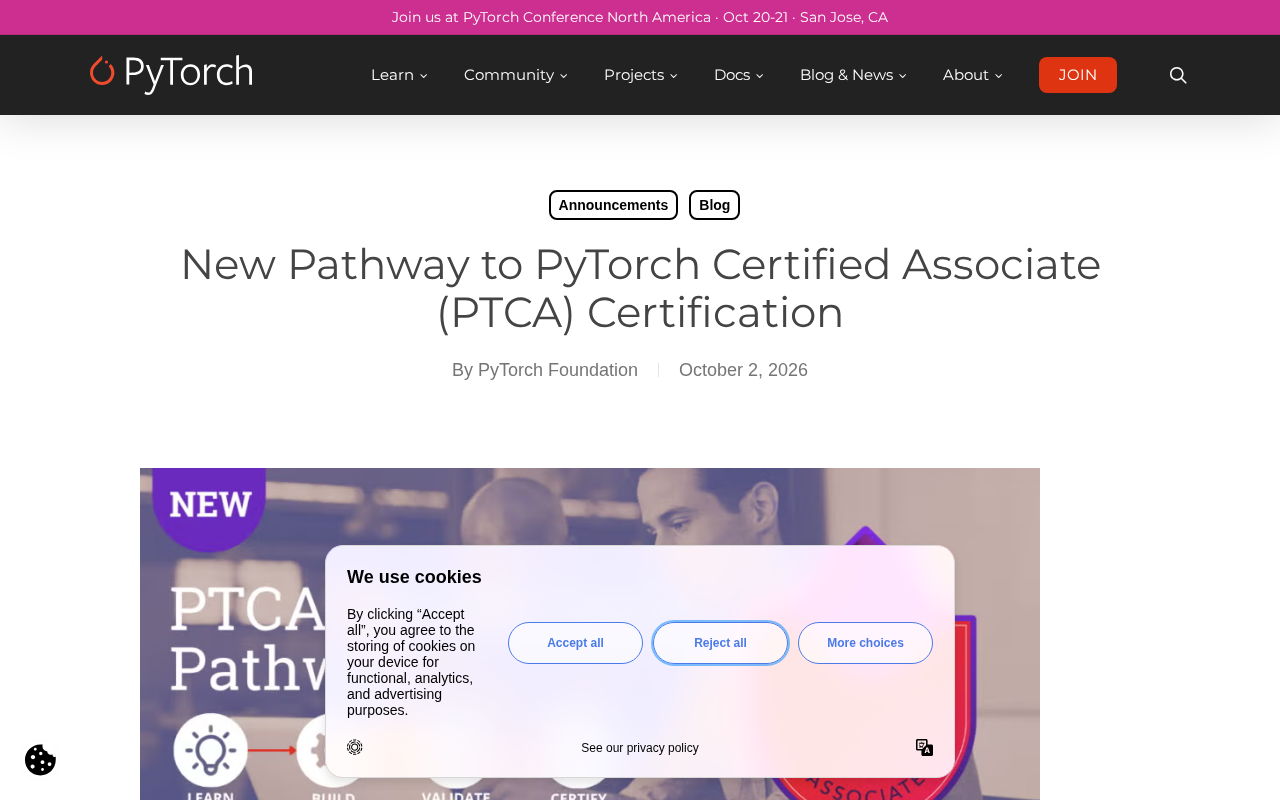
The newly launched PTCA learning path packages "learning" and "testing" into a cohesive experience. It consists of focused learning modules paired with the PTCA certification exam, allowing learners to follow an officially designed route — reducing the time wasted on aimless exploration. The value of this integrated design lies in structuring scattered knowledge into a clear, progressive path.
What Does This Certification Mean for AI Practitioners?
PyTorch is one of the most dominant deep learning frameworks today, having become the de facto standard in both academic research and industrial deployment. Being able to demonstrate proficiency in PyTorch has real implications for job hunting, career advancement, and team collaboration. The official Certified Associate credential offers a standardized validation of competence, transforming "familiar with PyTorch" on a résumé from a self-declaration into a verifiable credential.
For hiring managers, certifications like PTCA reduce screening costs — they provide a relatively objective benchmark for a candidate's skill level. For learners, the exam preparation process itself is a systematic knowledge review. Even if career advancement isn't the only goal, it helps identify and fill gaps.
PyTorch was open-sourced by Meta AI Research (formerly Facebook AI) in 2016 and is known for its Dynamic Computation Graph mechanism. Compared to the static graph model of early TensorFlow, dynamic graphs allow developers to debug neural networks just like writing regular Python code, significantly lowering the barrier to entry. PyTorch has since become the most widely used framework at top AI academic venues such as NeurIPS and ICML, and is broadly used in production environments at companies like Google, Meta, Microsoft, and OpenAI. Given its dominant ecosystem position, market demand for PyTorch skills continues to rise — job descriptions explicitly requiring PyTorch experience are now the norm, which gives the official certification system a solid foundation of real market value.
Advantages of a Structured Learning Path
The combination of "focused learning modules + certification exam" reflects an intentional approach to learning design: first cover core knowledge through modular content, then verify mastery through assessment. Compared to fully self-directed learning, this path offers several clear advantages:
- Clear scope: Learning content is aligned with exam requirements, avoiding the frustration of studying irrelevant material or encountering untested topics on exam day.
- Manageable pace: Modular breakdowns allow learners to progress in stages, rather than facing a wall of documentation with no clear starting point.
- Closed feedback loop: The exam as an endpoint provides a clear goal and tangible outcome for the entire learning process.
Who Is It For, and How to Get Started
This path is especially well-suited for a few groups: engineers transitioning into deep learning, researchers who need PyTorch for their projects, and job seekers looking to strengthen their résumés with a recognized credential. For those who already have some PyTorch experience, the certification path serves as a tool for systematic review. For beginners, it provides a relatively clear starting ladder.
It's worth noting that the official announcement is limited in its disclosure of specific module content, exam format, fees, and registration details. Those interested are encouraged to visit official PyTorch channels for the most up-to-date syllabus, exam guide, and registration information to avoid acting on outdated or misunderstood details.
In the technical certification landscape, the "Associate" level is typically positioned for practitioners who have some foundational knowledge but haven't yet reached expert status — similar in positioning to the AWS Certified Developer – Associate or Google Cloud Associate Cloud Engineer. This means PTCA is not a zero-experience entry-level certification. Candidates are generally expected to have a foundation in Python programming, an understanding of tensor operations, and familiarity with basic neural network concepts in order to comfortably work through the learning modules and pass the exam. For complete beginners, it's advisable to build up linear algebra fundamentals, Python basics, and introductory machine learning knowledge before entering the PTCA path — otherwise, gaps in foundational concepts may create significant friction during the learning modules.
Conclusion
The launch of the PTCA certification learning path reflects the continued maturation of the PyTorch ecosystem in terms of talent development and competency validation. By unifying learning modules and certification exam into a single integrated experience, it reduces decision fatigue for learners while providing the industry with a standardized benchmark for capability. For anyone looking to establish a solid footing in deep learning, this is a new option worth paying attention to.
Related articles

Chain of Thought Isn't Just for AI: How Humans Can Use CoT to Improve Thinking Quality
Chain of Thought isn't just a prompt trick for large models. Starting from a Hacker News discussion, this article analyzes why CoT works for human thinking too, breaks down actionable ways to transfer it, and highlights the key differences between human CoT and machine CoT.
Cloudflare Teams Up with OpenAI: Closi…
Cloudflare Teams Up with OpenAI: Closing the Loop from Vulnerability Discovery to Defense with AI
Cloudflare uses OpenAI Daybreak to investigate security vulnerabilities and generate reviewable remediation plans, while developers use Codex to boost coding efficiency and quality.

Orca Multi-Agent Orchestration in Practice: A Guide to Parallel Collaboration with Claude and Codex
Orca is Stable AI's free open-source agent workbench supporting 34 agents like Claude Code and Codex in parallel. Learn its Git worktree isolation, multi-model orchestration, and mobile management.