QA.tech MCP: Closing the E2E Testing Loop for AI Coding Agents
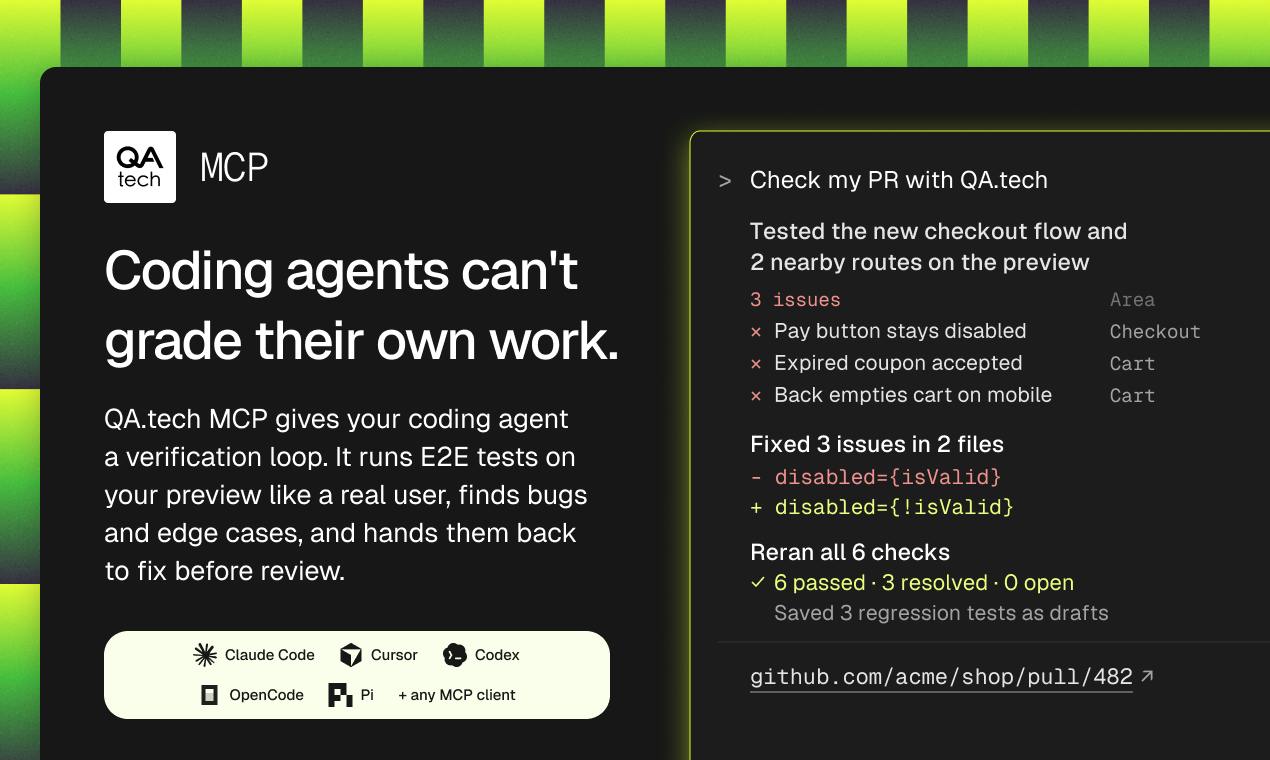
QA.tech uses MCP to connect coding agents to an external QA agent that runs E2E tests before PR review.
The article introduces QA.tech's MCP service on Product Hunt, which addresses the gap where AI coding agents rapidly produce changes but lack verification. Rather than having coding agents write and self-score their own tests, it connects an external QA agent via Model Context Protocol: the agent explores the app, generates and runs E2E tests, and returns missed bugs and edge cases for the coding agent to fix, all within the IDE. It supports any MCP client like Claude Code, Cursor, and Codex, and verifies changes before PR review to ease manual review pressure. The core value is separation of responsibilities—the external agent doesn't share the coding agent's bias—though public quantitative data on E2E speed and stability is lacking.
As AI writes code faster and faster, who verifies that it's correct?
AI coding assistants are evolving from "completing a single line of code" to "independently making multi-file changes." Agents like Claude Code, Cursor, and Codex can plan, edit, and submit PRs on their own—but one critical step is always missing: before the changes go out, who confirms they haven't broken anything else in the product?
The MCP service QA.tech launched on Product Hunt tries to fill this gap. Its approach isn't to have the coding agent write its own tests and then grade itself—instead, it introduces an external QA agent: the coding agent hands over its changes, the QA agent runs end-to-end tests on the real application, finds bugs and edge cases the coding agent missed, and sends the results back for the coding agent to fix.
The MCP protocol makes the "testing agent" a pluggable component
The technical foundation of this product is the Model Context Protocol (MCP). QA.tech MCP presents itself as a service that any standard MCP client can connect to; the official documentation explicitly states support for Claude Code, Cursor, and Codex, and it "works with any MCP client."
This means its positioning isn't yet another standalone testing platform, but rather a layer of capability embedded into existing coding workflows. Developers don't need to switch windows or manually export test cases—the coding agent calls the QA agent via MCP, the test results come back as structured information, and the coding agent decides which part of the code to change. The entire loop stays inside the IDE.
From the perspective of the MCP ecosystem's evolution, this is an interesting signal: MCP was first used to connect models to tools and data sources, and now it's starting to be used to connect to another agent. Agents collaborate through protocols rather than cramming all capabilities into a single model context.
Model Context Protocol (MCP) is an open protocol introduced by Anthropic in late 2024 to establish standardized bidirectional connections between AI models/agents and external tools and data sources. You can think of it as the "USB-C port for AI applications": whether the underlying system is a file system, database, API, or another agent, as long as it implements the MCP server specification, any MCP-compatible client (such as Claude Code or Cursor) can discover and invoke its capabilities in a unified way. MCP uses a client-server architecture, transmits messages via JSON-RPC, and supports three types of primitives: tool calls, resource reads, and prompt templates. Its core value lies in decoupling: tool providers only need to maintain a single MCP service to be reused by multiple different AI clients, without having to adapt separately for each host. This is precisely the technical prerequisite that allows QA.tech to embed itself as a "pluggable component" into multiple coding agent workflows.
What it actually does: explore, write tests, run tests
According to the product description, QA.tech's QA agent takes on three tasks:
- Explore the application: automatically understand what pages, flows, and interaction points the product has
- Write tests: generate corresponding E2E tests for each change
- Execute and report: run the tests and feed failures and edge-case issues back to the coding agent
The value of this division of labor lies in the separation of responsibilities. When generating code, coding agents naturally tend to validate "what they themselves think is correct," making it easy to write both the implementation and the tests within the same blind spot. An external QA agent doesn't share this contextual bias and is more likely to trigger paths the coding agent didn't think of.
For new QA.tech users, the official onboarding method is a single prompt: have QA.tech first "map" your application, then launch the first test. This design lowers the initial setup cost—no need to hand-write a test suite in advance; the agent figures out the application structure on its own.
End-to-end testing (E2E testing) refers to a testing approach that starts from the real user's perspective and simulates operation flows on the complete application stack—for example, opening a browser, clicking the login button, filling out a form, and confirming that the order was submitted successfully. Unlike unit tests, which only verify a single function, or integration tests, which only verify interfaces between modules, E2E tests focus on "whether the system behaves correctly after a user completes a full path," and therefore can catch integration defects across pages and services. E2E tests typically rely on browser automation frameworks such as Playwright, Cypress, and Selenium. The cost is slow execution, strong dependence on the environment, difficulty in pinpointing the cause of failures, and test scripts that easily become unstable due to UI changes (known in the industry as "flaky tests"). The article's emphasis that E2E tests "run slowly and have coverage constrained by testability" stems precisely from these inherent characteristics; and the difficulty of having agents automatically generate and maintain E2E tests is also concentrated in selector stability and understanding of dynamic interfaces.
Placed before the PR, not after the merge
The product copy repeatedly emphasizes one point in time: before the PR enters review.
This choice is pragmatic. The number of PRs produced by AI coding agents is rising, and manual review is becoming a bottleneck; if E2E verification can run automatically before a PR is submitted for review, reviewers receive a change that has already been cross-validated between agents. Information about test failures flows directly back to the coding agent, and it also handles the fixes—humans only need to make judgments at the final stage.
It should be noted that E2E tests themselves don't run quickly, and their coverage is constrained by the application's testability. How far QA.tech's solution can go depends on its ability to explore complex applications and maintain test stability; there is no quantitative public data on this part, and developers need to verify its actual performance themselves.
Who should try it
Teams already using Claude Code, Cursor, or Codex for multi-file changes are the most direct audience for this batch of tools. This is especially true for projects that have real user flows but lack automated E2E coverage—manually adding tests is costly, and delegating it to an agent is a reasonable starting point.
If you only use AI to complete scattered code snippets, the benefits of this MCP set are not obvious; when changes involve cross-page flows such as login, payment, and form submission, the value of an external QA agent becomes apparent.
Another angle for observation is the direction of the MCP ecosystem. As "testing" is integrated in the form of an MCP service, more similar specialized agents may emerge in the future: security scanning, performance regression, accessibility checks. Coding agents are responsible for writing, and specialized agents are responsible for verifying—this division-of-labor model is worth continued attention.
One-line Summary
QA.tech uses MCP to connect coding agents to an external QA agent that automatically runs E2E tests before PR review.
Paragraph Summary
The article introduces the MCP service QA.tech released on Product Hunt, which attempts to address the gap where AI coding agents rapidly produce changes but lack verification. Its approach is not to have the coding agent write its own tests and self-score, but to connect to an external QA agent through the Model Context Protocol: the coding agent hands over its changes, the QA agent automatically explores the application, generates and runs end-to-end tests, and then sends missed bugs and edge cases back to the coding agent for fixing, with the entire loop staying inside the IDE. The product supports any MCP client such as Claude Code, Cursor, and Codex, and is positioned to complete verification before a PR enters review, thereby easing the manual review pressure brought by the growing number of AI-generated PRs. The article argues that its core value lies in the separation of responsibilities—the external agent does not share the coding agent's contextual bias; but it also notes that there is a lack of public quantitative data on E2E test speed and stability, and developers need to verify the actual results themselves.
Related articles
Can AI Crack the Riemann Hypothesis? Starting from an Interdisciplinary Encounter
Grant Sanderson recounts how Montgomery and Dyson's chance encounter over a formula linked number theory and random matrix theory, and uses it to analyze why LLMs have a structural edge in cross-domain analogy—and the limits of that breadth in mathematical research.

The US Government Is Facing AI Cyberattack Threats
The US government faces AI-driven cyberattack threats. This article analyzes how AI is reshaping the attack-defense balance, the unique challenges for government agencies, and response strategies and future outlook.
Self-Hosted GitHub: Take Control of Your Code and AI Agents with Gitea
NetworkChuck shows how to self-host GitHub with Gitea: Docker deployment, SSH auth, AI agent MCP integration, GitHub mirror sync, and security hardening for full code control.