Qoder 1.0 In-Depth Review: How Good Is This AI Autonomous Coding Platform Really?

Programming shifts from assisted coding to managed execution units; Qoder 1.0 sets a new bar for domestic AI IDEs.
Three tech giants successively launched long-task execution capabilities, marking a paradigm shift from synchronous assistance to managed execution units. Alibaba's Qoder 1.0 centers on Quest task units with a three-panel interface and Multi-Agent expert team collaboration, supporting parallel autonomous task execution. Testing shows its Spec mechanism effectively prevents goal drift, expert team collaboration produces research reports surpassing traditional Deep Research, and the Knowledge Engine provides persistent knowledge support for long-term projects.
The Programming Paradigm Is Shifting: From Assisted Coding to Managed Execution Units
Within just 11 days, three major tech giants successively launched similar capabilities—Codex, Claude Code, and Gemini Agent all rolled out long-task execution features called "Goal." This alone signals a clear trend: the next step in programming isn't assisted coding, but managed execution units.
The technical roots of "managed execution units" come from asynchronous task scheduling in software engineering. Traditional AI coding assistants (like early GitHub Copilot) are essentially synchronous "request-response" systems: the developer asks, the model answers, and the human reviews before continuing. "Managed execution units," on the other hand, draw from the design philosophy of Serverless Functions and containerized tasks in cloud computing—tasks are encapsulated as independent units that can run autonomously in the background, pause, resume, and return results upon completion. The technical foundation for this paradigm shift includes the massive expansion of LLM context windows (from 4K to 200K+ tokens), the maturation of Function Calling capabilities, and the engineering implementation of the ReAct (Reasoning + Acting) framework. When a model can autonomously plan steps, invoke external tools, handle intermediate errors, and continuously push toward a goal, true "managed execution" becomes possible.
In this wave, Alibaba's recently released Qoder 1.0 (a product under Tongyi Lingma) has taken the "delegation and intervention" aspect of long tasks to a new level. After two days of intensive hands-on testing (burning through an entire Pro account's credits), I believe this may be the best domestic AI IDE currently available, particularly with notable highlights in Agent team collaboration and interaction design.
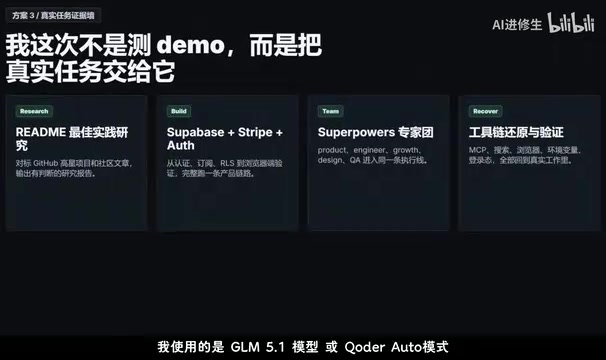
Core Architecture: Quest Task Units and Three-Panel Interaction
The core concept of Qoder 1.0 is the Quest (task unit)—each Quest represents an independent long task, with support for parallel multi-task execution. The overall interface uses a three-panel layout:
- Left panel (Navigation & Management): Task list, capable of running multiple Quests in parallel
- Middle panel (Conversation Flow): Real-time view of task progress
- Right panel (Artifacts Area): View knowledge, memory, and final deliverables
The advantage of this design is that you don't need to watch the Agent work. You can launch multiple tasks simultaneously, each running autonomously for 20 to 40 minutes, switching between them to check progress at any time, or simply go do something else. This is exactly what the "managed execution unit" philosophy looks like in practice.
Hands-On Test: Using Qoder for a Readme Best Practices Study
Why This Task?
Anyone working on open-source projects, publishing products, or releasing tools faces this question: how to write a Readme, how to present it on a landing page, and how to establish user trust at first glance. This is a genuine need and a great way to test an AI autonomous development platform's research capabilities.
I chose the Expo Expert Team mode for this task and enabled the Spec (task plan) feature.
It's worth noting that the Spec mechanism solves the "goal drift" problem in long-task execution from an engineering perspective. Without explicit planning, Agents tend to deviate from original intent during multi-step reasoning, producing "Hallucinated Execution." The Spec mechanism forces the Agent to generate a structured plan before execution, including task decomposition, resource allocation, and acceptance criteria—essentially providing the Agent with an "execution contract." This is analogous to Test-Driven Development (TDD) in software engineering: define expected results first, then drive the execution process. From a user experience perspective, Spec also provides natural intervention points for humans to step in and correct course, preventing the Agent from spinning its wheels in the wrong direction for extended periods.

Expert Team Division of Labor
After clicking to run the Spec, the system automatically created multiple sub-Agents and began parallel work. The expert panorama view shows each sub-Agent's status. The expert team has four members with a thoughtfully designed division of labor:
- Researcher A: Analyzes high-star GitHub Readmes for benchmark sampling
- Researcher B: Searches industry articles and guides to collect best practices
- Researcher C: Goes directly to social platforms for experience posts and frontline practices
- Full-stack Engineer: Responsible for integrating information and producing final deliverables

This expert team mode is an engineering implementation of a Multi-Agent System (MAS). Multi-Agent systems originated from distributed artificial intelligence research, with the core idea of decomposing complex tasks among multiple agents with different specializations for parallel processing, then having a coordinator integrate the results. In the LLM era, each sub-Agent is essentially a model instance with a specific System Prompt and tool permissions. The three-researchers-plus-engineer pattern corresponds to the classic "division-integration" paradigm: researchers handle information gathering (corresponding to the Map phase in MapReduce), while the full-stack engineer handles synthesis (corresponding to the Reduce phase). Compared to single-Agent sequential execution, the Multi-Agent parallel architecture reduces single-point bottlenecks, lowers context pollution risk, and improves sub-task quality through role specialization.
The three researchers approach the same topic from different dimensions—academic research, industry standards, and community practice—producing far deeper results than any single perspective could. The right side also features visual canvas cards with switchable views for files and final outputs, making it easy to review the intermediate process of the entire task execution.
How Good Are the Research Results?
I can say with full confidence: the final research report is better than any Deep Research feature I've used from any model. It's distinctly different from content directly generated by large language models—the information is more solid, the structure more logical, and the actionability much stronger.

However, it should be noted that this high-quality output isn't solely due to Qoder's Agent framework. In the initial prompt, I provided an MD document from my own past research on various topics (extracted from my personal Skills library). This "seed knowledge" pointed the Agent toward the research direction and quality standards. Great prompts + powerful Agent framework = output that exceeds expectations—this formula still holds true.
Knowledge Engine: Built for Long-Term Work
Qoder 1.0 has a feature worth discussing separately—the Knowledge Engine. Opening the Knowledge panel, the system automatically generates knowledge architecture, specifications, and tech stack information.
On a technical level, the Knowledge Engine is closely related to RAG (Retrieval-Augmented Generation). RAG was proposed by Meta AI in 2020, with the core approach of combining external knowledge bases with generative models: first retrieving relevant content from the knowledge base, then injecting it into the model's context to improve response quality. The limitation of traditional AI coding tools lies in their dependence on limited context windows—once a conversation ends, accumulated project understanding disappears with it. The Knowledge Engine addresses this through persistent storage of structured knowledge including project tech stacks, architectural specifications, and historical decisions.
Related articles
 Product Reviews
The Programmer's Desk Setup Guide: Building a Workspace That Feels Like Home
Discover how programmers build productive, comfortable workspaces. From multi-monitor setups to ergonomic design, explore the desk philosophy that drives focus and flow.
 Product Reviews
Qoder vs Cursor Real-World Comparison: Which $20/Month AI IDE Is Better?
Hands-on comparison of Qoder vs Cursor AI IDEs: Agent autonomy, human interaction count, and architecture decisions. Qoder needed only 2 interactions vs Cursor's 8.
 Product Reviews
Cursor Cloud Agent Demo: Eliminating Bottlenecks Across the Entire Software Development Lifecycle
Deep analysis of Cursor's Cloud Agent demo showing how cloud VMs, automated test artifacts, and a full-chain control plane systematically eliminate human bottlenecks across the software development lifecycle.